
Vacuum Hold Down for CNC Router: Setup, Compatibility, and When Its Worth It
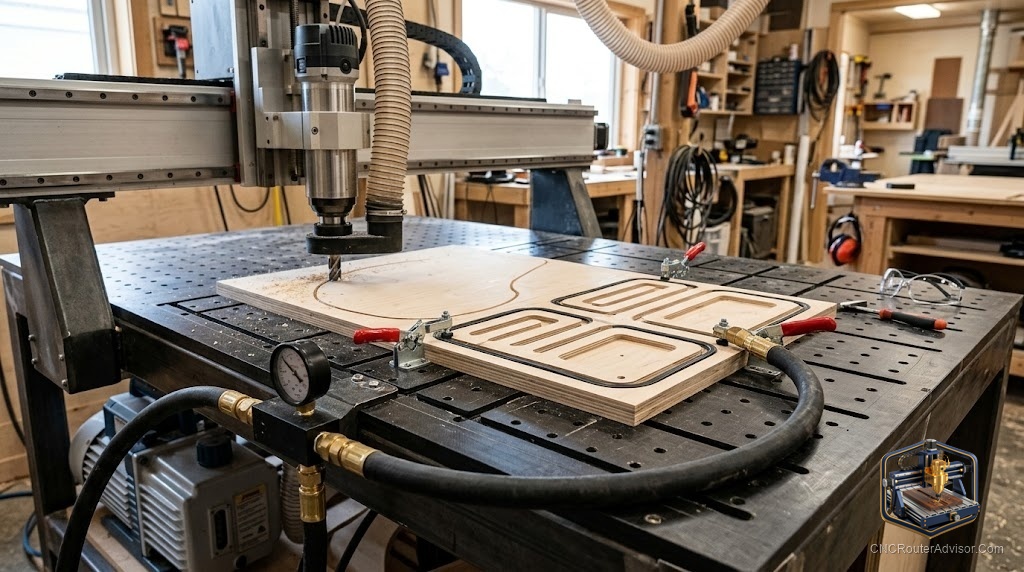
Clamps are honest. They grab the material and hold it, and you can see exactly what is happening. A vacuum hold-down system is more elegant, more productive, and more confusing to set up the first time, which is why it inspires equal parts admiration and frustration in CNC router shops. When a vacuum table works well, it transforms workholding from a setup problem into a non-issue: parts sit flat, load and unload in seconds, and the tool path has full access to the workpiece without clamps in the way. When it does not work well, parts lift mid-cut and bit bills go up. Understanding the difference between those two outcomes is almost entirely about seal area, material porosity, and pump capacity.
A vacuum hold-down system for a CNC router uses negative pressure (vacuum) applied through the machine table to hold workpieces flat without mechanical clamps, using a vacuum pump connected to a zoned table or vacuum pod system to secure material during cutting. The system works by creating a pressure differential across the workpiece: atmospheric pressure above pushes the material down while the table draws air out from below. The force generated is substantial, typically measured in kilograms per square centimeter of sealing surface, and is directly proportional to how well the material seals against the table.
The short version: vacuum hold-down works best on flat, porous materials (MDF and plywood especially) over a large surface area, with a pump matched to the table zone volume and a gasket or sealing system matched to the workpiece edges. It struggles with small parts (insufficient seal area), very porous material, parts with large through-holes, and setups where the vacuum circuit has leaks. Match those variables correctly and vacuum hold-down is the fastest, most production-friendly workholding method for sheet goods.
How vacuum tables are structured
Most vacuum CNC tables use a zoned structure: the table surface is divided into independently controllable zones (often marked T1, T2, T3, etc.), each connected to a valve that opens or closes the zone’s vacuum connection. This lets you activate only the zone the workpiece covers, concentrating the vacuum pump’s capacity where it is needed rather than trying to hold vacuum on an exposed empty zone.
The table surface itself is typically MDF (which is porous and lets vacuum distribute across the material face), a phenolic grid (harder and longer-lasting), or aluminum vacuum grid (for maximum durability). A spoilboard or MDF sacrifice layer goes on top of the base table, and parts sit on this spoilboard. When the part covers a zone, the pump evacuates that zone and atmospheric pressure holds the part down.
For materials that are not inherently flat or that need to span zone gaps, rubber gasket strips seal the perimeter of the part or zone, concentrating the vacuum under the material footprint and preventing atmospheric air from bypassing the seal.
What works well on a vacuum table
Full sheet MDF and plywood. The classic vacuum hold-down application: a full 4 by 8 sheet sits over all table zones, the seal area is enormous, and the vacuum pump has no trouble holding it flat through even aggressive cutting passes. This is the ideal case, and it is the application production cabinet shops are set up for.
Nested parts in sheet goods. Programming multiple parts into a single sheet (nesting) is where vacuum hold-down earns its cost back in production environments. Parts cut with tabs, or panels cut in nested sequences, are held throughout the program without repositioning.
Flat, non-porous sheet materials. Acrylic, HDPE, and thin aluminum sheet hold well on a properly gasketed zone, because the non-porous material creates a better seal than porous wood.
Where vacuum hold-down struggles
Small parts. A 50 by 50 mm part sitting over a 300 by 300 mm vacuum zone is supported by only a fraction of the zone’s area. Holding force is proportional to sealing area. Small parts with small footprints need custom vacuum fixtures (pods, vacuum jigs) rather than the flat table.
Very porous material. Open-grain wood and very porous MDF let air bleed through the material and into the vacuum circuit, reducing holding force. A separator layer or sealer between the material and the table helps.
Parts with large through-holes. If a toolpath cuts all the way through the material early in the program, the through-hole exposes the vacuum zone to atmosphere and reduces holding force for the rest of the cut. Tabbing strategies (leaving small bridges) prevent this.
Insufficient pump capacity. A small vacuum pump trying to hold a large table struggles when any zone is imperfectly sealed. Match pump CFM (cubic feet per minute) capacity to your table volume and the typical seal quality of your material.
Adding vacuum hold-down to an existing machine
For machines without a factory vacuum table, aftermarket vacuum systems add vacuum capability to existing spoilboards or T-slot tables. A vacuum pump, manifold, and either a vacuum grid top or a custom vacuum fixture system can be added to most gantry CNC routers.
For workholding with physical clamps in the meantime, the STARVAST dust shoe and vacuum accessory handles chip extraction at the spindle, and T-slot clamps on an existing table handle workholding until a full vacuum system is warranted.
Our guide on how to choose a CNC router includes workholding considerations for different machine classes.
The takeaway: vacuum hold-down is the most productive workholding method for production CNC work on flat sheet goods. It rewards good pump sizing, proper gasketing, and tabbing strategy on through-cuts. Add it when your production volume makes clamp setup time a real bottleneck, and invest the time to set it up correctly.
Frequently asked questions
Can I add vacuum hold-down to any CNC router? Yes, with the right table modification or a custom vacuum fixture system. A spoilboard can be modified to distribute vacuum, and aftermarket vacuum pump and manifold systems connect to most machines.
What pump size do I need for vacuum hold-down? Match the pump’s CFM capacity to your table zone volume and the porosity of your typical material. Undersized pumps lose holding force when zones are imperfectly sealed.
Why does my vacuum table drop pressure during cutting? The most common causes are: through-cuts exposing the zone to atmosphere, leaky gaskets or gasket gaps, material porosity bleeding air into the circuit, or insufficient pump capacity for the table size.
Does vacuum hold-down work for small parts? Poorly on a flat table, because holding force depends on seal area. Small parts need custom vacuum jigs or pod fixtures that seal tightly around the small footprint.
What is a vacuum pod? A smaller localized vacuum fixture that can be positioned precisely under a specific part, rather than relying on the full table zone. Essential for small, irregular, or non-flat parts.
Is a zoned vacuum table better than a single-zone one? Yes for production use, because you activate only zones under material, concentrating pump capacity where it is needed rather than losing vacuum through exposed empty zones.
References
- ShopBot Tools, “Vacuum Hold-Down: Setup and Best Practices” — https://www.shopbottools.com/
- CNCCookbook, “Workholding for CNC Routers” — https://www.cnccookbook.com/cnc-router/
- ONSRUD, Vacuum Hold-Down Technical Guide — https://cronsrud.com/vacuum-tables/