
CNC Router Industrial Guide: Machine Classes, Features, and Buying Considerations
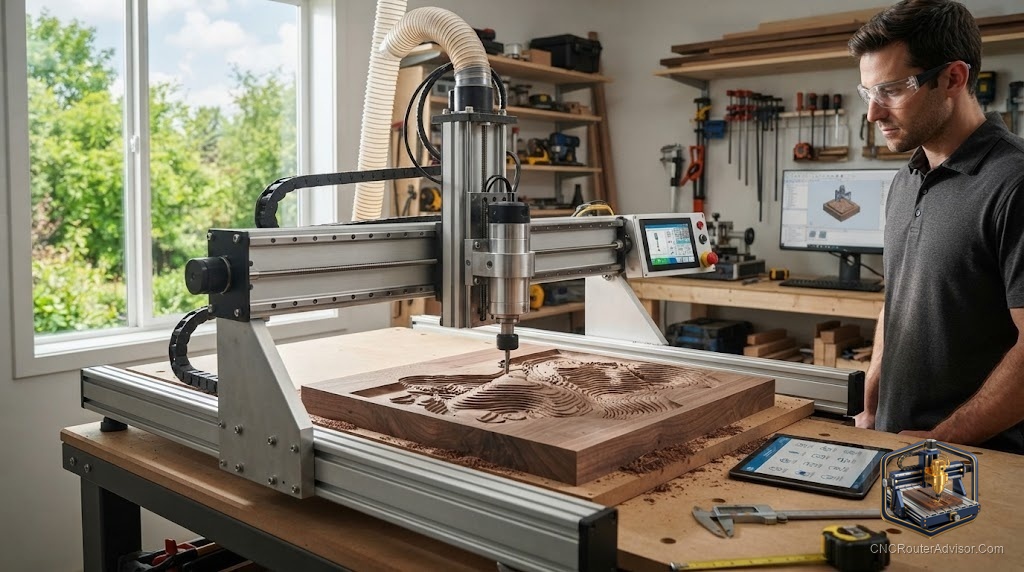
The phrase “industrial CNC router” covers everything from a serious small-shop machine to a factory-floor production line. That range matters because the step from prosumer to true industrial is not a spec upgrade, it is a different category: different cost, different support requirements, different infrastructure, and a different relationship between the machine and the business that runs it. This guide defines the industrial class clearly, explains what separates it from prosumer machines, and helps small shops work out where they actually belong.
An industrial CNC router is a production-grade gantry machine designed for continuous operation, high throughput, and long service life in a commercial or manufacturing environment. It is characterised by a heavy welded-steel frame, ATC capability, a high-power VFD spindle, integrated dust collection and pneumatics, and a controller and software suite built for production workflows.
Short answer: industrial machines earn their classification through duty cycle and throughput, not just table size. A machine that runs eight to twelve hours a day, changes tools automatically, and produces identical parts at volume is industrial. A machine with a large bed that runs a few hours a week is a prosumer. Most small shops with one or two operators belong solidly in the prosumer range.
What makes a CNC router industrial
Five things consistently define the industrial class.
Heavy welded-steel frame. Not bolted aluminium extrusion, but welded steel engineered for continuous vibration and load, designed to stay true for years of daily use.
Automatic tool changer (ATC). Production runs involve multiple tools. Stopping to swap bits manually is incompatible with the throughput targets industrial operations need.
High-power VFD spindle. Rated for continuous duty, with high power output matched to the cutting forces of production volumes in hardwood, composites, and non-ferrous metals.
Integrated vacuum table or pneumatic hold-down. Clamping parts by hand does not scale. Industrial machines use vacuum systems or pneumatic hold-down to fixture parts automatically.
Production controller and software. Industrial controllers handle tool tables, production queuing, and ATC management with software integration for manufacturing workflows.
Who actually needs an industrial machine
Shops running single-shift production, cabinet companies cutting hundreds of parts a day, signmakers with commercial contract volume, and any operation where the CNC is the production bottleneck. The machine needs to earn the capital expense through throughput.
A two-person custom furniture shop that runs the router for a few hours a day is almost certainly a prosumer buyer. The honest test: if the machine does not have a full schedule five days a week, you are paying for capacity you are not using.
The prosumer alternative
Machines from Avid CNC, ShopSabre’s entry lines, and similar brands occupy the overlap: professionally built, capable of real commercial work, but sold and maintained with smaller operations in mind. They are the right choice for most small shops that run a CNC as a main production tool but are not at factory scale.
Infrastructure requirements
Three-phase power, compressed air for pneumatics and ATC, a large-capacity dust collection system, and a physical footprint that accounts for material loading on all sides. Factor these into the purchase decision before the machine arrives.
The verdict
Industrial CNC routers are production tools, and their cost and capability are sized for production volumes. Buy into the class when the machine has a full production schedule that justifies the investment. Buy prosumer when you are running a smaller operation that needs professional capability without factory infrastructure.
Three things to remember:
- Industrial classification is about duty cycle and throughput, not just machine size or specs.
- ATC, VFD spindle, vacuum hold-down, and a welded-steel frame are the markers of a true industrial machine.
- Infrastructure (three-phase power, compressed air, large dust collection) is a required cost of industrial ownership.
FAQ
What is an industrial CNC router? A production-grade machine designed for continuous operation, high throughput, and long service life, featuring a heavy welded-steel frame, ATC, high-power VFD spindle, and vacuum or pneumatic hold-down.
How is an industrial CNC router different from a prosumer one? Duty cycle and throughput. Industrial machines run full shifts and change tools automatically. Prosumer machines are capable but sized for smaller operations and intermittent use.
Does my small shop need an industrial CNC router? Probably not unless the machine runs most of the working day. A well-built prosumer machine serves most small shops without the infrastructure cost.
What power supply does an industrial CNC need? Often three-phase, plus compressed air for ATC and pneumatics. Confirm requirements with the manufacturer before planning installation.
Can an industrial CNC router pay for itself quickly? Yes, when the volume is there. Reduced labour time on production parts, consistent quality, and ATC-enabled unattended runs deliver the payoff. At low volume, the payback period is very long.
What materials does an industrial CNC cut? Hardwood, plywood, MDF, composites, solid-surface materials, aluminium, brass, and other non-ferrous metals across the full range of commercial cabinet, signmaking, and light manufacturing work.
Is ATC necessary for industrial use? For most production workflows, yes. Multi-tool jobs without ATC require a person for every tool change, eliminating unattended-run benefit and limiting throughput.
References
- Avid CNC, PRO4896 CNC Router Machine: https://www.avidcnc.com/pro4896-4-x-8-cnc-router-machine-p-1337.html
- ShopSabre, Best CNC Routers for Small Businesses: https://www.shopsabre.com/cnc-routers-for-small-business/