
Vacuum Table for CNC Router: How It Works, Setup, and Whether You Need One
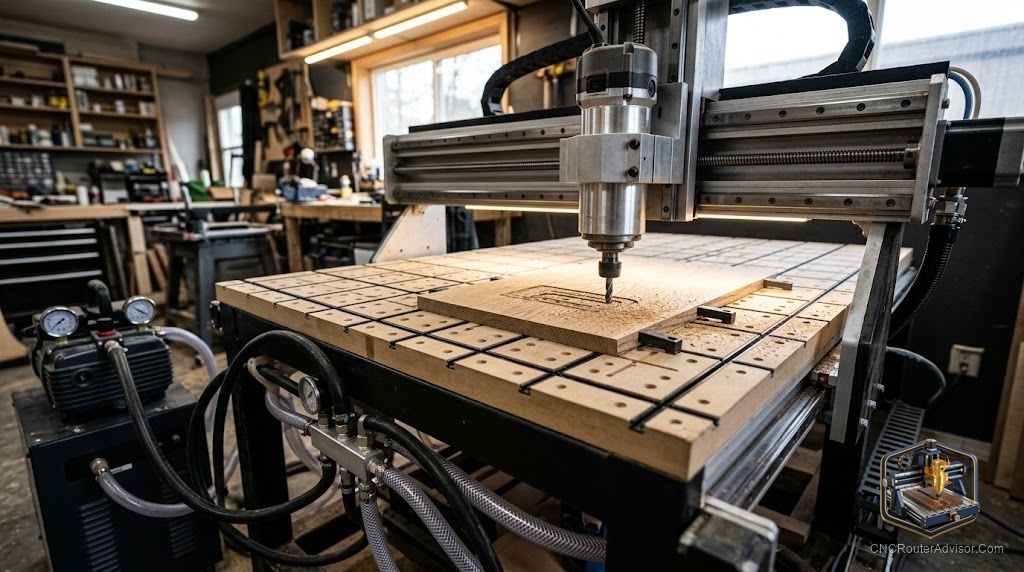
The first time you watch a CNC router run a full sheet of parts without a single clamp in the way, held down by nothing you can see, it feels a little like a trick. That trick is a vacuum table, and for shops that cut a lot of sheet material it is one of the biggest productivity improvements available. But a vacuum table is also a real investment in money, plumbing, and a pump that hums in the corner, and it is not the right answer for every shop. This guide explains how a vacuum table works, what it takes to set one up, and how to decide whether it earns its place in your workflow.
Workholding is the quiet determinant of how pleasant and productive a router is to run. Clamps and screws work, but they intrude on the cut and slow down loading. A vacuum table removes that friction for the right kind of work, which is why it dominates production sheet cutting.
A vacuum table for a CNC router is a bed that holds the workpiece down by suction, using a vacuum pump to pull air through a porous or zoned surface so atmospheric pressure clamps the material against the table. It clears the surface of physical clamps, allows fast loading and unloading, and holds full sheets flat, which makes it ideal for high-volume nested sheet cutting. Setup involves a vacuum pump sized to the table, a plenum or zoned bed, and often a sacrificial spoilboard (an MDF layer the vacuum pulls through). It is most worthwhile for shops cutting many flat parts from sheet goods; it is less suited to small parts, thick or non-porous odd shapes, and low-volume varied work.
If you cut sheets in volume, a vacuum table pays back in speed and flatness; if you cut varied one-off parts, mechanical workholding is often simpler and cheaper.
How a vacuum table works
The principle is simple: air pressure. When a pump removes air from beneath the workpiece, the roughly 14.7 pounds per square inch of atmospheric pressure above it presses the part firmly onto the table. Over a large sheet that adds up to enormous holding force with nothing touching the top surface.
The common implementations:
- Through-spoilboard vacuum: the pump pulls air through a porous MDF spoilboard mounted over a plenum (a chambered base). The MDF is porous enough to transmit suction across its whole surface, holding the sheet above it. This is the most common shop setup because the spoilboard is also sacrificial and surfaceable.
- Zoned vacuum: the bed is divided into zones that can be switched on individually, so you only pull vacuum under the area occupied by material, wasting less airflow for smaller parts.
- Gasket or pod systems: for specific parts, gaskets or vacuum pods seal around the part footprint, concentrating suction where it is needed, common for smaller or oddly shaped work.
The pump is the heart of the system, and there are two broad types: high-flow regenerative blowers (which move a lot of air and tolerate the leakage inherent in through-spoilboard setups) and vacuum pumps (which pull a deeper vacuum but less flow, better for well-sealed pod systems).
Setting one up
A workable vacuum setup has a few essential pieces:
- A pump sized to the table. The bigger the bed and the leakier the setup (through-MDF systems leak by design), the more airflow you need. A regenerative blower with adequate flow is the usual choice for a full sheet bed; undersizing the pump is the most common setup mistake.
- A plenum and bed. The plenum is the chambered base that distributes suction; the spoilboard sits on top. Zoned plenums add valves to switch zones.
- A spoilboard. For through-spoilboard systems, an MDF layer both transmits vacuum and provides a sacrificial, surfaceable top. Surface it flat with the machine before use.
- Sealing and management. Manage leakage: seal edges, cover exposed bed area (a scrap sheet or masking over uncovered zones), and keep the plenum and spoilboard in good condition. Leaks are the enemy of holding force.
When a vacuum table is worth it
It shines for volume sheet work. If you cut many flat parts nested on full sheets (cabinet parts, signs, panels), the clamp-free surface and fast loading save real time on every cycle, and the whole-sheet flatness improves accuracy. This is where vacuum earns its keep.
It struggles with small, thick, or non-porous odd parts. Small parts have little surface area for suction to grip, thick parts and irregular shapes seal poorly, and non-porous materials over a through-MDF bed can be fine but small ones may need pods or gaskets. For these, mechanical workholding or tape is often better.
It adds cost, noise, and maintenance. A pump, plenum, and plumbing cost money, the pump runs loud, and the system needs upkeep (spoilboard resurfacing, leak management). For a hobbyist cutting occasional varied parts, that overhead may not be justified when clamps and tape do the job.
Vacuum versus mechanical workholding
Think of it as a trade between throughput and flexibility:
- Vacuum: fast, clamp-free, flat, ideal for repetitive sheet work, but costs more and suits porous, flat, reasonably large parts.
- Clamps and T-track: cheap, strong, versatile, good for thick and odd parts, but intrude on the cut and slow loading.
- Tape and CA glue: cheap and clamp-free, excellent for small and thin parts, but manual per part.
Many shops run a hybrid: a vacuum bed for production sheets, with the ability to clamp or tape for the occasional odd job.
The verdict
A vacuum table is a superb upgrade for shops that cut flat parts from sheet goods in volume, delivering clamp-free speed, whole-sheet flatness, and faster loading. It is less compelling for small, thick, or irregular parts and for low-volume varied work, where clamps and tape are simpler and cheaper. Size the pump to your bed and leakage, plan a plenum and surfaceable spoilboard, and manage leaks. Match the workholding to your work, and if that work is sheets in volume, a vacuum table is one of the best investments you can make.
Three things to take with you:
- A vacuum table holds work by suction with no clamps in the way, making it ideal for fast, flat, high-volume sheet cutting.
- Sizing the pump to the bed and managing leakage are the keys to holding force; undersizing the pump is the most common setup mistake.
- It is less suited to small, thick, or irregular parts and low-volume varied work, where clamps, T-track, or tape are simpler and cheaper; many shops run a hybrid.
FAQ
How does a vacuum table hold the workpiece? A pump removes air from beneath the part, so atmospheric pressure (about 14.7 pounds per square inch) presses it down onto the table. Over a large sheet this produces strong holding force with nothing touching the top surface.
What kind of pump does a vacuum table need? Through-spoilboard beds, which leak by design, need a high-flow regenerative blower sized to the bed. Well-sealed pod or gasket systems can use a deeper-vacuum pump with less flow. Undersizing the pump is the most common cause of weak holding.
Can a vacuum table hold small parts? Small parts have little surface area for suction to grip and can lift or shift, especially on a leaky through-MDF bed. For small parts, vacuum pods or gaskets that concentrate suction, or tape-based workholding, usually work better.
Do I need a spoilboard with a vacuum table? For through-spoilboard systems, yes: a porous MDF layer transmits the vacuum across the surface and doubles as a sacrificial, surfaceable top. Surface it flat with the machine before use, and resurface it periodically.
Is a vacuum table worth it for a hobby CNC router? Usually only if you cut flat sheet parts in volume. For occasional varied or small-part work, the cost, noise, and maintenance of a pump and plenum often are not justified when clamps, T-track, and tape do the job well.
What materials work best on a vacuum table? Flat, reasonably large, porous or well-sealing materials (plywood, MDF, solid panels) hold best. Thick, irregular, very small, or poorly sealing parts are harder to hold and may need pods, gaskets, or mechanical workholding.
References
- OpenBuilds, CNC vacuum table and workholding reference: https://openbuilds.com
- CNCzone, vacuum table pump sizing and setup discussions: https://www.cnczone.com