
CNC Router Dust Collection Systems: How to Choose the Right Setup
Dust collection is the part of CNC routing that new owners underestimate and experienced owners obsess over, for good reason. A CNC router running without proper dust collection buries your shop in fine dust, clogs the machine’s moving parts, ruins cut quality as chips re-cut, and, most seriously, fills the air with fine wood dust that is a genuine respiratory and even explosion hazard. Choosing the right dust collection system is not an afterthought; it is a core part of setting up a router that is safe, clean, and produces good work. And the right system depends heavily on the scale of your machine.
A CNC router dust collection system captures the dust and chips produced during cutting, at the source (via a dust shoe or boot) and through an extraction system (a shop vac, dust collector, or cyclone), to protect your health, keep the machine clean, and maintain cut quality. The right system is sized to your machine’s scale and measured primarily in airflow (CFM) balanced against static pressure.
The short answer on choosing: match the extraction to your machine’s scale. Small hobby machines pair a dust shoe with a shop vac; benchtop and small production machines use a 1 to 2 HP dust collector (a Harbor Freight-class 2 HP unit is a common hobby pick at roughly 1,550 CFM); and industrial machines need 500 to 1,200+ CFM measured at the dust shoe, often with a cyclone separator and fine (HEPA-class) filtration. Understand CFM vs. static pressure to size it correctly.
The two parts of a dust collection system
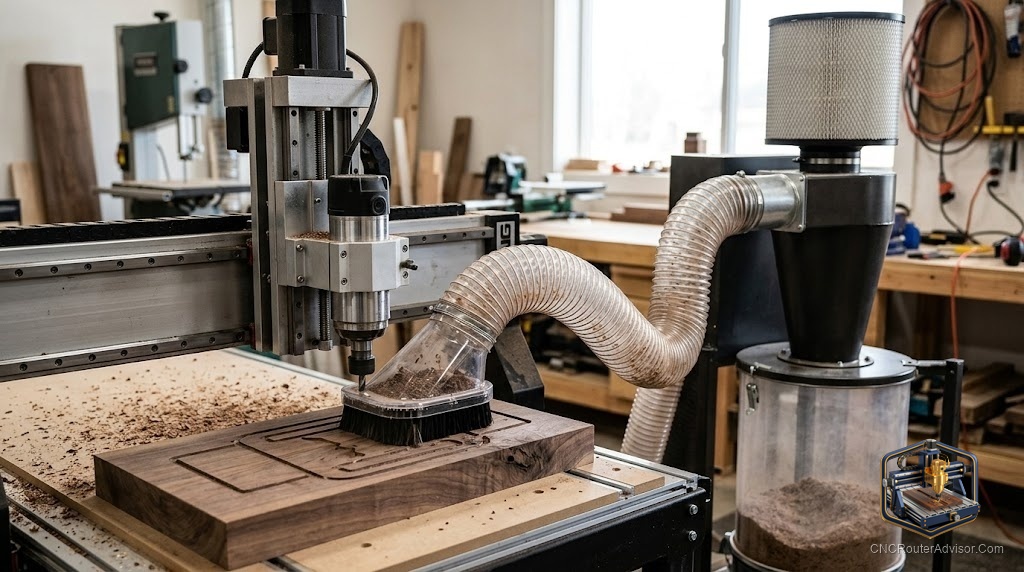
1. Capture at the source: the dust shoe (boot). A brush-skirted enclosure surrounds the spinning bit and connects to the extraction hose, capturing dust and chips right where they are made. This is the single most important component for keeping dust out of the air and off the machine. Popular examples include the Carbide 3D Sweepy and SuckIt dust boot. A good dust shoe captures the large majority of debris at the source.
2. Extraction: moving and separating the air. The system that pulls air (and dust) through the hose:
- Shop vacuum: high static pressure, low airflow (CFM), good for small machines and small-diameter hoses. Loud and small-capacity.
- Dust collector: high airflow (CFM), lower static pressure, moves large chip volumes through larger hoses, suited to benchtop and larger machines.
- Cyclone separator: a pre-separator (like a Dust Deputy or a cyclone-based collector) that drops chips into a bin before they reach the filter, keeping filters clean and maintaining suction. Highly recommended for volume cutting.
CFM vs. static pressure: the key concept
Sizing a system requires understanding two competing measures:
- CFM (cubic feet per minute): the volume of air moved. Higher CFM clears more chips, important for larger machines and bigger hoses.
- Static pressure (SP): the suction strength, the ability to pull air through resistance (long hoses, small openings, filters). Shop vacs have high SP but low CFM; dust collectors have high CFM but lower SP.
The right system balances both for your setup. A long run of small hose needs more static pressure; a big machine moving lots of chips needs more CFM. Undersizing either leaves dust behind.
Sizing by machine scale
Small hobby machines (3018, small desktop):
- A dust shoe plus a shop vacuum is usually sufficient. Small hoses and low chip volume suit the shop vac’s high-SP, low-CFM profile.
Benchtop / prosumer machines (Shapeoko, LongMill, Onefinity):
- A 1 to 2 HP dust collector, or a strong shop vac with a cyclone pre-separator. A Harbor Freight-class 2 HP dust collector (around 1,550 CFM nominal, roughly $175 to $200) is a common, cost-effective hobby choice, often paired with a cyclone.
Full-size / industrial machines (4x8, 5x10, MultiCam):
- Serious dust collection delivering roughly 500 to 1,200+ CFM measured at the dust shoe, sized to the machine’s material-removal rate. Often ducted, with a cyclone separator and fine filtration, and sometimes tied into a shop-wide system.
Filtration and safety
- Fine filtration matters: the smallest wood dust particles are the most hazardous to breathe. A HEPA or fine (1 to 3 micron) filter captures what a coarse bag lets through. Cheap collectors with coarse bags exhaust fine dust back into the air.
- Cyclone before the filter: keeps the filter clean and suction strong, and reduces filter cleaning.
- Fire and explosion awareness: fine dust is combustible; grounding hoses to prevent static buildup and keeping the system clean reduce risk.
- Respirator as backup: even with good collection, wear a dust mask/respirator for fine-dust tasks.
The verdict
A CNC router dust collection system is essential infrastructure, not an accessory, protecting your health, your machine, and your cut quality. Build it in two parts: a good dust shoe to capture at the source, and an extraction system sized to your machine’s scale, a shop vac for small machines, a 1 to 2 HP collector (often with a cyclone) for benchtop machines, and 500 to 1,200+ CFM with fine filtration for industrial machines. Understand CFM versus static pressure to size it correctly, prioritize fine filtration for the dust you cannot see, and treat it as a core part of your setup from day one.
Three takeaways: build the system in two parts, a source-capture dust shoe plus scale-appropriate extraction; size extraction by machine scale (shop vac for hobby, 1 to 2 HP collector for benchtop, 500 to 1,200+ CFM for industrial) and balance CFM against static pressure; and prioritize fine (HEPA-class) filtration and a cyclone separator, because the invisible fine dust is the real health hazard.
FAQ
Do I really need dust collection on a CNC router? Yes. Without it, fine dust fills your shop and lungs, clogs the machine, and degrades cut quality as chips re-cut. Fine wood dust is a respiratory hazard and combustible, so dust collection is essential infrastructure.
What is a dust shoe? A brush-skirted enclosure around the spinning bit that connects to your extraction hose, capturing dust and chips at the source. It is the most important component for keeping dust out of the air. The Sweepy and SuckIt are popular examples.
Should I use a shop vac or a dust collector for my CNC? A shop vac (high static pressure, low CFM) suits small hobby machines and small hoses. A dust collector (high CFM, lower static pressure) suits benchtop and larger machines that move more chips through bigger hoses.
What does CFM mean for dust collection? CFM (cubic feet per minute) is the volume of air moved, which clears chips. It is balanced against static pressure (suction strength through resistance). Larger machines need more CFM; long or narrow hoses need more static pressure.
How much CFM do I need for a CNC router? Small machines are fine with a shop vac. Benchtop machines suit a 1 to 2 HP collector (a 2 HP unit is around 1,550 CFM). Industrial machines need roughly 500 to 1,200+ CFM measured at the dust shoe, sized to material-removal rate.
What is a cyclone separator and do I need one? A pre-separator that drops chips into a bin before they reach the filter, keeping the filter clean and suction strong. It is highly recommended for volume cutting and extends filter life.
Is CNC dust a fire or explosion hazard? Fine wood dust is combustible and can be an explosion hazard in high concentrations. Ground hoses to prevent static buildup, keep the system clean, and use fine filtration and good housekeeping to reduce the risk.
References
- Carbide 3D, Guide to CNC Dust Collection (dust shoe, shop vac vs. collector): https://carbide3d.com/learn/cnc-dust-collection/
- Elephant CNC, How To Choose a CNC Router Dust Collection System (CFM by scale): https://www.elephant-cnc.com/blog/choose-cnc-router-dust-collection-system/
- Wood Magazine, Dust Collection Basics (CFM vs. static pressure, filtration): https://www.woodmagazine.com/woodworking-tools/dust-collection
- Oneida Air Systems, Cyclone Dust Collection and Filtration Guidance: https://www.oneida-air.com/
- OSHA, Combustible Dust and Wood Dust Hazards: https://www.osha.gov/wood-dust