
CNC Router Safety: Environment Setup and Operating Guidelines
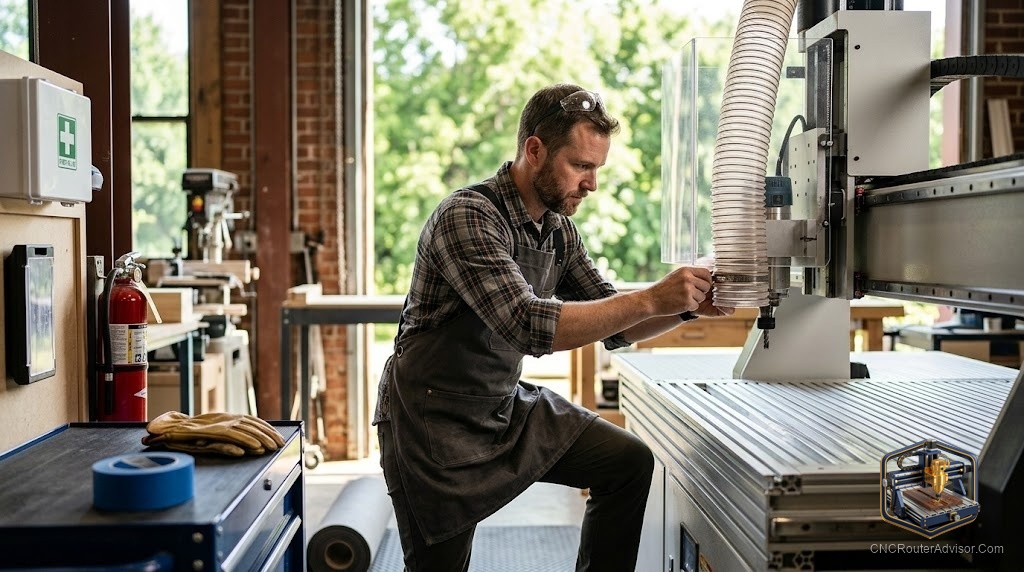
A CNC router running at 18,000 RPM in MDF does not stop itself when a clamp shifts. It does not notice when the bit breaks and a fragment flies. The operator manages these risks through setup before the job, not reaction during it. Safety in CNC routing is a pre-run checklist, not an emergency response plan.
CNC router safety starts with the environment: proper electrical, dust management, safe workholding, and operating habits that prevent the most common accidents before they happen.
Electrical Safety
- Verify the circuit handles the spindle load. 15A for trim routers; 20A provides headroom.
- Do not run spindle and dust collection on the same circuit if it causes breaker trips.
- Ground the machine frame properly. Static from MDF dust can be significant.
- Emergency stop (e-stop): know where it is before starting. Wire it to cut spindle power immediately.
Dust Management
MDF and wood dust are significant health hazards. MDF contains resin binders hazardous in fine-particle form.
- Dust shoe around the spindle connected to a shop vac: required, not optional.
- HEPA filtration for regular MDF work: standard shop vac bags do not capture fine MDF particles.
- N95 or better respirator during cleanup after cutting MDF.
Workholding Safety
Workpiece movement is the most common source of CNC accidents.
- Verify clamp engagement before every run by physically pushing the workpiece
- Use tabs in through-cut toolpaths to prevent small parts from lifting on the final cut
- Check that clamps are clear of toolpath boundaries before starting
- Carpet tape: apply enough surface area for the workpiece size and cutting forces
Bit Safety
- Inspect bits before every run: a chipped bit at 18,000 RPM fails unpredictably
- Do not exceed manufacturer-specified RPM for a given bit diameter
- Correct collet torque: under-tightened allows bit pull-out; over-tightened can crack ER collet sleeves
- Never run a bit with visible runout (wobble): indicates bent shank or collet issue
Operating Habits
- Run a dry (air) pass over the full toolpath before cutting to verify clearance
- Stay present during the first run of any new job on new material
- Keep hands away from the spindle area while the motor is running
- Hearing protection: trim routers exceed 80 dB at one meter
- Eye protection: standard ANSI Z87.1 safety glasses for all spindle operation
FAQ
Do I need dust collection for a CNC router? Yes, for all materials including wood. A dust shoe and shop vac is the minimum. MDF dust is a documented health hazard.
Is it safe to run a CNC router unattended? For repeat-proven jobs: yes, with an accessible e-stop and periodic check-ins. For new toolpaths on new materials: stay present through the first run.
What eye protection is needed? ANSI Z87.1 safety glasses minimum. A face shield when working close to the machine during active cutting.
References
- OSHA. Wood dust exposure guidelines. osha.gov
- Sienci Labs. CNC safety documentation. resources.sienci.com