
4x8 CNC Router with Vacuum Table: What a Vacuum Table Does and Whether You Need One
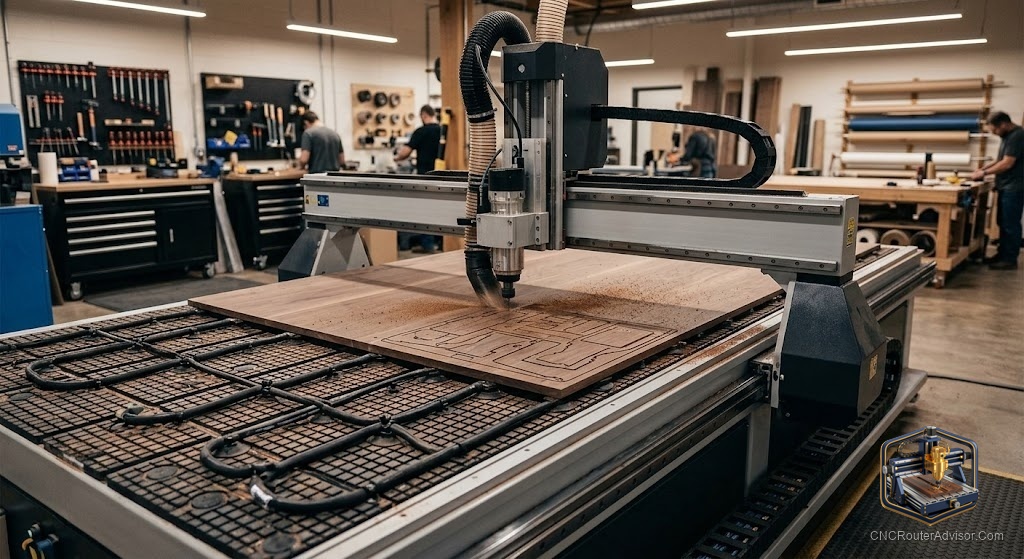
A vacuum table is the workholding upgrade that professional sign shops and cabinet makers reach for when they are tired of clamps slowing them down, and it is also an accessory that beginners over-invest in before they need it. Understanding what a vacuum table actually does, the real requirements for running one on a 4x8 router, and whether your work genuinely needs it is the difference between a worthwhile investment and an expensive addition that sits mostly idle.
A 4x8 CNC router with a vacuum table is a full-sheet CNC router that uses a vacuum system to hold sheet material flat against a perforated or gridded spoilboard, replacing or supplementing mechanical clamps by pulling the workpiece down across its entire surface. It speeds up sheet loading and unloading, reduces setup time on production runs, and holds large, thin, or oddly shaped material that clamps struggle to hold flat.
Here is the direct guidance: a vacuum table is worth it for production shops processing many full sheets, for material that mechanical clamps cannot hold reliably, and for workflows where sheet loading and unloading speed matter. For lighter use and hobby work, clamps and tabs handle most jobs at far lower cost and complexity. The sections below cover what a vacuum table does, the equipment required, and who genuinely needs one.
What a vacuum table actually does
A vacuum table creates negative pressure across the spoilboard surface, pulling sheet material flat against it without mechanical clamps. The benefits are practical: sheets can be loaded and removed quickly, there are no clamp obstacles in the toolpath, and the whole sheet surface is held uniformly rather than just at its edges. For production runs on large material, this translates directly into throughput. For thin, flexible, or large material that warps or lifts in the middle, a vacuum table holds what clamps cannot reach.
What a vacuum system requires
A real vacuum table is not just a spoilboard with holes; it requires a vacuum pump or regenerative blower sized to the table area and the spoilboard’s porosity, a plenum (the sealed chamber beneath the spoilboard that distributes vacuum), zone valves to localize vacuum under the workpiece (important for parts smaller than the full sheet), and a spoilboard matched to the system. The pump must maintain enough vacuum even when the spoilboard has open areas uncovered by material. Under-sizing the pump is the most common mistake, since a pump too small for the table loses holding force quickly.
Material and workflow requirements
Vacuum holding is not equally effective on all materials. Dense, flat sheet goods (plywood, MDF, solid wood panels) hold well. Porous wood can bleed vacuum and reduce holding force, which is managed by sealing the bottom face. Very thin or flexible material may need the full sheet covered to maintain enough holding force. Through-cuts that break the vacuum surface require zone control or a sacrificial thin layer to maintain the seal. These are manageable, not deal-breakers, but they are real workflow considerations.
Who genuinely needs a vacuum table
Production sign shops and cabinet makers who process dozens of full sheets per day gain real time and throughput from a vacuum table. Businesses running thin or flexible material that clamps cannot hold benefit from the uniform holding force. For a hobbyist or small shop running a few sheets per week, the investment in pump, plenum, and zone valves often exceeds the benefit that clamps and tabs cannot deliver. Match the investment to your volume and material needs honestly.
For the full 4x8 machine context, see our guide to the 4 x 8 CNC router.
Final verdict
A 4x8 CNC router with a vacuum table is a production workholding system that delivers real throughput, reduced setup time, and uniform holding for full-sheet material at the cost of a properly sized vacuum pump, a plenum, zone valves, and the workflow management they require. It is genuinely worth it for production shops processing many sheets, and less so for low-volume or hobby use where clamps handle most work competently. Match the system to your actual volume before investing, and you get real benefit. Buy it because it sounds professional, and the pump will run more than the router.
FAQ
What does a vacuum table do on a CNC router? It holds sheet material flat against the spoilboard using negative pressure, replacing or supplementing clamps. It speeds up sheet loading and unloading and holds material uniformly across its surface.
What equipment does a vacuum table need? A vacuum pump or regenerative blower, a plenum beneath the spoilboard, zone valves to localize vacuum under the workpiece, and a matched spoilboard. The pump must be sized to the table area.
Can I use a vacuum table for all materials? Dense flat sheet goods hold best. Porous wood may bleed vacuum and need a sealed bottom face. Very thin material needs full coverage to maintain holding force. Through-cuts need zone control to maintain the seal.
When is a vacuum table worth it? For production shops processing many full sheets, for thin or flexible material that mechanical clamps cannot hold uniformly, and where sheet loading speed affects throughput significantly.
Can I add a vacuum table to an existing 4x8 router? Often yes, but it requires adding a plenum, zone valves, and an adequate pump. Confirm the machine’s spoilboard and bed structure support the addition before purchasing the system.
Is a vacuum table better than clamps? For high-volume full-sheet work, yes. For low-volume or hobby use, clamps and tabs handle most jobs at far lower cost without the pump, plenum, and zone valve overhead.
References
- Avid CNC, full-sheet machine and vacuum workholding reference: https://www.avidcnc.com
- ShopSabre, vacuum table system documentation: https://www.shopsabre.com
- Carbide 3D, workholding overview: https://carbide3d.com