
CNC Router Vacuum Table: How It Works and Whether You Need One
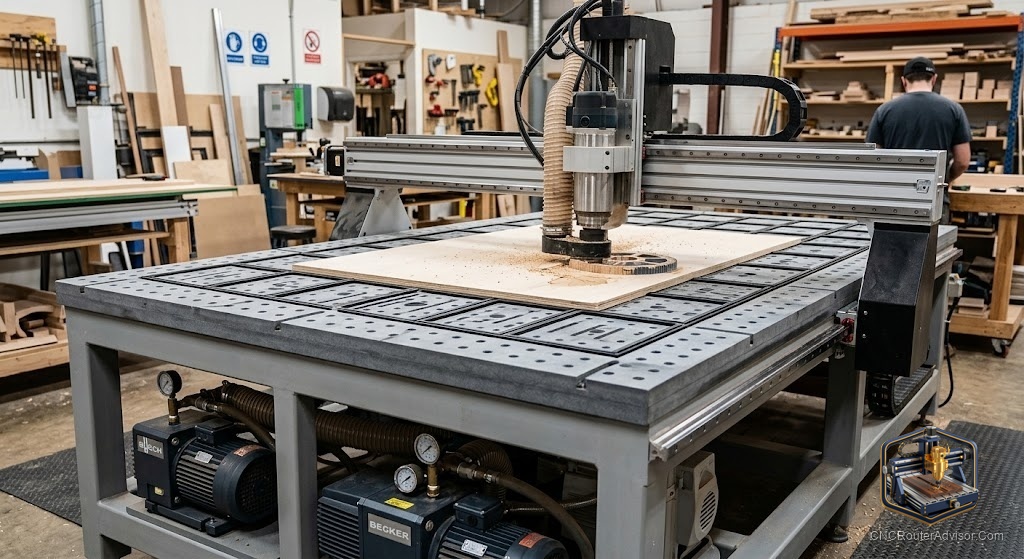
There is a moment every CNC router owner remembers: the first time they try to cut a batch of small parts and spend more time clamping than cutting. A vacuum table holds material with suction across its whole underside, no clamps blocking the tool path, no screw holes, fast repeatable loading. It is also genuinely complex and unnecessary for a lot of people.
A CNC router vacuum table uses suction to pull a workpiece against the bed. Instead of pinning material at its edges, it grips the whole underside, which is what makes it superb for sheet goods and small-part production.
How it works
Plenum and spoilboard. A sealed chamber sits under a porous MDF spoilboard. Vacuum pulls through the board, distributing suction across the surface. The classic full-sheet setup.
Gasketed zones. A groove routed around a part holds a gasket, concentrating suction under that specific part. Useful for smaller pieces.
Grid or pod systems. Multiple sealed zones or movable pods configure suction for specific part shapes.
The vacuum source matters enormously. A regenerative blower provides high airflow for through-board setups. A rotary vane pump provides strong suction for gasketed setups. A shop vac works only for small, light setups.
What it is genuinely great at
- Full sheet goods. Holding a whole sheet flat without edge clamps.
- Small-part production. Cutting many small pieces at once with nothing blocking the tool.
- Thin and flat stock. Material clamps would distort.
- Speed and repeatability. Load, cut, unload, repeat.
Where it falls short
- Tiny parts. Little surface area for suction to grip; cutting forces can break parts loose.
- Porous or warped material. Leaks air and weakens the hold.
- Through-cut air loss. Once the tool cuts through, suction leaks through the kerf.
- Cost and power. A proper pump or blower is a real investment.
DIY or buy?
Building your own is a popular project: MDF spoilboard over a sealed plenum connected to a pump. The tricky parts are sealing the plenum well and matching the right vacuum source. The most common DIY disappointment is pairing a weak shop vac with a large through-board table.
Who should get one, and who should skip it
Get one if you: cut full sheets regularly, run batches of flat parts, work with thin stock, or want fast repeatable loading.
Skip it if you: mostly cut one-off projects, make small individual parts, cut thick or warped stock, or are still learning.
The bottom line
For full sheets, flat-part batches, and thin stock a vacuum table is transformative. For tiny individual parts, warped material, and heavy cuts on small footprints, mechanical clamping wins. Match the vacuum source to your method and be honest about whether your work justifies the complexity.
Frequently asked questions
What is a CNC router vacuum table? A workholding system using suction to grip the whole material underside rather than clamping the edges.
Do I need a special pump? Yes. Through-board setups want a regenerative blower; gasketed setups want a strong vacuum pump. A shop vac is only for small setups.
Can it hold small parts? Not always well. Very small parts often still need tabs or mechanical help.
Can I build my own? Yes. MDF spoilboard over a sealed plenum connected to a pump or blower.
Why is my table not holding well? Vacuum source too weak, poorly sealed plenum, porous or warped material, or suction lost through a through-cut.
Is it worth it for a hobbyist? Only if you regularly cut full sheets or batches of flat parts.
References
- Vacuum pump and blower manufacturer documentation. Grizzly Industrial multi-zone vacuum table specs.