
Tabletop CNC Router Guide: Setup, Workholding, and Workspace Organization
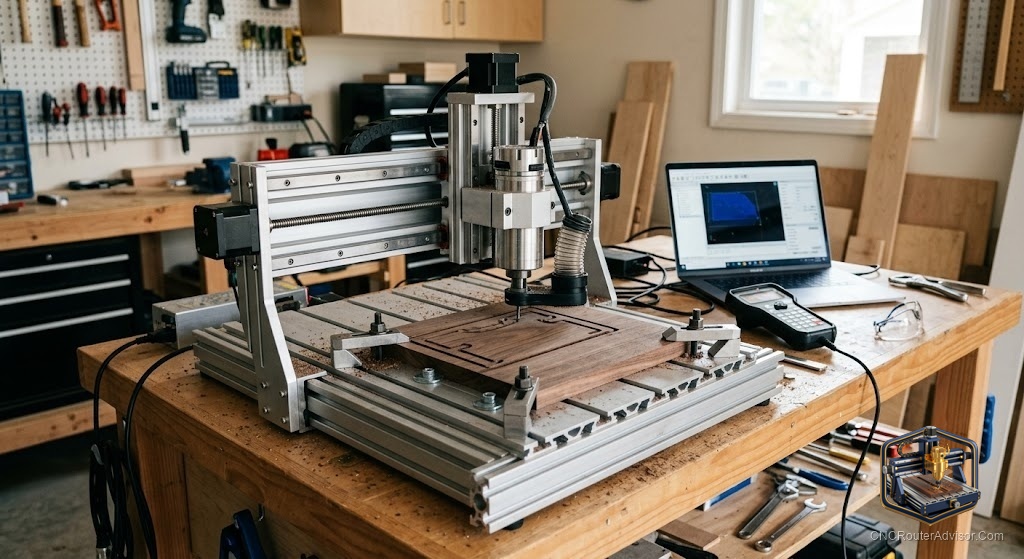
A tabletop CNC router sits on a workbench and cuts from there. No floor space consumed, no dedicated room needed, and no permanent installation that commits your workshop to a single layout. For most makers who are just starting with CNC, for crafters who cut small goods regularly, and for hobbyists whose shop doubles as a garage, a tabletop machine is the right format. It is not a compromise chosen because something bigger is unavailable. It is a format chosen because the work fits it and the shop suits it.
This guide covers tabletop CNC router setup: the workbench choices, workholding, workspace organization, and the specifics that make a tabletop machine work well in a real shop.
What tabletop means in practice
A tabletop CNC router is any compact to mid-size desktop machine that runs on a workbench rather than a floor-standing dedicated frame. In practice, this covers machines from the 3018 class through 4040 and similar formats: compact footprint, self-contained structure, and standard power requirements. The machine shares the bench with other tools and equipment, or has a dedicated portion of a bench to itself.
The setup discipline for a tabletop machine is different from a floor-standing one because the bench introduces variables: the bench must be flat, stable, and rigid enough that the machine cutting on it does not transmit vibration back from a flexy surface. Addressing those variables is the whole setup task.
The short answer
For a tabletop CNC router, choose a flat, stable, heavy bench and bolt or clamp the machine to it. Surface the spoilboard with the machine’s own spindle to establish a flat reference. Use a dust shoe and HEPA shop vacuum for dust management. Organize the cable run and controller so they do not overhang or pull. Keep tooling, collets, and workholding within arm’s reach but not in the machine’s motion envelope. Do those things, and a tabletop machine works as precisely and reliably as its footprint will allow.
The workbench
The bench is the hidden specification of a tabletop CNC router. A benchtop machine bolted to a solid, flat, heavy workbench cuts precisely. The same machine sitting on a thin wobbly folding table produces chatter and positional variation that looks like a machine problem but is a bench problem.
For a dedicated tabletop CNC bench, a solid wood workbench, a steel fabrication bench, or a torsion box assembly table provides a good surface. The bench height should allow you to see the cutting zone clearly while standing, and to reach the workpiece from the operator side without leaning across the machine. Bolt or use heavy clamps to secure the machine to the bench rather than relying on weight alone to hold it.
Spoilboard: surface it yourself
A tabletop machine’s spoilboard must be surfaced flat by the machine’s own spindle before the first real job. This is not optional: a spoilboard that has not been surfaced in place may be flat to the world but not flat to the machine’s XY plane, which means Z depth varies across the bed. Surface the spoilboard once after installation and re-surface it whenever Z depth variation becomes noticeable or after replacing a consumed spoilboard.
A threaded insert grid in the spoilboard gives workholding flexibility for a variety of part sizes. Plan the insert spacing based on the smallest workpiece you will regularly hold.
Dust management on a tabletop
On a tabletop machine in a shared or home workshop, dust at the source is the only effective approach. A well-fitted dust shoe at the spindle connected to a shop vacuum with a fine dust filter runs during every cut and keeps the bench and room clean. Without it, fine particles from MDF and hardwood spread through the workshop air.
Route the vacuum hose so it does not drag across the machine’s motion envelope. A simple overhead cable management hook or a short hose support arm keeps the hose out of the way without restricting gantry travel.
Workspace organization
A tabletop machine benefits from having its immediate workspace organized deliberately. Keep tooling and collets in a small tray within arm’s reach. Keep the controller or laptop at a comfortable viewing angle but not on the machine table itself. Route the USB cable or controller connection cleanly so it does not snag during gantry travel. Store workholding clamps and the touch-off block in consistent, immediately accessible spots.
Workspace organization sounds minor but it reduces the setup time for each job, which on a tabletop machine used frequently adds up to a meaningful difference over time.
Who should skip a tabletop machine
Skip a tabletop machine if your projects are consistently larger than the work area, or if your production volume demands a larger work area for efficiency. A full sheet benchtop or floor machine is the right step when you regularly find yourself resetting the workpiece to complete a single project, or when nesting parts on a small bed is consuming more time than the cutting itself.
Comparison: tabletop setup elements
| Element | What to prioritize | Why |
| Bench | Flat, stable, heavy | Eliminates vibration and positional error |
| Machine mounting | Bolted or heavy clamped | Prevents walking during cuts |
| Spoilboard | Surfaced by the machine | Accurate Z reference across full bed |
| Dust control | Dust shoe plus HEPA vacuum | Source capture, no spread through room |
| Cable routing | Clear of motion envelope | No snagging or hose drag on gantry |
For a capable tabletop mid-size machine, the Genmitsu 4040 PRO is at this listing. For a compact entry tabletop machine with great community support, the Genmitsu 3020 PRO MAX is at this listing. For a rigid compact machine that handles harder materials, the Genmitsu 3030 PROVer Ultra is at this listing.
The verdict
A tabletop CNC router is a serious cutting machine when the bench, spoilboard, and workspace are set up right. The format suits most makers and crafters whose projects fit the bed, and it keeps the machine accessible in a shared shop without consuming floor space. Get the bench right, surface the spoilboard, route the cables cleanly, and manage dust at the source, and the tabletop machine produces the same quality results as its motion system allows regardless of its compact footprint.
Frequently asked questions
What kind of bench do I need for a tabletop CNC router? Flat, stable, and heavy enough to resist vibration from cutting. A solid wood workbench, steel fabrication table, or torsion box assembly table are good choices. Avoid thin folding tables that flex under cutting loads.
Do I need to bolt a tabletop CNC router to the bench? Yes, or clamp it securely. Weight alone is not enough to prevent the machine from walking during cuts, especially on an aggressive operation. Bolt or use heavy clamps.
How do I surface a spoilboard on a tabletop machine? Mount a wide flat-bottom surfacing bit in the spindle, set a shallow depth of cut, and run a series of overlapping passes across the full work area. This makes the spoilboard parallel to the machine’s XY plane rather than to some external flat reference.
What is the best dust management for a tabletop CNC router? A fitted dust shoe at the spindle connected to a shop vacuum with a HEPA or fine dust filter. Run it during every cut and route the hose so it does not drag across the gantry’s motion path.
Can I use a tabletop CNC router for production work? Yes, for production of parts that fit the work area. Small signs, gifts, custom pieces, and short run panel components cut well on a tabletop machine. When work volume fills the bed constantly and lead time matters, scaling to a larger machine becomes the right decision.
How do I organize my workspace around a tabletop router? Dedicate a clean section of bench around the machine, keep tooling and workholding within arm’s reach, route cables clear of motion, and keep the controller at a comfortable viewing angle. Consistent organization reduces setup time per job.
References
- CNC Router Info, How to Choose a CNC Router: https://cncrouterinfo.com/guides/how-to-choose-a-cnc-router/
- CNC Dad, Best CNC Router for Beginners: https://www.cnc-dad.com/blog/best-cnc-router-for-beginners/