
Home CNC Router Buying Guide: Noise, Space, Dust, and the Right Machine
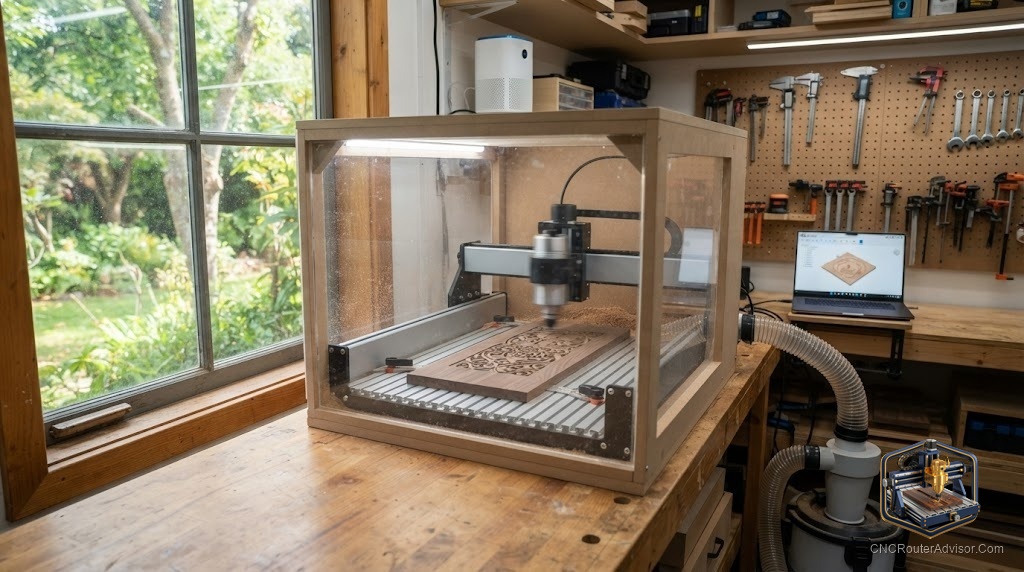
A home CNC router has different constraints than a shop machine, and most buying guides miss that. The garage hobbyist, the basement maker, and the person with a spare bedroom workspace all face the same set of concerns that a commercial shop does not: neighbors who can hear a screaming trim router at nine in the evening, a partner who notices when MDF dust drifts under the office door, a lease that means the floor stays in good shape, and a workshop that doubles as a storage room on the other side of a folding table. Those constraints shape which machine is actually the right one for a home - not just which machine is technically capable.
This guide covers the home-specific buying decisions alongside the standard specifications, because in a home shop the constraints are the purchase.
What makes a home CNC router different
A home router shares all the same fundamental specifications as a shop machine: work area, frame rigidity, spindle power, motion system, and controller. What changes is the weight you assign to the constraints around it. Noise matters in a home because you share walls, ceilings, floors, and neighborhoods. Space matters because the machine shares the room with other life. Dust matters because a home ventilation system was not designed for MDF production. And the machine has to fit through a door, up a staircase, or into a garage before it fits the work.
These are not reasons to avoid a CNC router at home. They are reasons to choose one that handles them rather than one that ignores them.
The short answer
For a home workshop, a compact to mid-size machine with a VFD spindle is the most practical combination. A VFD spindle runs noticeably quieter than a trim router and gives you better control at lower speeds, which helps both noise and material quality. A compact footprint fits a real home workshop without consuming the space. A well-designed dust shoe and a good dust collector - even a shop vacuum with a fine filter - handles the dust at the source so it does not reach the rest of the house. And a machine with a strong community means you can get help at midnight when you are puzzling over a setup, which is when home shop work often happens.
Noise: the constraint that surprises people
A trim router spindle on a consumer CNC machine is genuinely loud. Running one at 10pm in a semi-detached house or an apartment building with a garage is a real consideration for neighbors and housemates. A VFD spindle is meaningfully quieter, especially at lower RPM, and the difference matters in a residential environment.
The duty cycle also matters: a machine running an hour-long 3D carving job in the evening generates sustained noise, not a brief burst. Plan your cutting sessions, choose a VFD spindle, and if the machine is in a garage, check whether a simple acoustic panel on the wall between the garage and living space dampens the sound significantly.
Space: real footprint versus stated footprint
A machine’s nominal dimension does not include the working clearance around it. A compact 3020-class machine fits a kitchen table but needs clear space on all sides for the gantry to travel, and the computer or laptop that controls it needs a nearby spot. A mid-size 4040-class machine needs a dedicated workbench. A large machine needs a dedicated room.
Plan the full operational footprint: machine plus computer, dust collection, tool storage, and the space to load and unload material. In a home workshop, that honest footprint usually means going one size smaller than you initially planned - and still being satisfied.
Dust: managing it at the source
In a home, MDF dust is a real concern because the whole-house air system can distribute it. The answer is collection at the source: a dust shoe fitted at the spindle draws chips and fine dust into a hose before they become airborne. Pair it with a shop vacuum rated for fine dust, with a HEPA or equivalent filter, and run it whenever the machine cuts.
Keep a short cut session discipline: do not remove the part until the dust collector has had time to pull down the residual air in the enclosure. Some home shop builders add a simple enclosure - even a fabric curtain - around the machine to contain airborne particles during cutting.
Who should skip a large machine for home use
Skip a full sheet or large-format machine for a home shop unless you have a large detached garage or workshop space that can contain the footprint, noise, and dust independently of the living space. The return on investment from a machine your home setup fights every session is low. A compact or mid-size machine that fits the space, runs within the noise envelope, and manages dust effectively produces better work and more of it than a larger machine that never quite works in the environment.
Comparison: home-specific machine factors
| Factor | Best choice for home | Why |
| Spindle | VFD or DC spindle | Quieter than trim router |
| Footprint | Compact to mid | Fits a real home workshop |
| Dust control | Dust shoe plus fine-filter vacuum | Captures at source, protects living space |
| Community | Large, active | After-hours help when you need it |
| Work area | Sized to projects, not ambitions | Avoids the footprint trap |
For a quiet, compact machine that suits a home workshop well, the Genmitsu 3020 PRO MAX runs a DC spindle rather than a loud trim router and is at this listing. For a mid-size home workshop machine with more area, the Genmitsu PROVerXL 4030 is at this listing. For an air-cooled VFD spindle upgrade on any compatible machine, a 500W kit is at this listing.
The verdict
A home CNC router is entirely practical, and thousands of people run them in garages, basements, spare rooms, and apartments. The machine that works best at home is the one that fits the real constraints: quiet enough for the environment, compact enough for the space, and dust managed at source so cutting does not affect the rest of the house. A VFD spindle, a dust shoe and good vacuum, a compact-to-mid footprint, and a machine with a large community to help at midnight are the combination that makes home shop CNC genuinely enjoyable rather than a constant compromise.
Frequently asked questions
Can I use a CNC router in an apartment? Possibly, with the right machine and setup. A compact machine with a quiet VFD spindle, a dust shoe and fine-filter vacuum, and a session schedule that respects building rules and neighbors is manageable. Check your lease for workshop use restrictions first.
How loud is a home CNC router? A trim router spindle is loud, similar to a hand router. A VFD spindle is meaningfully quieter, especially at lower RPM. The dust collector also adds noise. Plan your session times and consider the spindle type before buying for a noise-sensitive environment.
How do I control dust in a home shop? A dust shoe at the spindle and a shop vacuum with a HEPA or fine filter captures particles at the source. Run it during every cut. Avoid MDF production indoors without dust collection, as the fine particles are a real health risk and distribute through household air.
What size CNC router fits a home workshop? A compact 3020-class machine fits a workbench. A 4040-class machine needs a dedicated bench and reasonable working clearance. Measure your space including working clearance before buying, not just the machine’s nominal dimensions.
Can I run a CNC router in a garage? Yes, and a detached garage is often the ideal home workshop location because it separates noise and dust from the living space. Ensure adequate ventilation and dust collection, and plan for temperature extremes if you are in a climate that matters.
Is a VFD spindle really quieter than a trim router? Yes, meaningfully so. A VFD spindle spins smoothly and can run at lower RPM than a trim router allows, reducing high-frequency noise. In a home environment, the difference is noticeable.
References
- CNC Router Info, How to Choose a CNC Router: https://cncrouterinfo.com/guides/how-to-choose-a-cnc-router/
- CNC Dad, Best CNC Router for Beginners: https://www.cnc-dad.com/blog/best-cnc-router-for-beginners/