5-Axis Wood CNC Router: The Rare Cases Where It Adds Value
The vast majority of woodworking done on CNC routers doesn’t need five axes. Furniture, cabinetry, carved relief panels, signs, moldings, guitar bodies - all of these are 3-axis problems. Five-axis capability in a wood shop adds significant cost, complexity, and operator skill requirements. The cases where it genuinely earns its place in a wood shop are specific enough to name.
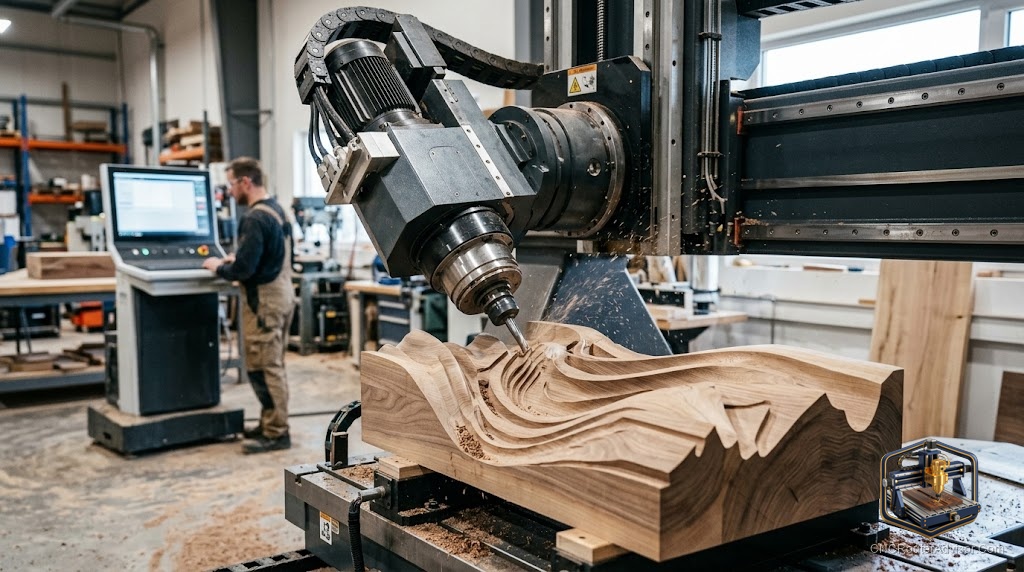
A 5-axis wood CNC router is a machine with five axes of motion used to machine wooden workpieces, typically for sculptural forms with complex compound geometry, high-end furniture with multi-directional curves, or architectural millwork requiring undercut surfaces.
The direct answer: for most wood shops, a 3-axis machine handles everything. The narrow category where 5-axis adds real value in wood work is: freeform sculptural furniture with compound curves (the kind seen in high-end design studios), complex architectural millwork with true undercuts, and pattern making for cast forms where every face must be machined. These applications are real but uncommon.
Applications Where 5-Axis Adds Wood Shop Value
Sculptural furniture: High-end design studios (think Zaha Hadid-influenced furniture forms) where the piece has curves flowing in multiple spatial directions simultaneously. A 3-axis machine produces a staircase approximation of these surfaces; 5-axis produces a smooth compound curve.
Complex architectural millwork: Column capitals, carved brackets, and ornamental elements with surfaces that project in multiple directions - faces that a vertical tool cannot reach cleanly from above.
Pattern making: Creating precise wooden patterns for casting that require all faces machined cleanly in a single setup.
What 5-Axis Doesn’t Add for Most Wood Work
Bas-relief carving: 3-axis covers this completely. Furniture components: 3-axis covers 95% of cases. V-carving and lettering: 3-axis. Guitar bodies and musical instrument work: 3-axis. Cabinet parts: 3-axis.
Verdict
For wood work specifically, 5-axis adds value in a narrow band of high-end sculptural and architectural applications. For 99% of wood shop production, a well-equipped 3-axis machine is the correct tool.
FAQ
Do I need a 5-axis machine for furniture making? Not for standard furniture. Only for sculptural furniture with compound curves and undercuts that a 3-axis machine can’t reach.
What wood shop applications need 5-axis CNC? High-end sculptural furniture, complex architectural millwork with undercuts, and pattern making for casting.