3D Wood CNC Router: What Makes a Machine Good at Relief Carving
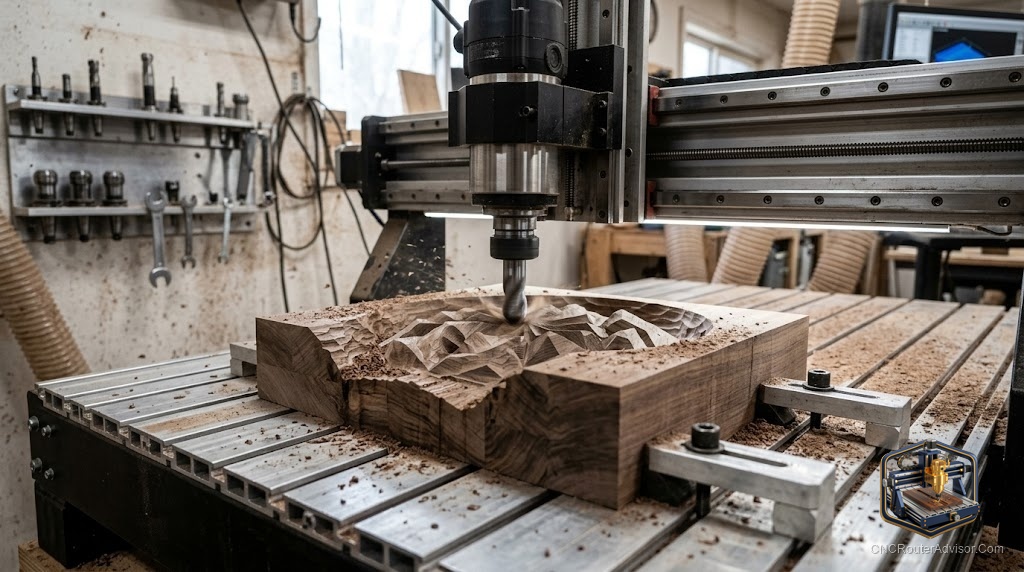
Pine at full depth cuts fast and smells great. Walnut takes a sharper bit and a slower hand before the grain starts cooperating. Basswood cuts cleanly in every direction at any speed the bit can handle. Each species is a different conversation with the machine, and the machine has to be able to hold up its end.
A 3D wood CNC router is a CNC router configured and used for simultaneous three-axis motion in wood: bas-relief carving, portrait panels, decorative furniture faces, and sculptural forms. The “3D” designation means the ball-nose bit traces curved surfaces continuously, not just moving up and down between flat passes.
The direct answer: for 3D wood carving, machine rigidity is the most important spec. Profile linear rails and ball screws produce noticeably better finishing-pass surface quality than V-wheels and lead screws. The Shapeoko 5.1 Pro and Onefinity Woodworker are the most commonly recommended machines for this use case at hobbyist-to-prosumer scale.
Why Machine Rigidity Matters for 3D Wood
A 3D finishing pass with a 6mm ball-nose at 10% stepover makes many more traversals over the material than a standard 2D pocket. Every traversal applies lateral force to the gantry. Gantry flex shows as micro-ripple in the carved surface, visible in raking light and fixable by sanding but a mark of inadequate machine construction.
Profile linear rails carry side loads without flex. V-wheels don’t. On basswood and MDF, V-wheels produce acceptable results. On dense hardwood like walnut, the difference between a rigid and a flexible machine is visible in the finishing pass.
Best Wood Species for CNC Carving
Basswood: The reference material for CNC 3D carving. Consistent density, tight grain, clean cut edges in all directions. Detail comes out crisp; the surface sands smooth. The standard for portrait relief and decorative panels.
Mahogany: Rich color, moderate hardness. Good detail fidelity. Some cross-grain tearout but manageable with sharp tooling.
Walnut: Dense, hard, beautiful. Rewards sharp carbide and correct chip load with deep color and clean carved detail.
MDF: Not a wood but the best material for prototype carving and paint-finish work. Uniform density, no grain, no tearout in any direction.
Pine/Softwood: Fast to rough but inconsistent. Grain varies between early and late wood, causing bit deflection in soft zones.
Tooling
Roughing: 6mm two-flute flat end mill (upcut). Removes bulk in layers at aggressive feeds.
Finishing: Ball-nose end mill. 6mm for general work, 3mm for fine detail.
Stepover guide:
- 15%: visible scallop, significant sanding needed
- 10%: light scallop, sands quickly
- 8%: display-quality surface on most species
- 6%: near-smooth, long cutting time
Recommended Machines
Shapeoko 5.1 Pro: Ball screws, HG-15 profile rails, 80mm spindle mount, 33x33 or 48x48 inch options. The most recommended machine for 3D wood carving at the prosumer level.
Onefinity Woodworker: Hollow-shaft linear guides, ball screws, 32x32 inch format. Very rigid for the price. Popular in the woodcarving community.
Verdict
For 3D wood carving, invest in machine rigidity first. A Shapeoko 5.1 Pro or Onefinity Woodworker with a VFD spindle and a 6mm rougher plus 3mm ball-nose finishing tool produces results that stand next to handwork. Basswood shows the machine’s capability most clearly.
- Profile linear rails + ball screws: significantly better 3D surface quality than V-wheels
- Basswood: the best species for evaluating and demonstrating 3D CNC carving quality
- 8 to 10% stepover on finishing pass: the standard for display-quality results
- VFD spindle required for extended multi-hour finishing sessions
FAQ
What wood is best for 3D CNC carving? Basswood for maximum detail and consistency. Walnut for natural-finish display pieces.
What bit do I use for 3D wood carving? Ball-nose end mill for finishing. 6mm ball-nose for general work, 3mm for fine detail. Flat end mill for roughing first.
Can I do 3D carving on a 3018? Yes on small pieces. The 300x180mm work area limits project scale and the small spindle limits depth per pass.
References
- Shapeoko 5.1 Pro: carbide3d.com
- Onefinity CNC: onefinitycnc.com
- Vectric Aspire: vectric.com