3D CNC Router for Wood: What the Machine Needs to Do This Well
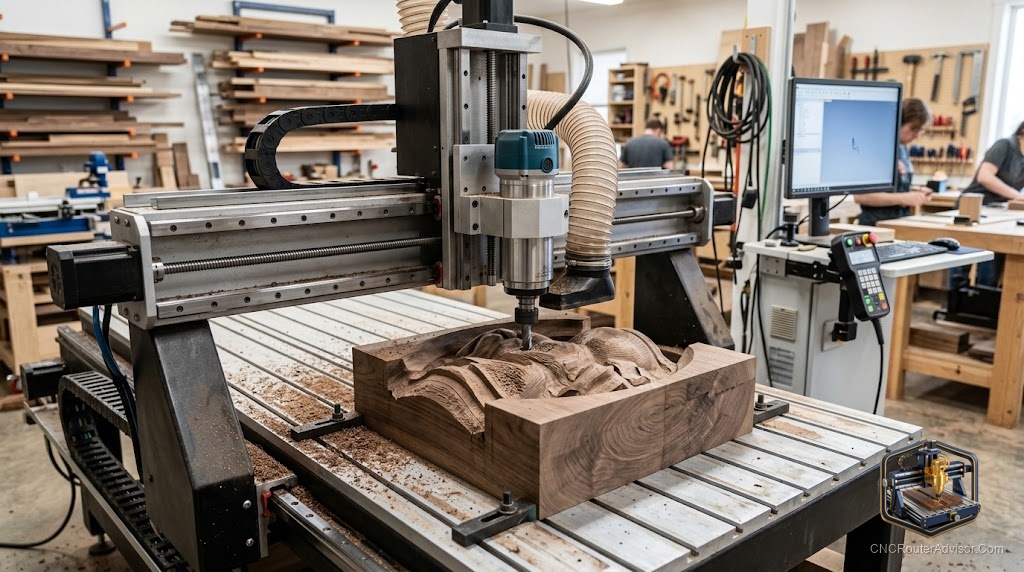
Wood carving by CNC is a slow reveal. The roughing pass looks nothing like the final piece. You’re watching a ball-nose trace a surface that won’t make sense until the last finishing pass sweeps through and the grain comes alive under the tooling. Getting to that moment requires the right machine, the right tooling, and a CAM setup that’s been thought through before the spindle starts.
A 3D CNC router for wood is a machine capable of simultaneous three-axis motion to carve sculptural surfaces - bas-reliefs, portraits, decorative panels, carved furniture parts - from wood. This requires more than basic 2D cutting capability; it requires a machine with sufficient rigidity, Z travel, and spindle control to follow curved surfaces accurately at the fine stepovers that 3D wood finishing demands.
The direct answer: for hobbyist-to-prosumer 3D wood carving, the Genmitsu 3030-PROVer Ultra and the Sienci LongMill MK2 are the most common starting points. For larger work in the 4x4-foot range, the Onefinity Woodworker and Shapeoko 5.1 Pro are well-suited. The critical machine requirement is rigidity - 3D finishing passes use fine stepovers and slow feeds that require the gantry to maintain position without vibration or drift.
Why Rigidity Matters More for 3D Work
In 2D pocketing and profiling, the tool follows straight or gently curved paths. Gantry flex causes edge deviation but doesn’t necessarily ruin the part. In 3D finishing, the tool traces a sculpted surface at a 10% stepover. Any gantry flex at this scale shows as ripple in the carving - visible in raking light, sandable to a degree, but a mark of inadequate machine rigidity.
Profile linear rails and ball screws are the relevant specification. V-wheel and lead screw machines can produce 3D carvings, but the surface finish requires more sanding to reach the same quality as a stiffer machine.
Wood Species and How They Carve
Basswood: The best wood for 3D CNC carving. Tight, consistent grain, low hardness, clean cut edges. Detail carves crisp and sands smooth. The default choice for portrait and decorative relief work.
Mahogany (African): Rich color, moderate hardness, good detail fidelity. Grain can tear slightly on across-grain passes but generally carves well. Good for furniture parts and decorative panels.
Walnut: Harder than basswood, but carves with excellent color depth and contrast. Finishing passes require sharp tooling and appropriate chip load.
MDF: Not a wood, but excellent for prototype and sign carving. Uniform density, takes detail well, finishes smooth. No grain means no tearout in any direction.
Pine: Soft and fast to carve but inconsistent. Softwood grain tears across the grain direction. Better for rough work than fine-detail relief.
Tooling for 3D Wood Carving
Roughing pass: 6mm or 1/4-inch flat end mill (2-flute for wood). Removes bulk material in layers. Feed rate can be aggressive since surface quality doesn’t matter here.
Finishing pass: Ball-nose end mill, 3mm to 6mm diameter. Traces the final surface at 8 to 15% stepover. Smaller diameter produces finer detail but requires more passes and time. For portrait relief, 3mm ball-nose at 10% stepover is the standard.
CAM Software for 3D Wood
Vectric Aspire is the dominant choice for 3D wood carving. Its combination of STL import, 3D modeling tools for creating relief from 2D artwork, and purpose-built woodworking toolpath strategies makes it the standard in professional and serious hobbyist shops. Carveco Maker is the subscription alternative. Fusion 360 covers advanced users who also work in other materials.
Verdict
For 3D wood carving, the combination of a rigid gantry (profile rails, ball screws), a fine ball-nose end mill, and Aspire or Carveco as CAM produces results that look genuinely handcrafted. The LongMill MK2 and Genmitsu PROVer Ultra are the entry points; the Shapeoko 5.1 Pro and Onefinity are the step up.
- Rigidity: profile rails and ball screws produce better 3D surface finish than V-wheels
- Basswood is the best species for detailed relief carving
- Ball-nose end mill at 10% stepover is the standard finishing tool
- Vectric Aspire is the CAM software for serious 3D wood work
FAQ
What is the best CNC router for 3D wood carving? For desktop-format work, the Genmitsu 3030-PROVer Ultra. For larger format work, the Onefinity Woodworker or Shapeoko 5.1 Pro. Key spec is rigidity: profile linear rails and ball screws.
What bit do I use for 3D wood carving? A ball-nose end mill. 3mm for fine detail, 6mm for larger carvings. Use a flat end mill for roughing passes first.
What wood carves best on a CNC router? Basswood is the standard choice for detail carving. MDF works well for signs and panels. Walnut produces beautiful results with sharp tooling.
How long does a 3D CNC carving take? Depends on size, depth, and stepover. A 200x200mm portrait at 10% stepover with a 3mm ball-nose takes 2 to 5 hours. Larger pieces with finer stepovers can run overnight.
References
- Sienci LongMill MK2: sienci.com
- Genmitsu 3030-PROVer Ultra: sainsmart.com
- Vectric Aspire: vectric.com