
3-Axis Wood CNC Router Guide: Materials, Applications, and the Right Machine for Woodworking
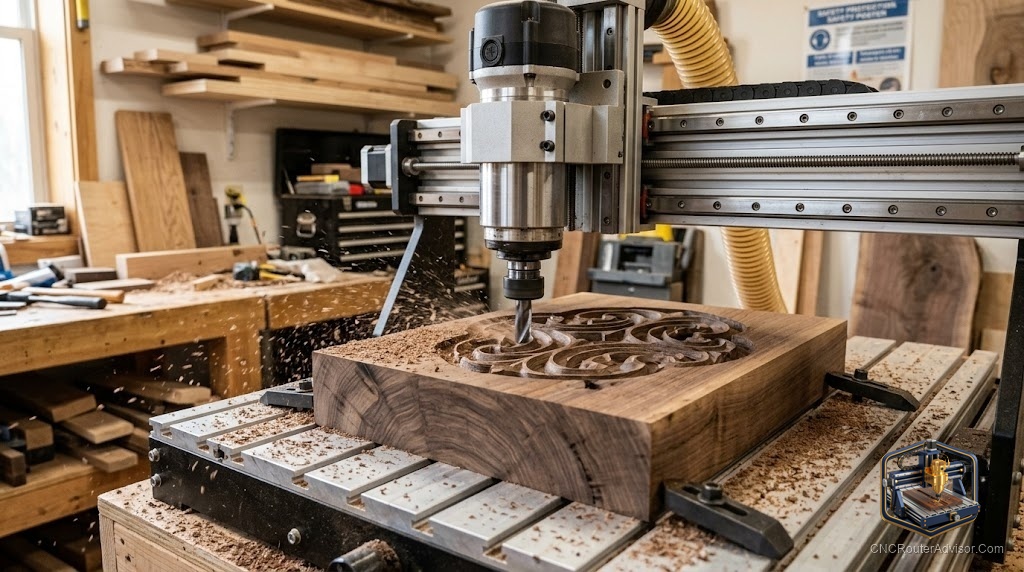
Wood is the material that the CNC router was built for in the prosumer and hobby market, and the three-axis platform is the native configuration for woodworking applications. Profile cuts, pockets, through-cuts, V-carving, and 3D relief work in wood are all three-axis operations; the wood asks for nothing more in most cases. What wood does ask for is the right cutting tool, the right spindle speed and feed rate for the specific species and board orientation, and a machine with enough rigidity and power to push through the material without flexing or burning. This guide is about choosing and using a 3-axis CNC router for woodworking specifically.
A 3-axis wood CNC router is a three-axis CNC routing machine configured and equipped for woodworking applications: cutting, carving, profiling, and engraving solid wood, plywood, MDF, melamine, and engineered wood products. The machine itself is the standard three-axis platform; what makes it suited to wood specifically is the spindle speed range (typically 10,000 to 24,000 RPM, appropriate for the chip loads wood cutting produces), the tooling (upcut and compression spirals, V-bits, and ball-nose bits designed for wood chip evacuation), and the workholding appropriate to flat sheet goods and irregular blanks.
The short guide: for wood, the most important machine specification after work area is spindle power and speed range. Underpowered spindles stall or burn in hardwood; overspeeding in soft wood produces dust rather than chips. Match the spindle to the work: 800W to 1.5kW for a prosumer machine cutting wood up to 3/4 inch in one or two passes, 2.2kW and above for production cabinet and furniture work. Then match the bits to the material and the operation.
Wood species and what they ask for differently
Softwoods (pine, cedar, poplar): Lower cutting resistance means higher feed rates are achievable without overloading the spindle. Softwood’s open grain structure accepts chip loads that would break bits in hardwood. The risk is tear-out on the face grain; a downcut spiral or compression spiral manages this.
Hardwoods (oak, maple, walnut): Higher cutting resistance requires lower feed rates and more modest depth per pass relative to softwoods of the same thickness. Hardwood rewards sharp bits - dull bits burn rather than cut, and burned hardwood is difficult to sand out. Running the correct chip load for the species is the fundamental skill in hardwood CNC work.
Plywood (birch ply, Baltic birch, furniture ply): The most common material in production CNC woodworking. The alternating grain direction in each ply resists tear-out differently than solid wood, but the face veneer tears easily on through-cuts. A compression spiral (upcut geometry below, downcut geometry above) is the standard solution for clean-face plywood through-cuts.
MDF: The most consistent CNC material. No grain, no knots, no directional variation. Takes very consistent chip loads, machines cleanly at high feeds, and produces a smooth cut surface. The downside is dust (fine MDF particles are a health concern; use good dust collection and respiratory protection) and edge fragility (MDF edges are weak relative to solid wood or plywood).
Melamine and laminated MDF: The face laminate chips easily on through-cuts. A compression spiral is the standard bit for melamine, producing a clean cut on both the top surface and the bottom face where the bit exits.
Bits for wood: matching geometry to operation
Upcut spiral: Pulls chips up and out of the cut; best for pocketing where chip evacuation is the priority. Leaves a clean floor but may lift the top surface grain slightly.
Downcut spiral: Pushes chips down; leaves the top surface clean but traps chips in the cut. Best for top-surface face-grain operations where the top surface finish is the priority.
Compression spiral: Upcut below, downcut above; cleans the top and bottom surfaces simultaneously on through-cuts. The production standard for plywood and melamine. Amana Tool 46170-K in 1/4 inch shank is the community’s consistent recommendation.
V-bit (90°, 60°): For text carving and decorative V-carving. Whiteside RD2100 covers the downcut profile work; standard V-bits in 1/4 inch shank cover the carving operations.
Ball-nose: For 3D relief carving detail passes in wood. A 1/4 inch (6.35mm) ball-nose for larger features, a 1/8 inch (3.175mm) ball-nose for fine detail.
Surfacing bit (fly cutter): For flattening live edge slabs, uneven stock, and spoilboards. The Genmitsu spoilboard surfacing bit handles both spoilboard maintenance and slab flattening on machines with adequate work area.
Our guide on how to choose a CNC router covers the full machine selection framework for woodworking applications.
The takeaway: a 3-axis wood CNC router needs the spindle power for the species and thickness you are cutting, the bit geometry matched to the operation (compression for through-cuts, downcut for face-grain, upcut for pocketing, V-bit for carving), and the machine rigidity to hold those parameters consistently over a full production run.
Frequently asked questions
What spindle speed is correct for wood CNC routing? 18,000 to 24,000 RPM for most wood species. Hardwoods at the lower end, softer woods at the higher end.
What is the best bit for cutting plywood on a CNC router? A compression spiral end mill. The Amana Tool 46170-K in 1/4 inch shank is the community’s consistent recommendation.
Can a 3-axis CNC router cut hardwood? Yes, with adequate spindle power and correct chip load for the species. Lower feeds and shallower passes than for softwood.
What causes burning in CNC wood routing? Too-slow feed rate (rubbing instead of cutting), dull bit, or incorrect chip load for the material. Burning means the bit is generating heat rather than removing chips.
Is MDF good for CNC routing? Yes - it is the most consistent and easy-to-machine CNC material. The health concern is the fine MDF dust; use good dust collection and respiratory protection.
What is the correct depth per pass for 3/4 inch plywood on a prosumer CNC machine? 2 to 3 passes for a 3/4 inch (18mm) sheet is typical: approximately 6 - 8mm per pass on a machine with a 1.5kW or stronger spindle and a sharp compression spiral.
References
- Vectric, wood CNC toolpath documentation — https://www.vectric.com/
- ToolsToday, wood router bit selection guide — https://www.toolstoday.com/
- CNC Router Info, machine and tooling guide for woodworking — https://cncrouterinfo.com/guides/how-to-choose-a-cnc-router/