
8 x 4 1325 Woodworking CNC Router by IEHK Guide: Work Area, Machine Size, and Buying Factors
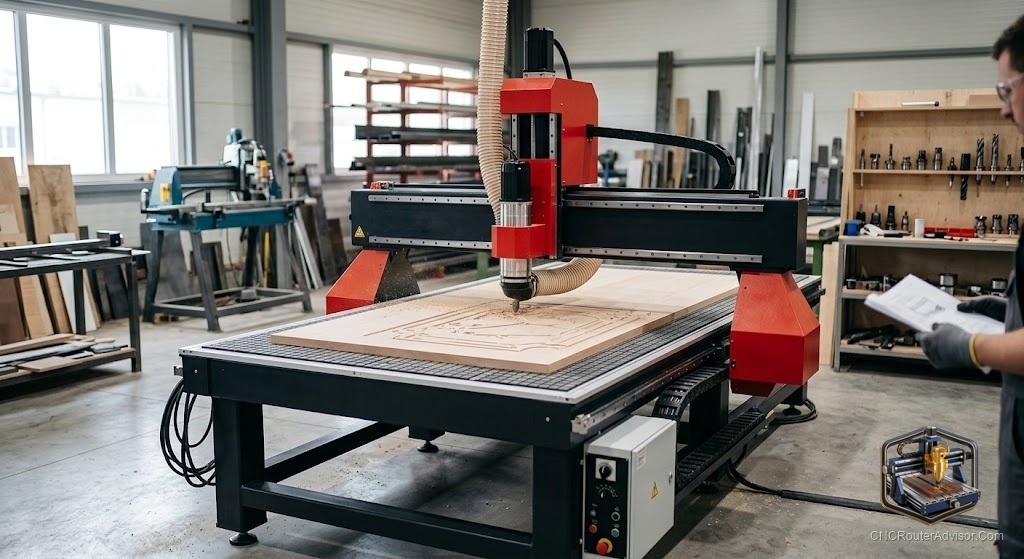
The first time you lay a full sheet of 3/4-inch birch plywood flat on a 4-by-8 table and watch the machine cut every cabinet part in a single setup, you realize how much time you were wasting clamping, repositioning, and referencing edges on a smaller machine. That is the promise of the 1325-class CNC router, and it is a real one if you buy the right machine.
A 1325 CNC router is a gantry-style machine with a nominal work envelope of 1,300 by 2,500 millimeters, which corresponds to roughly 4 feet by 8 feet. The designation comes directly from those metric dimensions. This format processes a standard 4-by-8-foot sheet of plywood, MDF, melamine, or similar sheet goods in a single setup without repositioning, which is why it became the default work size for cabinet shops, sign shops, and small furniture manufacturers worldwide.
If you are researching the 8-by-4-foot 1325 format and want a direct answer: it is the right machine if you process full sheet goods regularly. For occasional or smaller-scale work, a desktop or mid-size machine will give you the same cut quality without the footprint and setup complexity.
What “1325” Actually Means
The number is a shorthand for the machine’s X and Y axis travel in centimeters: 13 (130 cm, approximately 51 inches) by 25 (250 cm, approximately 98 inches). Manufacturers sometimes list the work area as 2,500 by 1,300 mm, 4x8 feet, or 4896 (48 by 96 inches). These all refer to the same format.
Z-axis travel varies by configuration. A standard 1325 typically offers 150 to 200 mm (6 to 8 inches) of Z travel. Machines configured for rotary axis work or thick 3D carving may offer more.
IEHK and the 1325 Market
IEHK is a CNC machine manufacturer that sells a 1325-class router under the IEP designation. Based on publicly available information from the IEHK website, the IEP 1325 offers the following confirmed specifications:
- X and Y axis travel: 2,500 by 1,300 mm (8 feet by 4 feet)
- Spindle motor: 3.2 kW, with water or air cooling options
- Control system: Mach3
- Stated positioning accuracy: plus or minus 0.05 mm
- Z axis travel: 200 mm (approximately 8 inches)
IEHK also offers an ATC (automatic tool changer) variant of the 1325 format, the ATC 1325, with a 9 kW air-cooled spindle, plus or minus 0.03 mm stated repeatability, and an 8-tool automatic changer.
User reviews of IEHK machines in public forums are mixed. At least one Reddit thread from real buyers reports quality control and support issues with multiple machines purchased. As with most machines in this price category, due diligence before purchase matters: ask for references from existing customers, verify what post-sale support looks like in your region, and understand the return and warranty terms.
Work Area vs. Machine Footprint
A 1325 machine does not fit in a small garage. The actual machine footprint is larger than the work envelope: you need to account for the gantry overhang on all four sides, plus clearance for the operator to load and unload sheets, access the control panel, and work around the dust collection hose.
A working rule: budget a floor space of roughly 10 feet by 14 feet minimum for the machine itself. Add clearance on at least two sides for sheet handling. If you are pulling full 4-by-8-foot sheets off a wall rack and loading them onto the table, you need a clear lane of at least 9 feet adjacent to the long axis of the machine.
What a 1325 Machine Can Cut
The 4-by-8-foot format handles the following materials well at the appropriate feeds and spindle speeds.
| Material | Common Application | Notes |
|---|---|---|
| Plywood (birch, pine, hardwood ply) | Cabinet parts, furniture panels | Compression bit for clean face edges |
| MDF | Sign blanks, paint-grade cabinets, templates | Abrasive: use carbide, run dust collection |
| Hardwood (oak, maple, walnut, poplar) | Furniture components, carved panels | Depth per pass 0.5x bit diameter or less |
| Softwood (pine, cedar) | Dimensional carving, sign making | Tolerates higher feed rates than hardwood |
| Acrylic | Signage, display components | Single-flute bit, high RPM, keep chipload healthy |
| HDPE | Jigs, fixtures, food-safe parts | Single-flute bit, avoid heat buildup |
| Foam | Mold patterns, packaging inserts | Very high feed rates, dust collection critical |
Carbon fiber and fiberglass are technically cuttable on a 1325 machine but require a dedicated enclosure or serious dust extraction. The fine particulate from both materials is a significant health hazard.
Spindle vs. Router: What the 3.2 kW Means in Practice
The IEP 1325’s 3.2 kW spindle is meaningful for production woodworking. A 3.2 kW spindle delivers consistent torque across its RPM range, runs cooler than a trim router, and accepts ER collets that can hold both 1/4-inch and 1/2-inch shank bits. A 1/2-inch shank bit has dramatically less deflection than its 1/4-inch equivalent under the same cutting load: for full-sheet production work this matters in edge straightness and tool life.
A water-cooled spindle runs quieter and maintains tighter temperature control during long production runs. An air-cooled spindle is simpler to maintain (no coolant reservoir to monitor) but runs louder and warmer. For an 8-hour production day, water cooling has the edge on thermal consistency.
Control Systems: Mach3 and the Tradeoffs
Mach3 is a mature, widely used PC-based CNC control software. It requires a dedicated Windows computer connected to the machine’s motion controller. It has an enormous community and large library of post-processors for CAM software. The downside is that Mach3 is older software: its user interface is not modern, and setup can be involved for new CNC users. Many shops run Mach3 for years without issues once it is configured correctly. Some prefer newer control options like Syntec or Mach4, which offer more intuitive interfaces.
Key Buying Factors for Any 1325-Class Machine
Whether you are evaluating an IEHK machine or any other 1325-format router, these are the factors that determine whether the machine performs as expected five years in.
Frame construction. A welded steel tube frame with proper stress-relief treatment holds alignment better than a frame that has not been treated. Ask what the frame material and construction process is.
Linear rails and ball screws. Hardened linear rails on all three axes and precision-ground ball screws are the foundation of repeatable positioning. Rack-and-pinion drives on X and Y are common on entry-level machines and acceptable for sign and furniture work; they are less accurate than ball screws for tight tolerance work.
Vacuum table or T-slot. For production sheet work, a vacuum table is faster and allows uninterrupted access to the full cutting surface. A T-slot table is more versatile for small or irregular workpieces. Some machines ship with a combination table that offers both.
Dust collection port. Verify the port size and that the machine accommodates a dust shoe. MDF and plywood cutting without dust collection is a maintenance and health problem.
Stated accuracy vs. real-world repeatability. Positioning accuracy figures from manufacturers are measured under ideal conditions. Ask for references from real users in your type of application before trusting stated specs.
Post-sale support in your region. Shipping a failed spindle or motion controller back to an overseas manufacturer takes time. Know before you buy what the support path looks like and whether replacement parts are stocked domestically.
The Real Conclusion
The 1325 format is the right-sized machine for any shop that processes full sheet goods more than occasionally. The IEHK IEP 1325 sits at the accessible end of the 1325 market with a legitimate 3.2 kW spindle, Mach3 control, and a confirmed 8-by-4-foot work envelope. As with all machines in this category, buyer experience varies and post-sale support deserves as much scrutiny as the spec sheet.
Four concrete takeaways: verify floor space requirements before ordering, ask about frame construction and linear rail spec, confirm that domestic replacement parts and support exist, and budget for a proper dust collection setup from day one.
FAQ
What does 1325 mean on a CNC router? It is shorthand for the machine’s work area dimensions in centimeters: 13 (130 cm in one axis) by 25 (250 cm in the other). This corresponds to approximately 4 feet by 8 feet, matching a standard full sheet of plywood or MDF.
What materials can a 1325 CNC router cut? The 1325 format handles plywood, MDF, hardwood, softwood, acrylic, HDPE, and foam well. With appropriate tooling it can also cut softer metals like aluminum. Carbon fiber and fiberglass require serious dust extraction and are not suitable for open-shop cutting without respiratory protection.
What spindle power do I need for full-sheet woodworking? For production cutting of plywood and MDF, 3 kW or higher is the practical floor. A 2.2 kW spindle can cut these materials but at slower feed rates. For hardwood panel processing in volume, 4.5 kW or more gives you the headroom to run at productive speeds.
Is Mach3 control good for a 1325 woodworking CNC router? Mach3 is reliable and well-supported by a large community. It requires a dedicated Windows PC and some initial configuration. Once set up, most production shops run it for years without issues. Newer control systems like Syntec offer more intuitive interfaces if that matters to you.
What is the difference between the IEP 1325 and the ATC 1325 from IEHK? The IEP 1325 is a single-spindle machine with a 3.2 kW spindle and manual tool changes. The ATC 1325 adds an 8-position automatic tool changer and a 9 kW spindle, suited for production runs where multiple bit types are used per part. The ATC variant is a larger investment but eliminates manual tool change time across production runs.
How much floor space does a 1325 CNC router need? Budget approximately 10 feet by 14 feet for the machine footprint alone. Add clearance for loading and unloading full sheets on at least one long side. A total shop footprint of 12 by 18 feet is a more realistic minimum for comfortable operation.
Do I need a vacuum table for a 1325 woodworking CNC? For cutting full sheets of plywood and MDF, a vacuum table is strongly recommended. It holds panels flat across their entire surface, eliminates manual clamping time, and allows your toolpaths to run without routing around hold-downs. Machines that ship with T-slot tables can often be upgraded with a vacuum surface.
What is chip evacuation and why does it matter on a 1325 machine? Chip evacuation refers to how efficiently the cutting zone is cleared of sawdust and chips during cutting. Chips that accumulate in a slot re-cut into the material, generate heat, and degrade finish quality. A dust shoe attached to the gantry paired with a dust collector is the standard setup for 1325 machines in production environments.