
Heavy-Duty Wood Crates and CNC Routing: What to Know Before You Buy
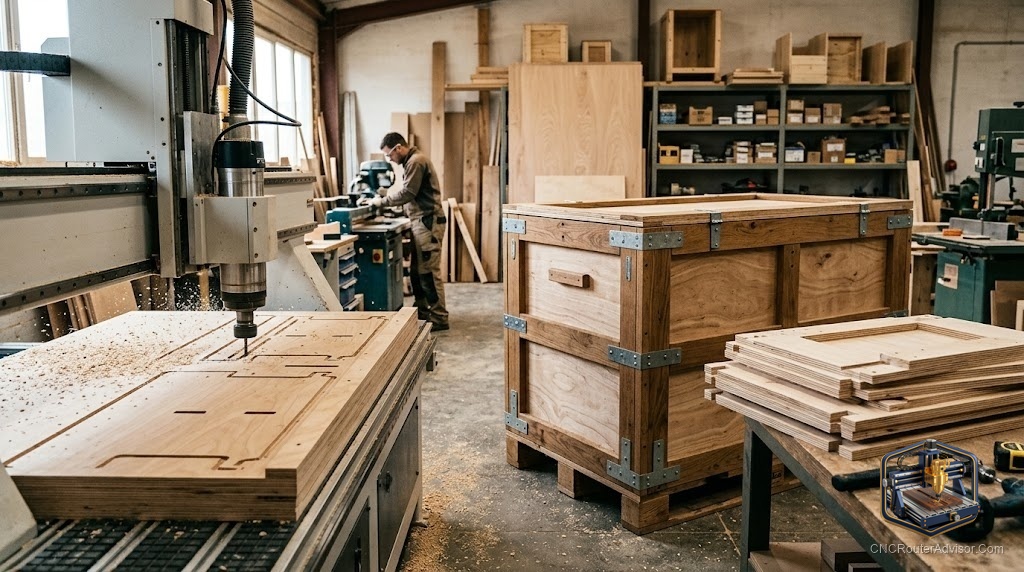
Heavy-duty wood crates occupy a niche where tolerance and repeatability matter in a way that purely decorative woodwork does not. A crate that ships fragile industrial equipment needs consistent corner joinery, predictable wall thickness, and dimensions that match the internal padding system without adjustment on every build. That requirement is why CNC routing found its way into crate and packaging production, and why buyers searching for CNC-routed crates or the equipment to make them have a specific set of questions that generic woodworking guides do not answer.
This guide covers both sides of that search: what to look for if you are buying finished CNC-routed heavy-duty crates, and what the equipment requirements are if you are considering routing crates in-house.
A heavy-duty wood crate is a structural shipping container made from plywood, OSB, or solid lumber, engineered to protect industrial, military, or commercial cargo during transport and storage. CNC routing enters the picture when the crate requires precise panel dimensioning, routed dovetail or box joints for corner strength, cut-outs for hardware and latches, or custom interior panel routing for foam padding systems. For production runs of identical or similar crates, CNC routing delivers the consistency that manual cutting cannot match at volume.
If you are buying crates: look for manufacturers that use CNC-cut panels for dimensional consistency, specify whether your application requires ISPM 15 heat-treated lumber (required for international shipping), and get a spec sheet on the panel material and joinery method. If you are making crates: a router with at least a 4-by-8 work area and a spindle suited to Baltic birch plywood is the production standard.
What CNC routing adds to crate production
The repetitive nature of crate production is exactly where CNC routing pays back. Cutting twenty identical panels for ten matching crates with consistent pocket depths, corner notches, and hardware cutouts is tedious and error-prone with a hand-operated table saw and router. A CNC table nests those cuts on a full sheet of plywood, runs the operation in sequence, and produces twenty panels that fit the same way without adjustment.
For joinery specifically, CNC routing enables corner joints that increase structural strength over butt joints. Box joints, finger joints, and interlocking panel edges that would require custom jigs and setup time by hand are standard toolpath operations on a router table. The result is crates with corner joints that resist racking under load, which is a functional requirement for crates carrying precision instruments or fragile industrial components.
Custom interior panels are another application: a routed pocket in a foam-lined plywood panel that exactly fits a specific component removes the tolerance variability in hand-cut foam and ensures repeatable packaging across production runs.
Buying CNC-routed heavy-duty crates: what to evaluate
When sourcing crates from a manufacturer, the following questions distinguish precision packaging suppliers from general lumber crate shops:
Panel material: Structural plywood grades (Baltic birch or equivalent) provide consistent thickness and void-free inner plies that hold fasteners and machine cleanly. OSB is sometimes used for lower-grade applications but does not hold fastener torque as well at the edges. Ask specifically about panel material and grade.
ISPM 15 compliance: If crates will cross international borders, the solid wood used in construction must be heat-treated or fumigated to comply with ISPM 15 phytosanitary requirements. CNC-cut plywood is generally exempt because the manufacturing process eliminates pests, but crates with solid lumber framing require compliant treatment and marking.
Joinery method: Butt joints with screws or nails are structurally adequate for lighter cargo. Box joints, finger joints, or interlocking panel designs add corner rigidity and racking resistance for heavier or more sensitive cargo. Ask whether joinery is CNC-machined or hand-assembled.
Repeatability documentation: A professional packaging supplier can provide dimensional drawings and tolerance specifications for crate production. This matters when the crate interior must match a specific pad or insert without field modification.
Equipment considerations for in-house crate routing
For a facility that wants to produce crates in-house:
Machine work area: Full 4-by-8 table coverage is the practical standard for crate production, since plywood sheets are 4-by-8 and nesting full sheets for panel efficiency requires that work area without repositioning.
Spindle power: Baltic birch plywood at 3/4 inch thickness is a demanding cut. A spindle of at least 1.5 kW (about 2 HP) is appropriate for production routing of structural plywood. Underpowered spindles slow feed rates and increase heat in the cut, which shortens bit life.
Hold-down: Vacuum tables are the production standard for sheet goods because they allow through-cuts without mechanical clamps blocking the nesting area. A T-slot table with clamps works for smaller runs but slows nesting efficiency.
Bit selection: Compression spiral bits are the standard for plywood routing: the upcut geometry at the tip prevents tear-out on the bottom face, and the downcut geometry at the top prevents tear-out on the top face. For structural plywood crate panels, compression spirals in 1/4 or 3/8 inch diameter produce clean edges on both faces without sanding.
The verdict
CNC routing brings consistency and structural joinery capability to heavy-duty crate production that manual cutting methods cannot match at volume. For buyers, asking about panel material, ISPM 15 compliance, and joinery method separates precision packaging suppliers from commodity crate shops. For producers, a 4-by-8 machine with a real spindle, vacuum hold-down, and compression spiral bits is the production-appropriate setup.
Three things to take with you:
- For crates shipping internationally, confirm ISPM 15 compliance on any solid lumber framing; CNC-cut plywood is generally exempt but solid lumber framing is not.
- CNC-machined box or finger joints add corner racking resistance that butt-joined crates do not provide under heavy or sensitive cargo.
- For in-house production, a 4-by-8 machine with at least 1.5 kW spindle and vacuum hold-down is the right minimum spec for structural plywood.
FAQ
What is ISPM 15 and does it apply to CNC-routed wood crates? ISPM 15 is an international phytosanitary standard requiring heat treatment or fumigation of solid wood packaging materials (including crates) for international shipping, to prevent the spread of pests. CNC-cut plywood is generally exempt because the manufacturing process eliminates pest risk; solid lumber framing is subject to the requirement.
What plywood is best for CNC-routed heavy-duty crates? Baltic birch plywood for structural applications: consistent thickness, void-free inner plies, and fastener holding strength. Standard construction plywood grades can be used for lighter-duty crates but have more inner voids and variable thickness.
What joinery makes CNC-routed crates stronger than conventional crates? Box joints, finger joints, and interlocking panel profiles routed into the panel edges add corner racking resistance. These joints are impractical to produce consistently at volume without CNC routing.
What work area do I need to make crates on a CNC router? A 4-by-8 table for full-sheet plywood nesting without repositioning. Smaller machines can cut crate panels by repositioning stock, but full-sheet nesting on a 4-by-8 machine is the production-appropriate approach.
What router bits should I use for plywood crate panels? Compression spiral bits in 1/4 or 3/8 inch diameter. The combined upcut and downcut geometry prevents face tear-out on both sides of the plywood panel.
Can I find suppliers of CNC-routed heavy-duty crates online? Yes. Industrial packaging suppliers, custom crate manufacturers, and shipping and logistics packaging companies offer CNC-produced crates. Search for custom industrial packaging or shipping crate fabrication alongside your material and ISPM compliance requirements.
References
- IPPC, ISPM 15 standard overview: https://www.ippc.int/en/publications/640/
- Forest Products Laboratory, “Wood as a Structural Material” (plywood and structural grades): https://www.fpl.fs.usda.gov