
DIY CNC Wood Router: Build Guide and Real Cost Comparison
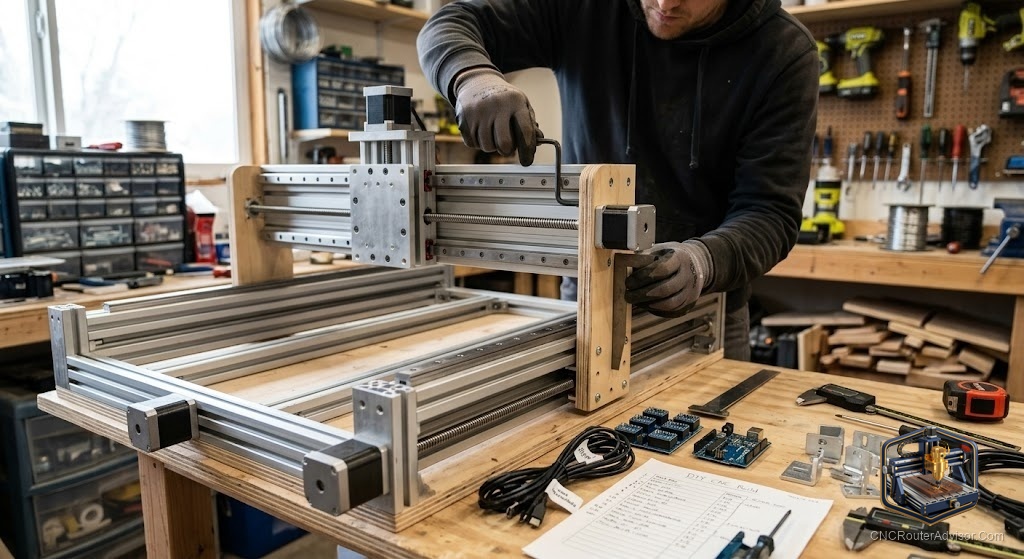
Building a CNC wood router teaches you more about the machine in one weekend than three months of reading. The 0.003-inch gantry misalignment that produces 0.030-inch positional error at the bit is not abstract when you are the person who just caused it. That knowledge pays back in every maintenance task afterward.
A DIY CNC wood router is a machine assembled from individual components: frame, motors, drive screws, controller, and spindle - built and configured for wood cutting.
Key Design Decisions
Frame: Aluminum extrusion (2040/4080 profile) is the most practical first-build choice. Welded steel is more rigid but requires welding capability. Avoid acrylic.
Drive: Lead screws for first build: adequate for hobby wood. Ball screws for second builds or precision joinery: less backlash.
Motion rails: V-wheels are the entry option. MGN12 linear rails are the step-up: more precise, less maintenance.
Essential Components
- 2040 aluminum extrusion frame
- NEMA 23 stepper motors (3-5)
- Lead or ball screws
- GRBL controller (Arduino + CNC shield or xPro V5)
- 65mm spindle clamp
- Makita RT0701C - community standard spindle
- 24V power supply
- X, Y, Z limit switches
Honest Cost Assessment
DIY hardware alone: often less than equivalent kit machine. Real cost includes labor: 20-40 hours for a first build. The Sienci LongMill MK2.5 (sienci.com) delivers better results faster at comparable total investment when labor is included. DIY makes sense for specific working areas not available off-the-shelf, or when the full learning experience is the goal.
FAQ
Is it cheaper to build a DIY CNC wood router? Hardware alone: sometimes. Including labor time: comparable to well-priced kit machines.
What controller should I use? Sienci Labs xPro V5 is the most polished dedicated GRBL controller. Arduino Uno + CNC shield works at lower cost.
How accurate can a DIY wood router be? With linear rails and ball screws, carefully assembled: plus or minus 0.005-0.010 inches.
References
- V1 Engineering. Open-source designs. v1e.com
- Sienci Labs. LongMill comparison. sienci.com