
Heavy Duty Wood Crates and CNC Routing: How CNC Makes Industrial Packaging Better
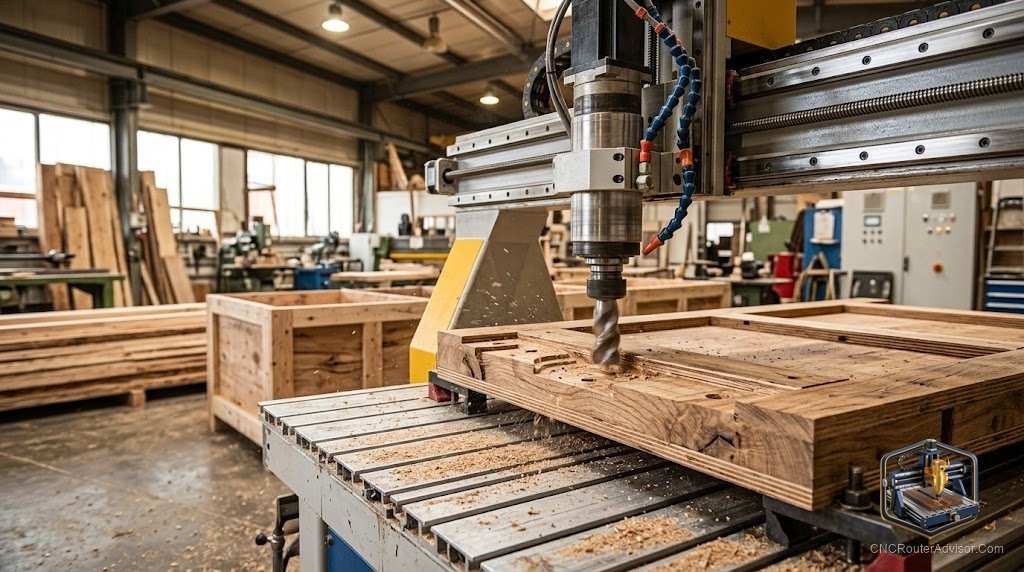
Heavy duty wood crates have to do one job reliably: protect equipment, machinery, or parts through rough handling, freight, and outdoor exposure. The way they are built determines whether they hold up or fail in transit. CNC routing is changing how quality crates are made, bringing precision joinery, repeatable notch cuts, and consistent panel sizing to a product that used to depend entirely on manual carpentry skill.
CNC routing for heavy duty wood crates means using a CNC router to cut, notch, and shape the plywood, OSB, or dimensional lumber panels and structural members that make up industrial-grade shipping crates. Rather than cutting each piece by hand, the CNC processes a file and produces identical, dimensionally accurate parts that assemble faster and fit together more tightly than hand-cut stock.
The short answer on why it matters: precision fit means stronger crates. When lid panels, base frames, and side walls are cut to exact dimensions with clean notches and dado joints, the assembled structure is more rigid and the hardware goes in without gaps or shimming. For runs of ten, fifty, or a hundred identical crates, CNC also means every single one is the same.
Why heavy duty crates demand precision
A crate carrying a hydraulic pump or a medical device is not a rough shipping box. It is a structural container that may need to be forklift-rated, stack-loaded, export-fumigated under ISPM-15 rules for wooden packaging, and capable of surviving a transatlantic freight haul. Precision in the cut parts matters for several reasons:
- Tight joints add shear resistance. Notched and dadoed corners lock panels against racking under impact and stacking loads.
- Consistent sizing means repeatable assembly. A shop running dozens of crates per week cannot afford each one to be a custom fit.
- Accurate bolt and fastener holes position correctly. CNC drilling ensures that mounting hardware, skid attachment points, and lid locking hardware land in the same place on every crate.
- Proper fit reduces waste. Material that is cut accurately is not shimmed, trimmed, or discarded.
What CNC routing specifically contributes to crate production
Not all crate operations benefit equally from CNC. The biggest gains come from repetitive panel work: routing skid notches into base frames, cutting panel dados for corner posts, drilling patterns for through-bolts and fastener rows, and producing lid frames with accurate groove rabbets for fitted lid panels. A large-format CNC router (4 by 8 or 5 by 10 feet) processes full sheets of structural plywood in one setup, cutting multiple panels per sheet with minimal handling.
For custom and one-off export crates, CNC routing compresses design-to-build time: the shop redesigns the file, not the jigs. For production runs, it makes each crate match the last. And for complex crates with custom insert cutouts, pockets, and foam-retention profiles, a CNC is the only practical way to produce the interior fitting accurately.
Materials for CNC-routed crates
Heavy duty crates use structural sheet goods and lumber. Common panel materials for CNC routing include:
- Structural plywood (11/32 through 3/4 inch, exterior rated): the workhorse of crate side and lid panels, machines cleanly.
- OSB (oriented strand board): used in some crate applications, rougher edge quality than plywood.
- LVL (laminated veneer lumber) and dimensional lumber: CNC-routed for base frame notches and post dados.
For export, ISPM-15-regulated crates must use heat-treated (HT) lumber marked with the IPPC stamp; that is a supply chain and compliance issue, not a routing one, but it affects material selection.
The verdict
CNC routing turns heavy duty wood crate production from a manual carpentry skill into a repeatable manufacturing process. Precise panel sizing, accurate notches and dadoes, and consistent fastener hole placement make CNC-built crates stronger, faster to assemble, and identical run to run. If your shop is building crates regularly, a large-format CNC router pays for itself in reduced layout time, lower waste, and assembly consistency. If you are buying crates, a supplier who cuts panels with a CNC is likelier to deliver a dimensionally accurate product.
Three takeaways: CNC routing brings joint precision and repeatability that hand-cutting cannot match for production crate runs; accurate notches and dados make structurally stronger crates; and a large-format 4 by 8 or 5 by 10 table processes full crate panels efficiently.
FAQ
What wood is used for heavy duty CNC-routed crates? Structural plywood (exterior-rated, various thicknesses) is the most common panel material. OSB is used in some applications. Base frames and corner posts often use dimensional lumber or LVL that the CNC notches and drills.
What CNC operations are most used in crate production? Panel profiling and cutting to size, notching for corner and base joints, dado routing for panel assembly, and drilling repeatable fastener and hardware hole patterns.
Does a CNC router handle full sheets for crate panels? Yes, when the table is large enough. A 4 by 8 or 5 by 10 foot router bed processes full plywood sheets, cutting multiple crate panels per sheet in a single setup.
Why does joint precision matter in a wood crate? Tight-fitting notches and dados create shear-resistant corners that hold up under stacking loads and rough freight handling. Loose or misfit joints rely on fasteners alone and are weaker.
Do CNC-built crates meet ISPM-15 requirements for export? ISPM-15 compliance is a material and treatment issue, not a cutting issue. Crates must use heat-treated (HT) lumber with a valid IPPC mark. CNC routing does not affect this status, but precise cutting ensures proper fit of compliant materials.
Is CNC routing crate production worth it for small runs? For truly one-off crates, manual carpentry may be faster. CNC pays off once a design is run repeatedly: even a run of five to ten identical crates shows measurable time and consistency gains.
Can CNC routers cut the custom foam or insert profiles inside a crate? Yes, with the right tooling and material. Foam inserts and retention profiles are commonly cut on CNC machines using foam-specific toolpaths, and rigid insert panels (plywood, MDF) can be profiled on the same machine.
References
- CNC Router Info, How to Choose a CNC Router (large-format capabilities): https://cncrouterinfo.com/guides/how-to-choose-a-cnc-router/
- ISPM-15 Phytosanitary Measures for Wooden Packaging (FAO overview): https://www.fao.org/fileadmin/templates/agphome/documents/Pests_Pesticides/IPPC/DP16Add1ISPM15.pdf
- Blue Elephant CNC, CNC Router Applications (panel processing): https://www.elephant-cnc.com/
- ToolsToday, CNC Software Library and toolpath resources: https://toolstoday.com/t-cnc-software-library