
CNC Router Woodworking 5-Axis Guide: Capabilities, Applications, and Buying Factors
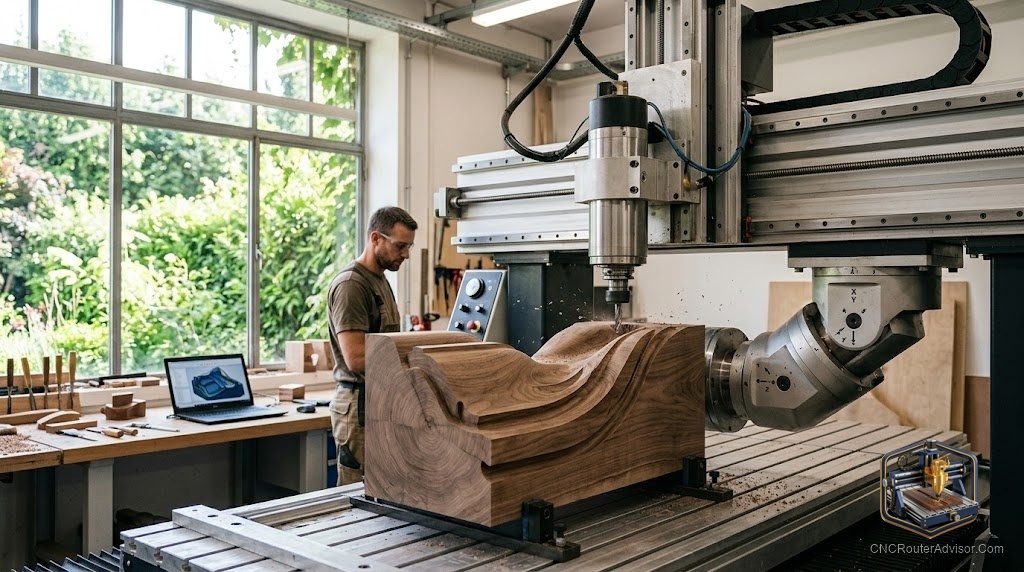
Watch a 5-axis router carve a curved chair leg or a sculpted relief in a single setup and it is genuinely impressive. The head tilts and swivels while the gantry moves, so the cutter reaches faces that a flat 3-axis machine can only dream about. Then you look at what one costs to buy, house, and run, and the fantasy meets reality fast. For the overwhelming majority of woodworkers, a 5-axis router is a beautiful answer to a question they are not actually asking.
This guide explains what 5-axis actually buys you in woodworking, the real applications where it earns its keep, and the honest buying factors, including the big one: whether you need it at all.
What 5-axis woodworking really means
A standard router moves in three linear directions: the X axis, Y axis, and Z axis. It cuts from the top down, which is perfect for flat work like signs, panels, and pockets. A 5-axis machine adds two rotary movements, letting the spindle tilt and rotate. That means the cutter can approach the material from many angles in one setup, reaching undercuts, compound curves, and steep vertical faces without flipping or refixturing the part.
In wood, that unlocks true sculptural work: carved furniture components, curved moldings, architectural elements, artistic reliefs, and complex three dimensional forms. The materials are familiar, plywood, MDF, hardwood, softwood like pine, cedar, poplar, oak, maple, and walnut, plus acrylic and foam for patterns. What changes is the geometry you can reach, not the material list.
The short answer
Most woodworkers do not need 5-axis. If your work is flat or two and a half dimensional, meaning signs, inlays, panels, and pocketed parts, a good 3-axis router does everything you need and costs a fraction as much to buy and learn. Move to 5-axis only when your product genuinely requires reaching multiple faces or true sculptural forms in a single setup, and when the volume justifies an industrial machine and the software skills to drive it. Buying 5-axis to future proof a hobby is a way to own an expensive machine you rarely use.
Where 5-axis actually earns its place
The machine pays off in specific shops. Furniture makers producing carved or curved components at volume benefit because one setup replaces several 3-axis operations and hand finishing. Architectural millwork shops use it for complex moldings and decorative elements. Pattern and mold makers value the smooth multi angle finish it leaves on curved forms, which reduces sanding. Musical instrument makers and sculptors use it for organic shapes that would be brutal to fixture any other way.
What these have in common is geometry that a 3-axis machine cannot reach cleanly, combined with enough repeat work to justify the investment and the steeper learning curve.
The buying factors that matter
Rigidity and build come first. Multi angle cutting puts loads on the frame from directions a flat machine never sees, so a serious 5-axis router needs a heavy, rigid structure and a robust motion system.
Software is the hidden cost. Programming 5-axis tool paths needs capable CAM software and real skill. Chip evacuation and dust collection get harder because the head moves through many orientations, so a single flute end mill choice and good extraction matter more, not less.
Support and training round it out. This is industrial equipment, and buying from a vendor who trains you and stands behind the machine matters far more than saving on the purchase. Because these are large, direct sale industrial systems rather than boxed consumer products, evaluate them through the manufacturer and dealers, not a marketplace add to cart button.
Who should skip 5-axis
Skip it if you make flat work, signs, or 2.5D carving, which describes most hobby and small shop woodworking. A 3-axis router will serve you better and leave money for bits, dust collection, and material. Skip it also if you cannot commit to learning multi axis CAM, because the machine is only as capable as the person programming it, and an underused 5-axis machine is the most expensive dust collector in the building. Start with 3-axis, master it, and let a real production need pull you toward 5-axis later.
Comparison: 3-axis vs 5-axis for woodworking
| Factor | 3-axis router | 5-axis router |
| Motion | X, Y, Z linear | Adds two rotary axes |
| Best work | Flat and 2.5D: signs, panels, pockets | Sculptural, curved, multi face parts |
| Setups per part | Often several, with flips | Often one |
| Software skill | Approachable | Advanced CAM required |
| Right buyer | Hobby to small shop | Industrial and specialist shops |
The verdict
A 5-axis router is a remarkable machine for a narrow group of woodworkers: those making carved furniture, complex millwork, patterns, or sculptural forms at enough volume to justify industrial equipment and advanced software skills. For everyone else, and that is most people, it is overkill. A capable 3-axis router handles the flat and 2.5D work that fills real shops, costs far less to own and learn, and gets you making parts sooner. Let a genuine production need, not ambition alone, be the thing that moves you to 5-axis.
Frequently asked questions
What can a 5-axis router do that a 3-axis cannot? It tilts and rotates the cutter to reach undercuts, compound curves, and steep faces in a single setup. A 3-axis machine cuts from the top down only, so complex sculptural forms need flipping, refixturing, or hand finishing.
Do hobby woodworkers need a 5-axis router? Almost never. Hobby work is mostly flat or 2.5D, which a 3-axis router handles fully. A 5-axis machine adds cost and a steep software learning curve most hobbyists will not use.
Is 5-axis harder to program? Yes. It requires advanced CAM software and real skill to generate safe, efficient multi angle tool paths. The programming effort is a major part of owning one.
What materials does a 5-axis wood router cut? The same woods and soft materials as any wood router: plywood, MDF, hardwoods, softwoods, acrylic, and foam. The advantage is geometry and reach, not a different material range.
Can I upgrade a 3-axis router to 5-axis? Generally no in any practical sense. True 5-axis needs a frame, motion system, and control built for it. It is a different class of machine, not an add on.
Where should I buy a 5-axis router? From an industrial manufacturer or dealer who provides training and support. These are large direct sale systems, so vendor support matters far more than finding the lowest sticker.
References
- CNC Router Info, How to Choose a CNC Router: https://cncrouterinfo.com/guides/how-to-choose-a-cnc-router/
- Bubble Relief, CNC Router Projects for Beginners: https://bubblerelief.com/cnc-router-projects-for-beginners/