
5 Axis CNC Router Woodworking: Capabilities and Who Needs It
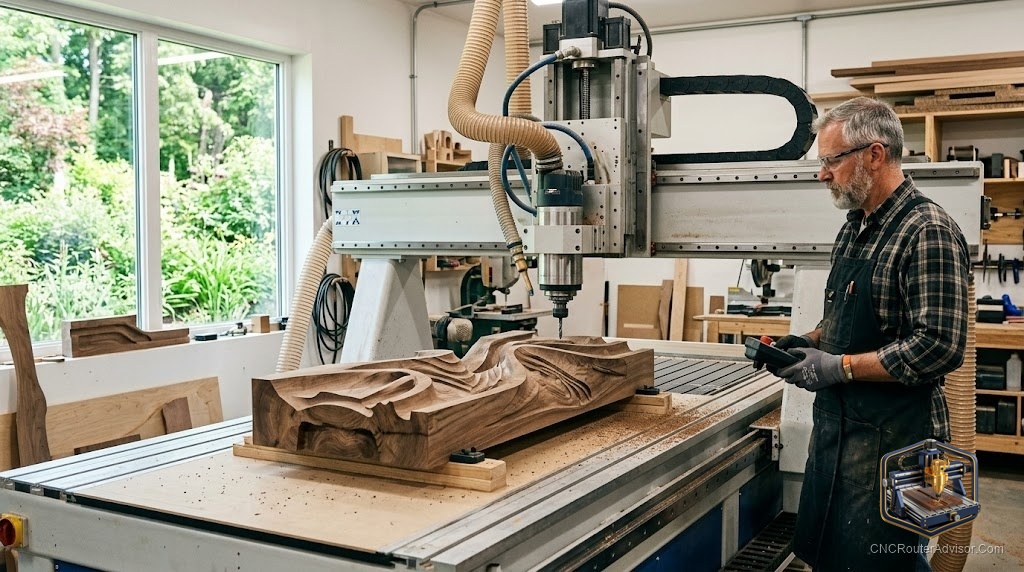
Five-axis machining is the top of the mountain in CNC woodworking, and like most summits, far more people admire it than actually need to stand on it. A 5-axis router can carve compound curves, undercuts, and complex sculptural forms in a single setup that would take a simpler machine many flips and fixtures, if it could make them at all. It is genuinely remarkable technology. It is also expensive, complex, and unnecessary for the vast majority of woodworkers, and being honest about that will save you a great deal of money.
This guide explains what a 5-axis router does in woodworking terms, the work it truly unlocks, and how to tell whether you are one of the few who need it.
What five axes mean in woodworking
Every CNC router moves the tool through the three linear axes: X (left to right), Y (front to back), and Z (up and down). A 5-axis router adds two axes of rotation, allowing the tool or the workpiece to tilt and turn so the cutter can approach the material from almost any angle. In woodworking, that means the bit can reach the sides of a form, cut undercuts, and follow compound curves without stopping to reposition the part.
The practical result is that shapes requiring many separate setups on a 3-axis machine, with all the alignment risk that flipping a part introduces, can be cut in one continuous operation. For sculptural furniture, curved architectural elements, musical instruments, and artistic work, that capability is not a convenience, it is what makes the piece possible at all. But it also demands rigidity, sophisticated software, and skill in equal measure.
The short answer
Choose a 5-axis CNC router for woodworking only if you regularly produce complex three-dimensional forms, compound curves, or undercuts that simpler machines cannot make efficiently, and you have the budget and skill to run it. For flat parts, signs, relief carving, and even most furniture, a 3-axis machine is entirely sufficient, and a 4-axis machine covers cylindrical work.
Almost every woodworker should master a rigid 3-axis machine first, since it handles the overwhelming majority of projects and builds the foundation five-axis work depends on. A rigid, capable machine such as the Genmitsu 4040-PRO MAX is a sound place to develop that foundation before considering multi-axis complexity: Check on Amazon
What five axes unlock in wood
| Capability | Why it needs five axes |
| Compound curves | Tool tilts to follow the surface continuously |
| Undercuts | Tool reaches beneath overhanging features |
| Sculptural forms | Complex shapes cut in one setup |
| Curved furniture parts | Chair backs and legs without endless flipping |
| Instrument bodies | Contoured surfaces from many angles |
Where a 5-axis machine is worth it
The value shows up when your work is inherently three-dimensional and complex. A shop producing curved chair components, sculptural art, carved instrument bodies, or ornate architectural millwork gains real efficiency and capability from cutting these forms in a single setup. Fewer setups mean fewer alignment errors, tighter results, and less hand finishing. For a professional whose product depends on such shapes, the machine can pay for itself in what it makes possible and in the labor it removes. This is a production and artistry tool, and in the right hands it is extraordinary.
The demands it makes
Be clear-eyed about the costs. A 5-axis router is a major investment, it requires advanced CAM software capable of five-axis toolpaths, and it has a steep learning curve that few hobbyists will justify. Programming compound movements safely leans heavily on simulation, since a collision in five axes is easy to create and expensive to discover. The machine must also be rigid and accurate, because complex toolpaths magnify any weakness in the frame or motion system. For a hobbyist making signs and boxes, all of this is cost and complexity with no matching benefit.
The honest progression
Most woodworkers are best served by a clear progression. Learn on a rigid 3-axis machine, which covers flat parts, relief, and most furniture. Add a fourth axis only if cylindrical work like legs and columns becomes a regular need. Consider five axes only when compound curves and undercuts are central to what you make and a business case supports the investment. Skipping steps rarely works, because each level builds the skills and judgment the next one requires. There is no shame in a 3-axis machine handling everything you make, since for most people it does exactly that.
Who should skip five axes
Skip a 5-axis router if your work is flat or moderately three-dimensional, since a 3-axis machine makes signs, plaques, relief carving, and most furniture without the cost or complexity. Skip it if cylindrical parts are your main goal, because a 4-axis machine handles those for far less. And skip it if you are still learning, since five-axis programming assumes fundamentals you build on simpler machines. Reserve it for professionals and serious artists whose product genuinely depends on complex contoured forms.
The verdict
A 5-axis CNC router is a magnificent, specialized tool that earns its place only when compound curves, undercuts, and sculptural forms are central to your woodworking and you have the budget, software, and skill to wield it. For the overwhelming majority of woodworkers, a rigid 3-axis machine does everything needed, with a 4-axis machine covering cylindrical work. Progress through the axes as your work genuinely demands, and do not buy capability your projects will never use. The most impressive machine is the wrong choice if it sits idle.
Admire five-axis work, learn from it, and buy into it only when your own projects truly require it. Until then, master the machine you have.
Frequently asked questions
What can a 5-axis CNC router do that others cannot? It cuts compound curves, undercuts, and complex sculptural forms in a single setup by approaching the material from almost any angle, which simpler machines cannot do efficiently.
Do I need 5 axes for woodworking? Rarely. A 3-axis machine handles flat parts, relief, and most furniture, and a 4-axis machine covers cylindrical work. Five axes suit complex three-dimensional forms.
Is a 5-axis router hard to learn? Yes. It requires advanced CAM software and careful simulation to program safely, with a steep learning curve that few hobbyists will justify.
What woodworking projects justify five axes? Curved furniture parts, sculptural art, instrument bodies, and ornate architectural millwork, where cutting complex forms in one setup improves accuracy and saves labor.
Should a beginner buy a 5-axis machine? No. Beginners should master a rigid 3-axis machine first, since five-axis work builds on fundamentals learned on simpler machines.
Is a 4-axis machine a cheaper alternative? For cylindrical parts, yes. A 4-axis machine carves around rotating parts for far less than five axes, but it cannot match five-axis compound-curve work.
References
- CNCRouterInfo, how to choose a CNC router: https://cncrouterinfo.com/guides/how-to-choose-a-cnc-router/
- Bubble Relief, CNC router projects for beginners: https://bubblerelief.com/cnc-router-projects-for-beginners/