
Spindle CNC Router Guide: Types, Power, Speed, and How to Choose
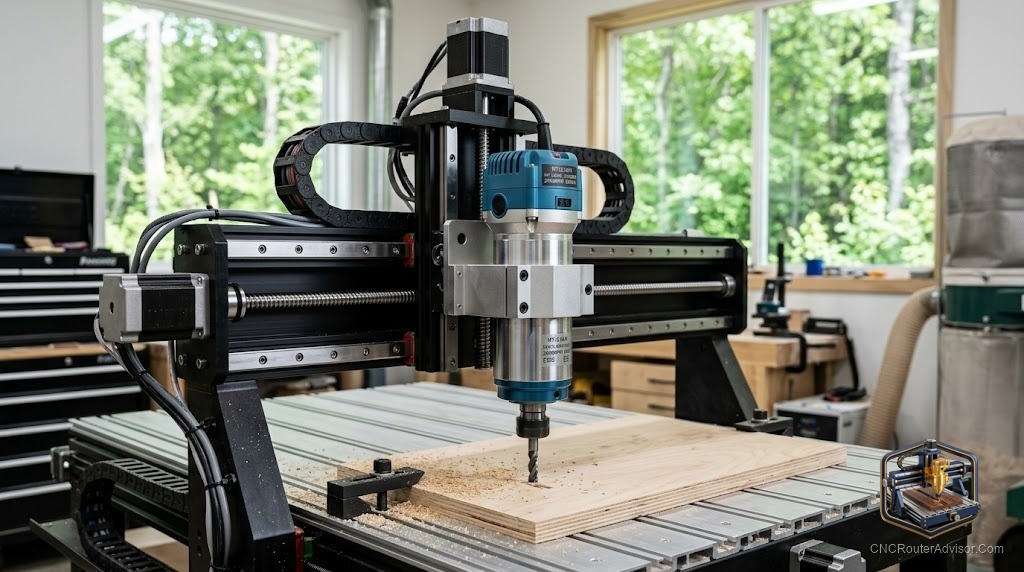
The spindle is the part of a CNC router that actually does the work, and almost every beginner underestimates how much it matters. The frame holds the geometry. The motion system positions the cut. But the spindle determines what materials you can cut, how long you can run before heat becomes a problem, how precise your cut is, and how loud your shop is every time the machine runs. Choosing the right spindle for your CNC router is one of the most consequential decisions in the build or upgrade process, and it is also one of the most confusing because the vocabulary is scattered across manufacturer pages, forum threads, and electrical specifications that assume you already know things you are still trying to learn.
A CNC router spindle is the motorized tool-holding assembly that spins the cutting bit. It holds the bit in a collet, rotates it at a controlled speed, and transfers that rotation into cutting force at the tip. Spindles range from repurposed handheld trim routers at the cheap end to purpose-built, VFD-controlled motors at the serious end, and the differences in noise, precision, longevity, and material capability are substantial.
The short version of choosing: match the spindle type (trim router vs. air-cooled spindle vs. water-cooled spindle) to how long and how hard you plan to run, match the power to the material and depth-of-cut you need, and match the collet to the bit shanks you use most. Get those three right and the rest is details.
Trim router: the cheap, capable starting point
Most hobby and desktop CNC routers start with a trim router, a repurposed handheld routing tool bolted into a spindle mount. The appeal is price and availability: a quality trim router like the Makita RT0701C or the DeWalt DWP611 is well under a hundred dollars, widely stocked, and well-documented for CNC use. Both are popular CNC choices because their speed ranges are well matched to hobby feeds-and-speeds for wood and plastic, and their 1/4 inch collets cover the shank size most hobby bits use.
The honest limitations of a trim router in a CNC role: they are louder than purpose-built spindles, they have fewer speed steps (not continuous variable speed without a separate speed controller), and their brushed motors wear over time under extended CNC duty. For a machine that runs a few hours a week, a trim router can last years. For a machine running production hours, a purpose-built spindle will outlast it and run more quietly.
Air-cooled spindles: the step-up choice
Air-cooled CNC router spindles are purpose-built for CNC routing, with brushless motors, continuous-variable speed through a VFD (variable frequency drive), ER collet systems for better tool holding, and run-out specifications far tighter than a trim router. They run quieter than trim routers at equivalent cutting speeds and handle extended duty cycles without overheating. A 1.5 kW or 2.2 kW air-cooled spindle is the standard step up from a trim router for a machine that runs regularly.
The VFD is the matching control unit: it converts the power supply’s fixed frequency to variable frequency, setting the spindle’s RPM precisely. A spindle without a matched VFD is a motor without a control, so budget for both together. The VFD also enables ramping speed up and down rather than slamming to full RPM, which is easier on the spindle bearings and the machine frame.
The ER collet system is worth noting. ER20 collets (the standard on 2.2 kW spindles) accept a wide range of shank diameters, from small engraving bits to full 1/2 inch shank tooling, with far tighter tool runout than a trim router’s collet. Less runout means more precise cuts and longer bit life.
The one honest flaw: air-cooled spindles blow chips back toward the work surface, which can require a more aggressive dust shoe. The fan that cools the motor faces outward and moves air, and that air goes somewhere.
Water-cooled spindles: the quiet, long-running option
Water-cooled spindles replace the cooling fan with a liquid cooling circuit, which makes them dramatically quieter in operation and even better suited to continuous-duty running. They are the choice for shops where noise is a constraint, for very long production runs, and for applications where the cooling fan’s airflow would cause problems (some delicate materials or enclosed setups).
The trade-off is the plumbing. A water-cooled spindle requires a water pump, reservoir, and coolant lines routed to and from the spindle, which adds complexity to the machine setup and one more potential failure point. For most small shops and hobbyists, the air-cooled spindle is simpler and sufficient. For a machine running all day in a noise-sensitive environment, water cooling pays for its complexity.
Collets: the part most buyers forget
The collet is the clamping sleeve inside the spindle that holds the bit shank. Size matters: an ER20 collet on a 2.2 kW spindle accepts 1/8 inch, 6 mm, 1/4 inch, 6.35 mm, and larger shanks with appropriate collet inserts. A trim router’s 1/4 inch collet only accepts 1/4 inch shanks without an adapter. Knowing your collet system before buying bits prevents buying a quality bit in the wrong shank size.
Tool runout is the other collet metric that matters: it describes how much the bit’s tip wobbles off-center as it spins. Less runout means a more precise cut and longer bit life. Purpose-built spindles with ER collets have tighter runout specs than most trim routers, which is part of why their cut quality is better.
Matching spindle power to material
Spindle power determines how hard you can cut without stalling the motor. For wood and most plastics, 1.5 kW to 2.2 kW is the standard prosumer range and handles a wide range of work. Aluminum at real feed rates benefits from 2.2 kW and above. Larger production machines run 3 kW to 6 kW spindles. A trim router at 700 W is adequate for light wood and engraving.
The spindle power you choose also needs to be matched to your machine’s frame rigidity. A powerful spindle on a flex-prone frame does not produce better cuts than a moderate spindle; it produces more chatter. Power and rigidity scale together.
Frequently asked questions
What is the difference between a trim router and a CNC spindle? A trim router is a repurposed handheld tool: louder, brushed motor, fewer speed options, good for light duty. A CNC spindle is purpose-built: brushless motor, VFD-controlled variable speed, tighter runout, longer duty cycle, quieter.
What is a VFD and do I need one? A VFD (variable frequency drive) controls the spindle’s speed continuously. Any purpose-built CNC spindle requires a matched VFD. Trim routers have their own speed adjustment and do not need a separate VFD.
What collet size should I use? For hobby and prosumer work, ER20 (on 2.2 kW spindles) accepts 1/4 inch and 6 mm shanks, which covers most tooling. Trim routers typically accept 1/4 inch shanks natively.
Is a water-cooled spindle worth it? For noise-sensitive environments or very long duty cycles, yes. For most small shops and hobbyists, an air-cooled spindle is simpler and equally capable.
How important is tool runout? Significantly. Less runout means more precise cuts and longer bit life. Purpose-built spindles with ER collets typically outperform trim routers here.
What spindle power do I need to cut aluminum? At least 1.5 kW with conservative settings; 2.2 kW gives more margin. The frame rigidity to support the spindle is equally important.
References
- Spark Robotic, CNC Spindle Troubleshooting and Selection — https://www.sparkrobotic.com/pages/trouble-shooting
- WorkshopCalc, “Best CNC Routers: Spindle Comparison” — https://workshopcalc.com/guides/best-cnc-routers
- CNCCookbook, “CNC Router Spindle Guide” — https://www.cnccookbook.com/cnc-router/