
CNC Router Spindles Explained: Types, Cooling, Power, and How to Choose
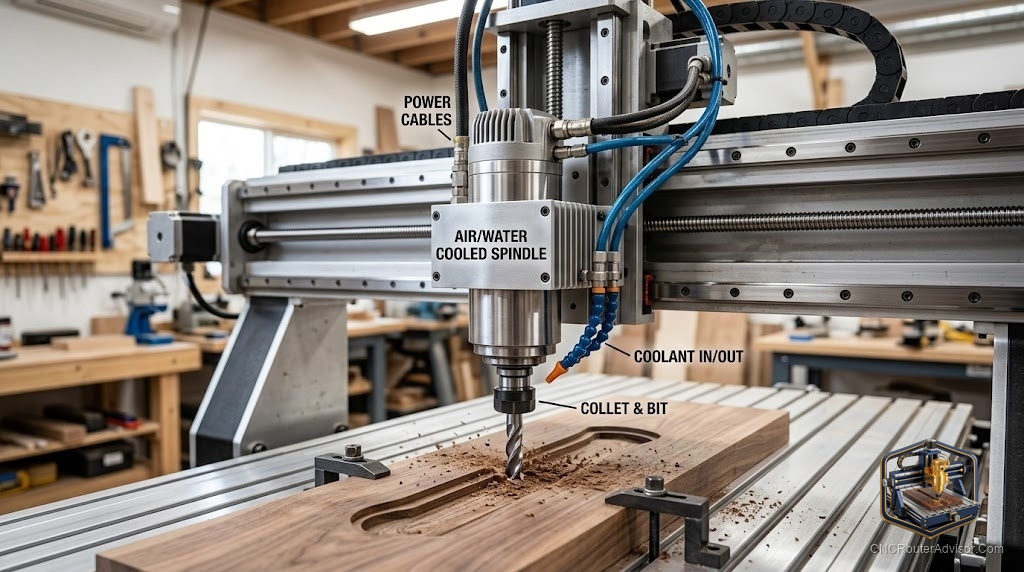
The spindle is the heart of a CNC router, the motor that holds and spins the cutting tool, and it shapes almost everything about a machine’s performance: the materials it can cut, how cleanly and quickly, how quietly, and how long it lasts. Yet spindles are one of the most misunderstood parts of a CNC setup, with confusion around trim routers versus true spindles, air-cooled versus water-cooled, and how much power you actually need. Understanding CNC router spindles, their types, cooling, power, and control, lets you choose or upgrade the right one for your work.
A CNC router spindle is the motorized unit that holds and rotates the cutting tool. Spindles range from trim routers used as budget spindles to dedicated VFD-controlled spindles (air-cooled or water-cooled) in power classes from under 1kW to several kW. The right spindle depends on your materials, machine rigidity, and needs for power, noise, precision, and duty cycle.
The short answer on spindles: for light hobby work a trim router (Makita RT0701C, DeWalt DWP611) is fine; for serious, quieter, more precise work, step up to a VFD-controlled spindle, choosing water-cooled for the quietest, coolest running and air-cooled for maximum torque, and matching the power (commonly 0.8 to 2.2kW for hobby/prosumer) to your materials and your machine’s rigidity.
Trim router vs. dedicated spindle
Trim router (compact router) as a spindle. Many entry machines use a trim router like the Makita RT0701C or DeWalt DWP611. Advantages: cheap, available, and adequate for light wood and hobby work. Drawbacks: louder, less precise (more runout), no automatic speed control from the controller (manual dial), brushes that wear, and a limited duty cycle.
Dedicated VFD spindle. A purpose-built spindle driven by a Variable Frequency Drive (VFD). Advantages: quieter, far lower runout (better precision and finish), controller-driven speed (RPM set in software), higher continuous-duty rating, and longer life (brushless). This is the upgrade that most transforms a machine’s capability and pleasantness to run.
Air-cooled vs. water-cooled spindles
Both are common on VFD spindles; the trade-off is central:
Water-cooled spindles.
- Quieter: noticeably so, no cooling fan, the spindle itself runs nearly silent (you mostly hear the cut).
- Cooler running: a pump circulates coolant, keeping temperatures low (often under ~40 degrees C), which extends bearing life.
- Longer life and smooth operation.
- Drawback: requires a pump, reservoir, and coolant, more to set up and maintain, and freeze protection in cold spaces.
Air-cooled spindles.
- More torque/cutting force in comparable classes, favored for heavier cutting.
- Simpler: no water system.
- Noisier: the cooling fan adds noise (though modern electric-fan designs are quieter than older ones).
- Runs warmer than water-cooled and can draw dust through the fan.
A common guideline: choose water-cooled for the quietest, coolest, longest-lived operation (great for long jobs and noise-sensitive spaces), and air-cooled for maximum torque and simplicity.
Power (and why more isn’t always better)
- Hobby/prosumer range: commonly 0.8kW to 2.2kW VFD spindles. A 1.5kW spindle is a popular, versatile upgrade; 2.2kW suits heavier work.
- Match power to rigidity: a powerful spindle on a flimsy machine cannot use its power, the frame flexes before the spindle bogs down. Spindle power should match the machine’s rigidity and your materials.
- RPM and torque: high-frequency spindles spin fast (often to 24,000 RPM) but lose torque at low RPM, so very slow speeds (helpful for aluminum and large bits) can be a weak point. Consider your material’s ideal RPM range.
- Collets: ER11 (smaller) vs. ER20 (larger) determine bit shank capacity.
How to choose or upgrade a spindle
- Match your materials: light wood and hobby, a trim router or ~0.8 to 1.5kW spindle; hardwoods, aluminum, and long jobs, a 1.5 to 2.2kW VFD spindle.
- Choose cooling: water-cooled for quiet, cool, long-life running; air-cooled for torque and simplicity.
- Match power to your machine’s rigidity, don’t over-spindle a light frame.
- Check fit: mount diameter (e.g., 65mm, 80mm), and confirm your machine and mount accept it.
- Confirm control: a VFD spindle needs a VFD and a controller with spindle (PWM/0-10V) control for automatic RPM.
- Consider collets and RPM range for your typical bits and materials.
The verdict
The spindle defines what a CNC router can do, so choosing well matters. For light hobby work, a trim router is an acceptable, budget spindle; for serious, quieter, more precise work, a VFD-controlled spindle is the single most transformative upgrade, adding controller-driven speed, low runout, continuous-duty operation, and long life. Between cooling types, water-cooled gives the quietest, coolest, longest-lived running (ideal for long jobs and noise-sensitive spaces), while air-cooled offers more torque and simpler setup. Match power (commonly 1.5 to 2.2kW for prosumer work) and RPM range to your materials, and, crucially, to your machine’s rigidity. Get the spindle right and everything downstream, finish, speed, noise, and longevity, improves.
Three takeaways: a dedicated VFD spindle beats a trim router on noise, precision, duty cycle, and controller-driven speed, and is the most transformative upgrade; water-cooled spindles run quietest and coolest with longest life (needing a pump/coolant), while air-cooled offer more torque and simpler setup; and match spindle power and RPM range to your materials and your machine’s rigidity, more power on a flimsy frame is wasted.
FAQ
What is a CNC router spindle? The motorized unit that holds and spins the cutting tool. Spindles range from trim routers used as budget spindles to dedicated VFD-controlled spindles (air- or water-cooled) from under 1kW to several kW, and they shape a machine’s cutting capability.
Should I use a trim router or a dedicated spindle? A trim router (Makita RT0701C, DeWalt DWP611) is fine for light hobby work and is cheap. A dedicated VFD spindle is quieter, more precise (lower runout), controller-speed-controlled, and continuous-duty, the best upgrade for serious work.
Air-cooled or water-cooled spindle, which is better? Water-cooled runs quietest and coolest with the longest life but needs a pump, reservoir, and coolant. Air-cooled offers more torque and simpler setup but is noisier and runs warmer. Choose by your priorities: quiet/cool vs. torque/simplicity.
How much spindle power do I need? Commonly 0.8 to 2.2kW for hobby/prosumer work. A 1.5kW spindle is a versatile choice; 2.2kW suits heavier work. Match power to your materials and, crucially, your machine’s rigidity, extra power on a flimsy frame is wasted.
Why are water-cooled spindles quieter? They have no cooling fan, a pump circulates coolant instead, so the spindle itself runs nearly silent and you mostly hear the cut. This makes them ideal for long jobs and noise-sensitive spaces like home shops.
Do I need a VFD for a CNC spindle? A dedicated spindle requires a Variable Frequency Drive (VFD) to power and control it, and a controller with spindle output (PWM or 0-10V) to set RPM automatically from software. Trim routers instead use a manual speed dial.
Can a spindle be too powerful for my machine? Effectively yes, a powerful spindle on a machine that lacks rigidity can’t use its power, because the frame flexes before the spindle bogs down. Match spindle power to the machine’s rigidity and your materials rather than maximizing power alone.
References
- BuildYourCNC, Spindles and VFDs (water-cooled 2.2kW, control): https://www.buildyourcnc.com/
- Carbide 3D, Router vs. Spindle Options (1.2kW vs. 2.2kW): https://carbide3d.com/
- FoxAlien, 1.5kW VFD Air-Cooled Spindle (65mm, 24,000 RPM): Check on Amazon
- CNCRouterInfo, Choosing a CNC Spindle (cooling, power, RPM): https://cncrouterinfo.com/
- Makita, RT0701C Compact Router (trim router as spindle): https://www.makitatools.com/products/details/RT0701C