
Air Cooled CNC Router Spindle: Simple, Capable, and When It Is the Right Choice
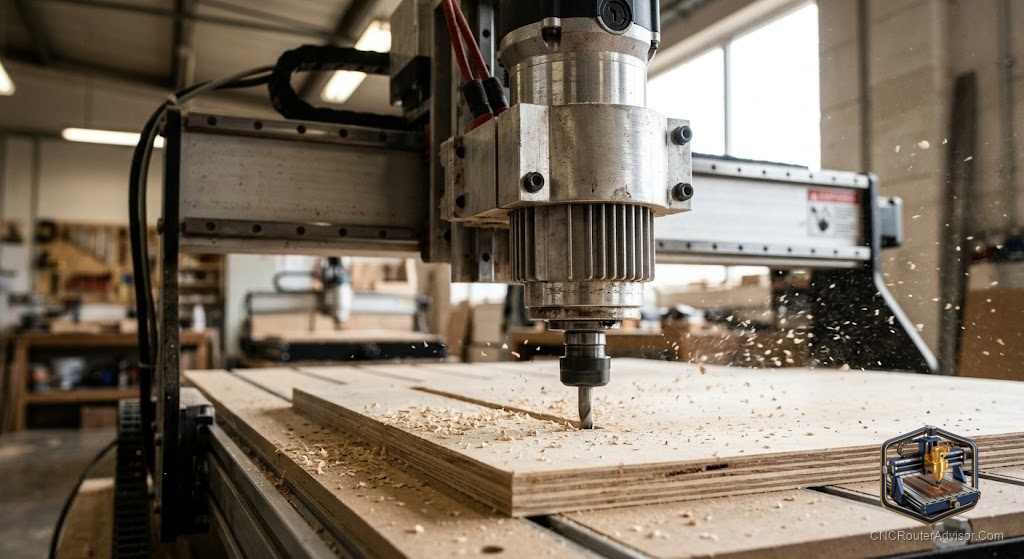
An air cooled CNC router spindle is the simpler choice of the two spindle cooling methods, and simple is genuinely valuable in a workshop context. No plumbing, no pump to maintain, no coolant to check, just a spindle that cools itself with an internal fan. For a large segment of CNC users, that simplicity is the correct trade to make. Understanding exactly what you gain from air cooling, what you give up compared to water cooling, and which use cases it suits confidently is what makes the choice clear rather than uncertain.
An air cooled CNC router spindle is a spindle motor that uses an internal fan to draw air across the motor and bearings, dissipating heat without external cooling equipment. It is simpler to install and maintain than a water-cooled spindle, suited to a wide range of hobby and prosumer CNC applications, and the right choice when duty cycles and noise levels are not extreme.
Here is the direct take: an air-cooled spindle is the right choice for most hobby and small-shop applications where runs are measured in hours rather than continuous production shifts, and where the simplicity of no plumbing is a genuine benefit. A verified kit option is noted below. The sections below cover the benefits, the limits, the comparison to water cooling, and who air cooling fits.
What air cooling delivers
Air cooling keeps the spindle thermal management entirely self-contained. The spindle’s internal fan runs when the motor runs, drawing air through the motor to carry heat away, so there is no external equipment to install, prime, or maintain. Installation is straightforward: mount the spindle, connect the power and VFD, and run. For the majority of hobby and prosumer CNC work, the internal fan provides enough cooling for the duty cycles involved. Air-cooled spindles are also widely available, well-documented, and use standard mount diameters (typically 65mm for smaller spindles) compatible with most machines.
The limits of air cooling
The internal fan introduces noise, more than a water-cooled spindle, which matters in home shops and shared spaces. At sustained high-load duty cycles, the fan cooling has less thermal capacity than a water circuit, so long production runs in demanding materials can push operating temperature higher than a water-cooled spindle would reach. Neither limit is a failure; they are the defined trade for simplicity. For moderate duty cycles in wood and typical materials, they do not affect performance.
A verified air-cooled spindle kit
For a complete air-cooled setup, the RATTMMOTOR 800W 110V CNC air-cooled spindle kit includes the spindle motor, a speed controller, mount bracket, ER11 collet set, and wiring, making it a self-contained upgrade that avoids the parts-sourcing of assembling individual components. The honest caveat: confirm the mount bracket diameter matches your machine’s spindle mount before ordering, verify the voltage (110V) matches your shop wiring, and note that an ER11 collet set limits bit shank diameter to 1/8 inch, so confirm your bits match.
Air cooling versus water cooling
The trade between the two comes down to duty cycle and noise priority. Air cooling is simpler, needs no external plumbing, and is sufficient for moderate hobby and prosumer use. Water cooling runs quieter, handles sustained high-load production runs better, and prolongs bearing life at the high end of the duty cycle. For home shops and moderate use, air cooling is the right choice. For production shops and noise-sensitive environments, water cooling earns its complexity.
For the detailed comparison from the water-cooling side, see our guide to the water cooled CNC router spindle.
Final verdict
An air cooled CNC router spindle is the right choice for most hobby and small-shop applications: simple to install, self-contained, and capable across moderate duty cycles in wood, plastics, and foam without plumbing overhead. Its limits are noise (more than water cooled) and thermal capacity at very long production runs, neither of which affects most users. Match the mount and voltage to your machine, confirm the collet fits your bits, and an air-cooled spindle delivers significant capability over a trim router without the complexity of water cooling.
FAQ
What is an air cooled CNC router spindle? A spindle motor that uses an internal fan to cool the motor and bearings, with no external water circuit required. It is simpler to install and maintain than a water-cooled spindle.
Is air cooling enough for a CNC router? For most hobby and small-shop applications with moderate duty cycles in wood and plastics, yes. It is not ideal for sustained production runs or noise-sensitive environments.
What are the advantages of air cooling over water cooling? Simpler installation (no plumbing), no pump or coolant to maintain, self-contained operation, and straightforward setup. For moderate use, it is the more practical choice.
What are the disadvantages of air cooling? More noise than water cooling because of the internal fan, and less thermal capacity for sustained high-load production runs. Neither is a problem for typical hobby use.
What is a VFD and do I need one with an air-cooled spindle? A variable frequency drive controls the spindle RPM. Most real CNC spindles, air or water cooled, require a VFD. Many kit purchases include one; verify before buying.
What collet size does an 800W air-cooled spindle use? Commonly ER11, which limits bit shank to a maximum of about 1/8 inch (7mm). Larger spindles may use ER16 or ER20 collets, which accept larger shank sizes. Confirm before buying.
References
- RATTMMOTOR, air-cooled spindle kit documentation: Check on Amazon
- Onefinity CNC community, spindle wiring and setup guidance: https://forum.onefinitycnc.com
- Carbide 3D, spindle selection and setup guidance: https://carbide3d.com