3D CNC Router Projects: What the Machine Can Actually Finish
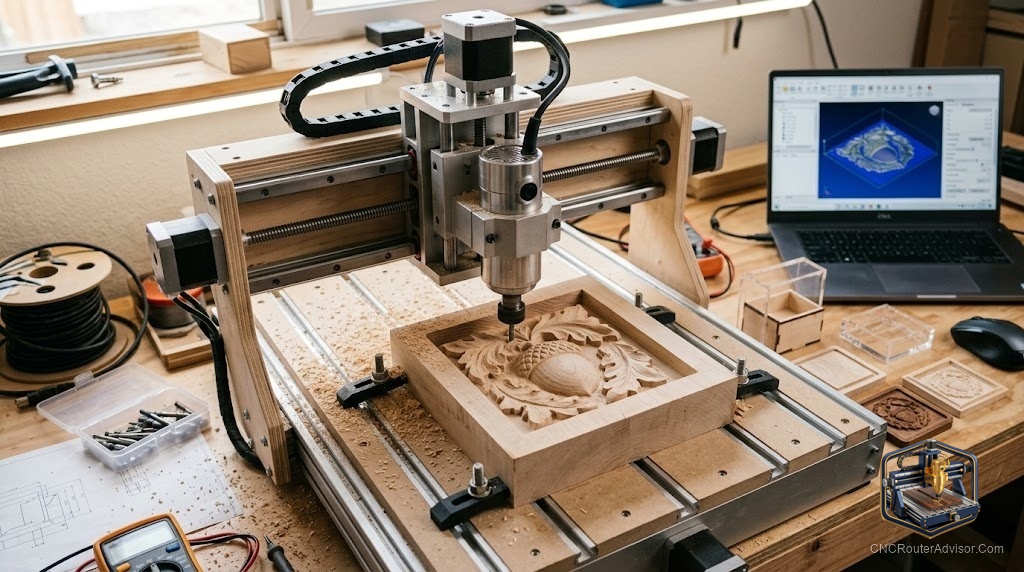
A 3D CNC finishing pass running for six hours sounds like a long time until you see a walnut bas-relief portrait emerge that would have taken a skilled carver three days to produce by hand. The machine doesn’t replace the craftsperson at the finishing and detail stage. But it handles the geometry with a consistency that no hand tool can match, and it does it while you’re doing something else.
3D CNC router projects are any carvings that use simultaneous three-axis motion, moving X, Y, and Z together to trace a sculptural surface. This is distinct from 2D pocketing and profiling, where Z only moves up and down between passes. 3D projects require a ball-nose end mill, a CAM program capable of 3D toolpath generation, and a machine rigid enough to execute fine finishing passes without vibration.
The direct answer: the most approachable 3D CNC projects are bas-relief decorative panels, portrait medallions, topographic map carvings, carved house signs, and decorative cabinet door inserts. All of these are achievable on mid-range hobbyist machines with Aspire or Carveco as the CAM tool.
Bas-Relief Decorative Panels
The entry-level 3D project and the one that most people recognize immediately as the work of a CNC router. A bas-relief has figures or design elements that project outward from a flat background surface. Animals, botanical patterns, Celtic knotwork, geometric mandalas, and brand logos are common subjects.
Material: Basswood for paint-finish work (consistent grain, clean edge definition). Walnut or mahogany for natural-finish panels (grain depth adds visual richness).
File source: Cults3D and Etsy carry large selections of purpose-designed CNC relief STL files. Quality varies; read reviews from buyers who actually cut the file.
Concrete issue: The step-over in the finishing pass determines surface texture. At 15% stepover you’ll see scallop lines in raking light that require sanding. Use 8% for display-quality results.
Portrait Medallions
A face carved in round relief, typically 150mm to 300mm diameter. These are among the most impressive demonstrations of 3D CNC capability. The key is the source file: a 3D scan converted to STL produces a lifelike result; a stylized relief STL from Etsy produces a decorative interpretation. Know which you’re getting before you buy.
For a portrait of a specific person, commission a 3D scan or use photogrammetry to create the model. Tools like Meshroom (free photogrammetry) and Revopoint scanners produce STL output that imports directly into Aspire.
Topographic Map Carvings
Publicly available elevation data from the USGS National Map and tools like Terrain2STL and TouchTerrain convert geographic terrain into CNC-ready STL files. The result is a tactile three-dimensional map of any location you choose.
What makes it work: Choose a region with meaningful elevation change. Flat coastal plains produce unimpressive topographic carvings. Mountain ranges, river valleys, and coastal cliffs produce dramatic reliefs. Scale the Z exaggeration in Terrain2STL for visual impact.
Material: MDF for prototyping. Walnut or cherry for display pieces.
Architectural Molding Profiles
CNC-generated molding profiles for door trim, cabinet edges, and furniture frames. A profile run from a custom design produces consistent repeatable results across every piece without resharpening a dedicated router bit. Useful for restoring trim to a specific historical profile or creating custom furniture in a consistent style.
Carved Cabinet Door Inserts
A cabinet door panel with a carved center field: a shallow 3D relief inset into the face of the door. This combines 2D profiling (the door outer shape) with 3D relief toolpaths (the carved insert) in a single setup. Aspire’s Drive Rail feature handles the transition between flat panel and carved field.
Verdict
Bas-relief panels and topographic maps are the most accessible 3D CNC projects for a new user. Portrait medallions require better file sources but produce the most impressive results. All require a CAM program with 3D toolpath capability and a machine with adequate rigidity for finishing pass quality.
- Bas-relief panels: entry-level 3D project, many file sources, excellent results in basswood
- Topographic maps: free data sources, impressive gifts, use Terrain2STL
- Portrait medallions: require 3D scan or quality STL source for lifelike results
- 8% stepover produces display-quality surface; 15% requires significant sanding
FAQ
What software do I need for 3D CNC projects? Vectric Aspire or Carveco Maker for woodworking. Fusion 360 for engineering-oriented 3D work.
Where do I get STL files for 3D CNC projects? Cults3D, Etsy, and STLFinder for paid commercial files. Thingiverse and Printables for free files (check for undercuts before using).
Can I do 3D CNC projects on a 3018? Yes on small pieces. The 3018 work area limits scale and spindle power limits depth per pass. A 30x30-inch or larger machine is more practical for serious 3D work.
What causes a rough surface on 3D CNC carvings? Stepover too large, worn or undersized ball-nose, machine gantry flex, or too fast a finishing feed rate.
Where do I find free topographic map STL files? Generate them at terrain2stl.com or touchterrain.org using free USGS elevation data.
References
- Terrain2STL: terrain2stl.com
- USGS National Map: nationalmap.gov
- Cults3D: cults3d.com