Stiles CNC Router: What Stiles Machinery Sells and Who Its Built For
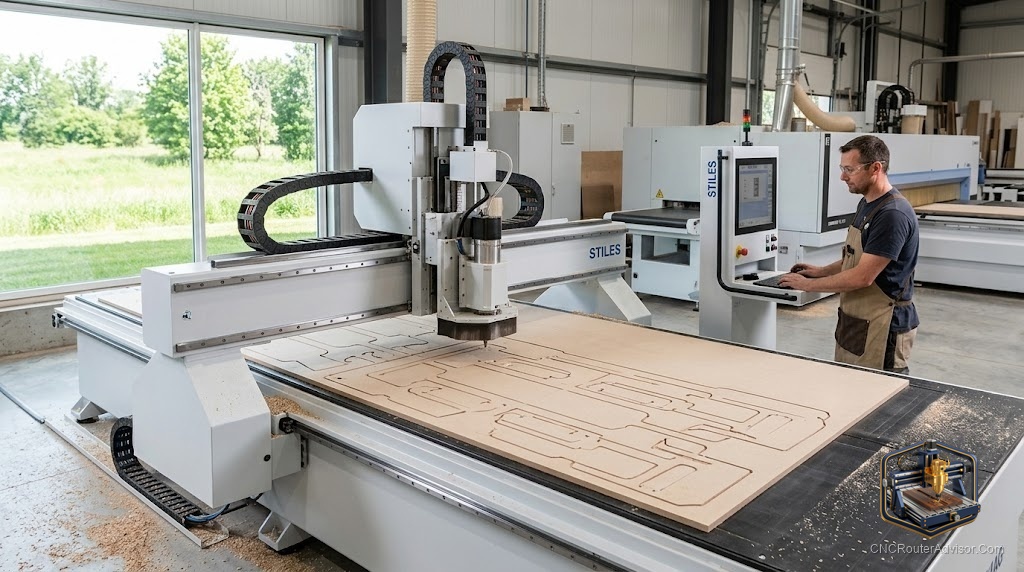
Stiles Machinery is not a brand you encounter until you start asking serious questions about industrial woodworking equipment, and once you encounter it, you realize you are in a different category of conversation entirely. This is not the world of desktop routers and hobby software. It is the world of production lines, dedicated service teams, and equipment decisions measured in decades rather than years. If you searched for “Stiles CNC router” and expected a machine you could order on a credit card and have running by the weekend, this guide will save you some confusion.
Stiles Machinery is a North American distributor of premium European woodworking and panel processing equipment, most notably the Homag Group brands, which include Weeke and Homag CNC routers and machining centers. Stiles does not manufacture its own machines. It represents established European manufacturers with strong track records in production furniture, cabinet, and millwork shops, and provides the service, training, and parts infrastructure that industrial buyers require.
The short answer: a “Stiles CNC router” means a machine sold and serviced by Stiles Machinery, typically from the Homag or Weeke line, built for professional production environments. These are industrial-class machines designed for all-day throughput in cabinet, furniture, and millwork manufacturing. They are excellent at what they do, priced for the industrial buyer, and supported by a service network that justifies the investment in a production context.
What Stiles distributes and what that means
Stiles represents the Homag Group, one of the most respected names in European woodworking machinery. Homag and its subsidiary Weeke make CNC machining centers, nesting machines, and CNC routers that are standard equipment in many of the world’s most efficient cabinet and furniture factories.
Weeke machines are particularly well known for pod-and-rail work (sometimes called point-to-point or PTP machining), where cabinet parts sit on pneumatic pods rather than a flat spoilboard, allowing the machine to cut, drill, and mill all faces of a part in one setup. This is production efficiency at a level that no desktop or prosumer CNC router approaches. A single Weeke machine can process hundreds of cabinet parts per shift, drilled and routed to exact specification, without operator intervention beyond loading and unloading.
For buyers whose operation genuinely processes that volume, the investment in a Stiles-distributed Homag or Weeke machine makes economic sense. For smaller shops considering it, the honest question is whether your volume justifies not just the machine cost but the full support infrastructure, training, and tooling investment that a production machine requires.
The support model: what you are buying beyond the machine
A significant part of Stiles Machinery’s value is the service and support layer. Industrial CNC equipment is not a self-service category: when a production machine goes down in a cabinet shop, every hour of downtime has a measurable cost. Stiles maintains service technicians, parts inventories, and training programs designed to minimize that downtime.
This support infrastructure is expensive to build and expensive to maintain, and it is priced into the machines Stiles represents. Buyers who do not need all-day production reliability are paying for support capacity they will rarely use. Buyers who do need it find the service layer is the difference between a manageable incident and a production crisis.
The honest question for any buyer evaluating Stiles equipment is whether their volume and margin justify industrial-grade support. A shop running one shift of cabinet production a few days a week is a different calculation than one running multiple shifts seven days a week. Be honest about which operation you actually run.
What smaller shops should look at instead
Most readers who find this page are not production cabinet manufacturers. They are serious hobbyists, small custom shops, or growing businesses exploring their options. For those buyers, a mid-tier prosumer or light-industrial CNC router, one with a rigid frame, ball screws, and a real spindle from a brand with accessible service, will serve them far better per dollar than an industrial machine they do not have the volume to justify.
Our guide on how to choose a CNC router helps match machine class to actual production needs and budget, and it is the right starting point for buyers who are not yet in the industrial tier.
The takeaway: Stiles Machinery represents excellent industrial woodworking equipment for the professional production buyer. That buyer should contact Stiles directly for a serious conversation. Everyone else should match their budget and volume to an appropriate machine class first.
Frequently asked questions
Does Stiles Machinery manufacture CNC routers? No. Stiles is a distributor, primarily representing Homag Group brands including Weeke and Homag, for North American industrial buyers.
What brands does Stiles distribute? Primarily the Homag Group brands, including Weeke and Homag, plus other European woodworking machinery manufacturers.
What is a Weeke CNC router? A pod-and-rail (point-to-point) CNC machining center from the Homag Group, designed for production cabinet and furniture manufacturing. Weeke machines are well-regarded for drill-and-route efficiency on cabinet parts.
Are Stiles machines available on Amazon or standard retail? No. They are industrial machines sold through direct sales with service contracts, not through general retail channels.
How do I contact Stiles Machinery? Through their website at stilesmachinery.com or through their sales and regional service teams.
What should a small shop consider instead of a Stiles machine? A mid-tier prosumer or light-industrial CNC router with ball screws, a real spindle, and accessible support, sized to the actual production volume and budget of the shop.
References
- Stiles Machinery, products and services overview — https://www.stilesmachinery.com
- Homag Group, Weeke and Homag CNC machining centers — https://www.homag.com/en/
- C.R. Onsrud, industrial CNC comparison context — https://cronsrud.com/industrial-cnc-machines/