Define CNC Router: A Clear Explanation of Uses, Setup, and Key Considerations
Sometimes the most useful place to start is a plain definition. If you have heard the term CNC router and want to know exactly what it means, without jargon or sales pitch, this is the place. Once the definition is clear, everything else about these machines, how they work, what they make, and what to look for, follows naturally. This guide defines the CNC router and then builds outward from that foundation.
The definition
A CNC router is a computer-controlled cutting machine that moves a spinning cutter along programmed paths to carve, cut, and shape material. CNC stands for Computer Numerical Control, meaning a computer directs the machine’s movements. Router refers to the spinning cutting tool, the same basic idea as a handheld router, but here guided by a computer instead of a human hand. Put simply, it is a machine that turns a digital design into a physical part with precision and repeatability.
Breaking the definition down
Each part of that definition carries meaning. Computer-controlled means the machine follows instructions rather than freehand guidance, so it repeats work exactly. The spinning cutter removes material through routing, carving, cutting, and engraving. Programmed paths come from G-code, the instructions produced by design software. And the result, precision and repeatability, is the whole reason the machines exist. A person can make one good part by hand. A CNC router makes a hundred identical ones.
How it works
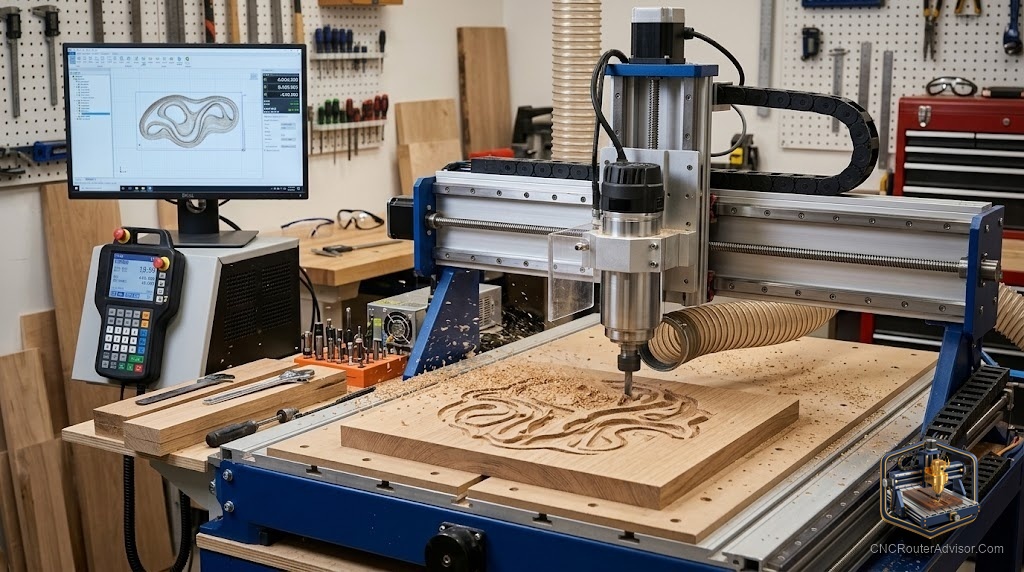
Underneath the definition is a clear process. A design is created in software and converted into G-code. A controller, often a GRBL controller on hobby machines, reads that code and drives motors. The cutter then moves across three axes, the X axis for left and right, the Y axis for front and back, and the Z axis for depth, following the design exactly while the material is held firmly in place. That chain, from design to code to motion to finished part, is the same on machines of every size.
What a CNC router is used for
The definition covers a remarkably wide range of work. CNC routers carve signs and three-dimensional reliefs, cut flat parts and furniture components, engrave detail and lettering, and produce repeatable parts for small runs. They work across materials, from wood and plastics to softer metals with the right setup. That versatility is why they appear in hobby garages, sign shops, cabinet makers, and factories alike.
The parts that make it work
A machine’s ability to route well depends on a few fundamentals. Frame rigidity, from a steel frame or heavy aluminum extrusion, keeps cuts clean. The motion system, whether ball screws, lead screws, or timing belts, shapes precision. Spindle power decides what materials and depths are practical. And the work area sets how large a piece you can cut. These are the things to understand when the definition turns into a buying decision.
Key considerations
If the definition has you interested in owning one, a few realities are worth knowing. There is a software workflow to learn, since turning a design into toolpaths is where much of the skill lives. Workholding matters on every job, because material that moves ruins the cut. Dust management is part of the process. And matching the machine’s size and power to your intended work saves frustration later.
From definition to understanding
A CNC router, defined plainly, is a computer-guided cutting machine that turns digital designs into physical parts with a steadiness no hand can match. Hold onto that core idea and the rest stops being intimidating. The machine is not magic, it is a spinning cutter following a digital plan, and understanding that simple truth is the first step toward making it work for you.