
4x8 CNC Router Kit: What You Are Really Signing Up For
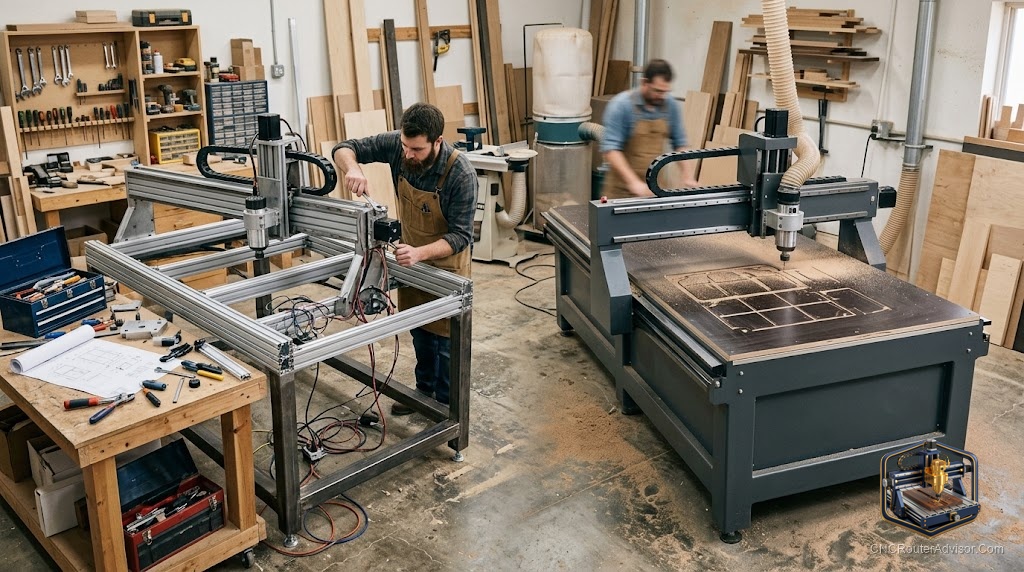
A 4x8 CNC router kit sounds like the smart way in. Instead of paying for a finished full-sheet machine, you buy the parts and the plans, spend a few weekends building, and save real money. Sometimes that is exactly how it goes. Other times a buyer ends up with a garage full of extrusion and a slow, frustrating education in squaring a gantry. Which outcome you get depends almost entirely on the kit you choose and the honesty of what you expect from it.
A 4x8 CNC router kit is a full-sheet-capable machine sold as a set of parts to assemble yourself, typically including the frame or extrusion, motion components, electronics, and instructions, with a router or spindle sometimes left for you to add. It sits between a scratch build and a plug-and-play machine.
The direct answer: a kit is worth it if you value the money saved and the deep understanding you gain by building it, and you have the patience for careful assembly and tramming. If you want to cut parts this weekend and never think about mechanics, a kit is the wrong path and an assembled machine is the right one. The rest of this guide is about telling those two situations apart.
What a full-sheet kit usually includes, and what it leaves out
Kits vary widely. A well-specified 4x8 kit gives you the structural extrusion or steel, the linear motion (rails or wheels), lead or ball screws or a rack-and-pinion drive, stepper motors, a controller, and wiring, along with detailed build documentation. Many leave out the spindle or router, the dust collection, and the computer, so the sticker is not the finished cost.
Read the parts list like a contract. The things most often missing are the router or spindle, the dust boot, the material for the spoilboard, and sometimes the power supply for the electronics. A kit that looks cheaper can end up even once you add what it omits, so total everything before comparing.
Rigidity is still the whole game at this size
A full-sheet span is long, and long spans flex. On a kit, you are the one responsible for making the frame stiff and square, so the design you start with matters even more than on an assembled machine. Steel-frame and heavy-extrusion kits with rack-and-pinion drives handle the 8-foot length far better than light aluminum kits meant for smaller builds.
If a kit’s frame looks thin for a 4 by 8 span, believe your eyes. No amount of careful assembly makes an under-built gantry rigid. For hardwood and aluminum especially, mass and a stout gantry cross-section are what keep the cut clean over that long a travel.
The build itself: time, tools, and tramming
Expect a real project, not an afternoon. A full-sheet kit involves assembling and squaring a large frame, aligning rails, tensioning belts or setting backlash on screws, wiring electronics, and configuring the controller. Then comes tramming, getting the spindle perfectly perpendicular to the bed, which is fussy on a machine this large and is the difference between smooth surfaces and visible ridges.
The payoff is understanding. People who build their own machine can diagnose and fix almost anything on it later, which is a genuine advantage over owners who never opened the box. That knowledge is part of what you are buying, so count it as value, not just cost.
Who should skip a kit
Skip the kit if your goal is production and your time is worth more than the savings. A shop that needs to be cutting revenue parts next week should buy an assembled, supported machine. Also skip it if you have no interest in mechanics, because a kit demands ongoing tinkering that some owners love and others quietly resent.
Still deciding between building and buying at this size? Our 4 x 8 CNC router guide covers the space, power, and dust realities that apply to any full-sheet machine, assembled or kit.
Final verdict
A 4x8 CNC router kit is a builder’s machine. Choose it for the savings and the education, not for speed to first cut. Two rules keep buyers out of trouble: total the real cost including the router, spindle, and dust collection the kit leaves out, and start from the stiffest frame design you can afford, because you cannot assemble rigidity into a weak one. Get both right, and building your own full-sheet machine is one of the most satisfying projects in the hobby. Get them wrong, and it is an expensive lesson in patience.
FAQ
Is a 4x8 CNC router kit cheaper than an assembled machine? Usually the parts cost less than a finished machine, but the gap narrows once you add the router or spindle, dust collection, and other items kits often exclude. Total the full build before deciding.
How long does it take to build a 4x8 kit? Plan for multiple weekends, not a single day. Assembling and squaring a full-sheet frame, wiring electronics, configuring the controller, and tramming the spindle all take time to do well.
What tools do I need to build one? Common needs include metric and standard wrenches and hex keys, a square and a way to check for flatness, a multimeter for wiring, and patience for tramming. Specific kits list their own required tools.
Do kits include the router or spindle? Often not. Many kits leave the cutting spindle, dust boot, and computer for you to supply. Always check the parts list so the price you compare is the finished price.
Can a beginner build a 4x8 kit? A careful beginner can, especially with a well-documented kit, but it is a large first project. Some people build a small machine first to learn the fundamentals before tackling a full-sheet build.
What is tramming and why does it matter? Tramming is squaring the spindle so it is perpendicular to the bed. On a large machine, even a small error shows up as ridges or uneven surfaces across wide cuts, so it is worth getting right.
References
- Avid CNC, DIY and kit-based full-sheet CNC systems: https://www.avidcnc.com
- GRBL project documentation (controller configuration reference): https://github.com/gnea/grbl/wiki
- Carbide 3D, machine rigidity and work area guidance: https://shop.carbide3d.com/collections/4x4-cnc-router