
CNC Router vs. Planer: Key Differences and Which to Choose
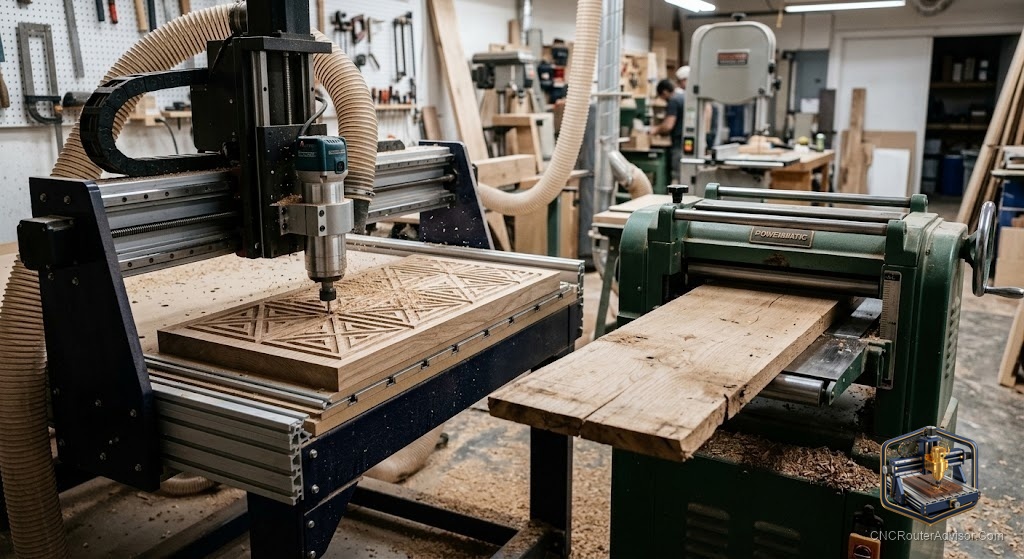
A reader emailed me convinced these two machines competed for the same slot in the shop. They do not. A CNC router and a planer both touch wood and both make noise, and that is roughly where the overlap ends. Confusing them is easy if you have only seen photos, but once you understand what each one does with a board, the choice becomes obvious. Usually the honest answer is that you want one of them clearly, and sometimes you want both for completely different reasons.
This guide lays out what each machine does, where they overlap, and how to decide which one earns space on your bench.
What each machine actually does
A CNC router is a computer controlled cutting machine. It guides a spinning bit across a work area using coordinates from a design file, carving shapes, pockets, and detail into the surface and through the material. You feed it a vector file such as an SVG or DXF, choose your bits, and it cuts a personalized name sign, an address plaque, a jewelry box, or geometric wall art without you touching the cutter.
A planer does one thing well. It takes a rough or uneven board and shaves its face to a consistent, flat thickness. Feed a bumpy plank in, get a smooth board of even thickness out. It does not carve, shape, or make designs. It makes stock flat and dimensioned so you can build with it.
So one machine creates shapes and art, and the other prepares raw lumber. They sit at opposite ends of the woodworking process.
The short answer
If you want to make signs, carvings, inlays, boxes, or any designed object, you want a CNC router. If you buy rough lumber and need to flatten and dimension it before building furniture, you want a planer. They do not replace each other. A CNC router cannot thickness a stack of rough boards efficiently, and a planer cannot carve a house number plaque. Buy based on the job in front of you, and if you do both fine woodworking and design work, you may genuinely want both over time.
Where the confusion comes from
Both machines remove wood, both use cutting edges, and both can leave a smooth surface. Beginners see “cuts wood, controlled by a machine” and assume they compete. The difference is what they control and why. A CNC router controls a cutter’s path in three dimensions to make a specific shape. A planer controls only thickness, running the board through rollers past a fixed cutterhead. One is about geometry and design. The other is about flatness and dimension.
What a CNC router is for
The router shines at anything designed. Think engraved cutting boards, quote signs, animal silhouette wall art, cribbage boards, bookends, and pet memorial photo frames. You design in software, export a vector file, and cut with a straight bit for clearing and a V-bit for lettering and fine detail. It works in plywood, hardwood, and plastics, and it repeats the same part exactly every time. If your interest is making things with detail and design, this is the machine that opens that door.
What a planer is for
The planer is a preparation tool for people who work with real lumber. Rough sawn boards arrive uneven and often cupped. A planer brings both faces parallel and takes the board to a target thickness so joints fit and panels glue up flat. If you build furniture, cabinets, or anything from raw stock, a planer saves you from paying a premium for pre surfaced wood and gives you control over final thickness. It makes nothing decorative. It makes your material usable.
Can one ever do the other’s job?
Barely, and not well. A CNC router can technically surface a small panel by running a flattening bit across it in a raster pattern, and people do use routers to flatten slabs too wide for a planer. That is a real niche. But for a stack of boards, a planer is dramatically faster and easier. In the other direction, a planer cannot carve or shape anything, so it cannot stand in for a router at all. The overlap is a one way sliver, not a real substitution.
Who should skip which
Skip the CNC router if your work is strictly building furniture from lumber and you have no interest in signs, carving, or designed parts. It will sit unused while your planer does the real work. Skip the planer if you buy surfaced boards or sheet goods and only make designed items, because you will rarely need to thickness raw stock. Match the tool to what you actually make.
Comparison: CNC router vs planer
| Factor | CNC router | Planer |
| Main job | Carve and cut designed shapes | Flatten and thickness boards |
| Input | Vector file (SVG, DXF) | Rough or uneven lumber |
| Output | Signs, art, boxes, parts | Flat, dimensioned stock |
| Design work | Yes, its whole purpose | None |
| Best buyer | Makers, sign and craft shops | Furniture and cabinet builders |
The verdict
CNC router versus planer is not really a contest, because they solve different problems. The router is a design and fabrication machine that turns files into finished carved objects. The planer is a stock preparation machine that turns rough boards into flat, usable lumber. Decide by looking at what you want to make. If it is signs, carvings, and designed parts, the router is your answer. If it is furniture from raw wood, the planer is. Woodworkers who do both eventually own both, and never once regret keeping them for separate jobs.
Frequently asked questions
Can a CNC router replace a planer? Not practically. A router can surface a small slab with a flattening bit, but it is slow and awkward for dimensioning boards. A planer does that job far faster. For designed cutting, though, the planer cannot substitute at all.
Can a planer do what a CNC router does? No. A planer only flattens and thicknesses boards. It cannot carve, shape, or make any design. The two machines do not overlap in that direction.
Which should a beginner buy first? Buy based on your goal. If you want to make signs, carvings, and designed items, start with a CNC router. If you want to build furniture from rough lumber, start with a planer.
Do I need both machines? Only if you do both kinds of work. Many woodworkers who build from rough stock and also make designed pieces own both, because each handles a stage the other cannot.
What files does a CNC router need? It cuts from vector files such as SVG and DXF, which you create or download and then turn into tool paths in CAM software. A planer needs no files at all.
Which machine is easier to learn? A planer is simpler to operate since it does one thing. A CNC router has a learning curve around design software, tool paths, and bits, but it rewards that effort with far more creative range.
References
- CNC Router Info, How to Choose a CNC Router: https://cncrouterinfo.com/guides/how-to-choose-a-cnc-router/
- Bubble Relief, CNC Router Projects for Beginners: https://bubblerelief.com/cnc-router-projects-for-beginners/
- Instructables, DIY CNC Router: https://www.instructables.com/DIY-CNC-Router/