DIY CNC Router Kit: What You Are Really Signing Up For
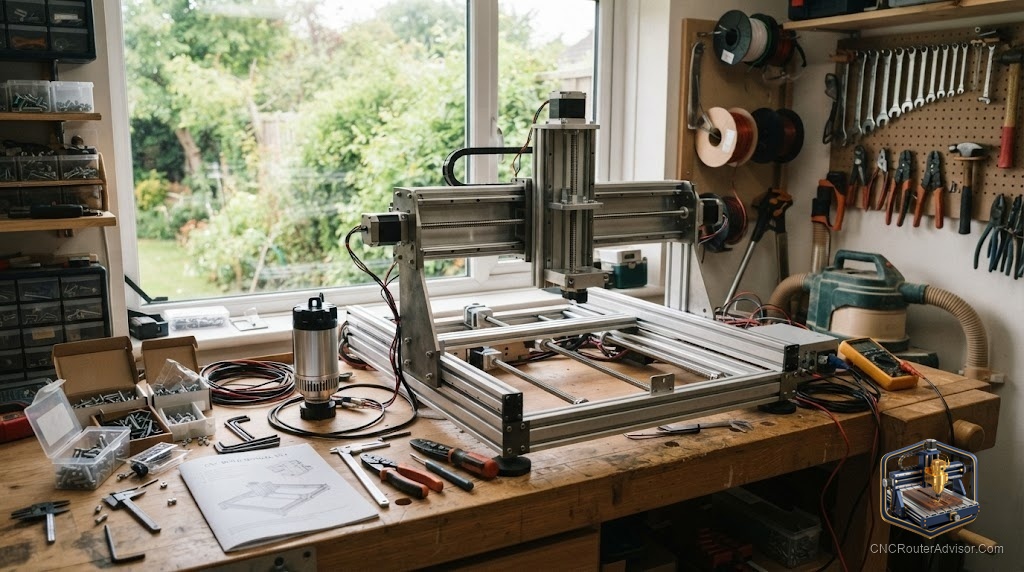
Building your own CNC router from a kit is one of the most rewarding projects in the hobby, and one of the most underestimated. A kit promises a capable machine for less money and the deep satisfaction of understanding every part of it. What it does not advertise is the weekend of assembly, the tuning, and the troubleshooting that turn a box of parts into a machine that actually cuts. Both sides of that bargain are real, and you should know them before you commit.
This guide explains what a DIY CNC router kit includes, the parts that determine whether it cuts well, and who should build versus who should just buy a finished machine.
What a DIY CNC router kit is
A DIY CNC router kit is a package of parts you assemble into a working CNC router. A CNC router is a Computer Numerical Control machine that moves a spinning cutter across the X, Y, and Z axes, guided by G-code, to carve wood, plastics, and soft metals. A kit hands you the frame, the motion components, the electronics, and usually the instructions, and you provide the time, the patience, and often a few basic tools.
Kits sit between two extremes. At one end are fully assembled machines that cut the day they arrive. At the other are scratch builds like the PrintNC, where you source parts yourself from a community design. A kit is the middle path: more involved and cheaper than a ready machine, but far more guided than a scratch build. What you gain is value and understanding. What you spend is time.
The short answer
Choose a DIY CNC router kit if you enjoy building things, want to understand your machine deeply, and are comfortable with assembly and tuning. Choose a finished machine if you want to cut this weekend and see the build as an obstacle rather than a reward. A kit rewards patience and punishes impatience in equal measure.
If you would rather skip the build entirely, a mostly assembled machine such as the Genmitsu PROVerXL 4030 gets you cutting with far less effort: Check on Amazon . If the build itself is the appeal, read on, because the components you choose decide whether your finished machine cuts cleanly or fights you.
The parts that decide cut quality
Frame and rigidity
The frame is the foundation, and rigidity is what makes cuts clean. Kits built from heavy aluminum extrusion or steel resist the flex that causes chatter and poor edges. Lighter frames cost less and assemble easily but limit what you can cut. If the kit lets you choose, favor the stiffer frame, because you cannot tune away flex later.
Motion system
How the gantry moves matters enormously. Timing belts are cheap and simple but can stretch and lose precision. Lead screws are a step up. Ball screws are stiffer and more accurate. For guidance, V-wheels riding on extrusion are common and affordable, while linear rails add rigidity and precision at higher cost. A kit pairing ball screws with linear rails cuts noticeably better than one on belts and V-wheels, and the price reflects it.
Motors and electronics
Stepper motors drive the axes, with NEMA 23 motors offering more torque than the smaller NEMA 17 for a router. The electronics usually center on a GRBL-compatible controller, which accepts G-code from common software. If your kit includes a spindle rather than a trim router, a variable frequency drive spindle runs quieter and more controllably. Match the controller to your software’s post-processor so your first cut succeeds.
The small parts that matter
Details like an anti-backlash nut on a lead screw remove the slop that ruins precision, and a gantry plate that is stiff and square keeps the tool where it belongs. Quality in these small components separates a kit that holds tolerance from one that drifts.
Kit versus finished machine
| Factor | DIY kit | Finished machine |
| Value | More capability for the money | You pay for assembly |
| Time to first cut | A weekend or more | Same day to next day |
| Understanding | Deep, you built it | Limited until you dig in |
| Troubleshooting | On you, with community help | Backed by the maker |
| Best for | Tinkerers and learners | People who want to cut now |
What the build actually involves
Expect to assemble the frame square and true, install the motion components without introducing binding, wire the electronics carefully, and then tune. Tuning is the part beginners underestimate. You will square the gantry, set motor currents, calibrate steps so a commanded inch moves exactly an inch, and dial in belt tension or eliminate backlash. None of this is beyond a patient beginner, but all of it takes time, and a rushed build cuts poorly. The community around popular kits is your best resource when something does not behave.
Who should skip a kit
Skip a DIY kit if you want to cut immediately, dislike troubleshooting, or have no patience for calibration, because a kit will frustrate you where a finished machine would delight you. Skip the cheapest belt-and-V-wheel kits if you want to cut hardwood cleanly or light metal, since a flexible build will fight you, and a stiffer kit or a finished rigid machine is the better path. Build a kit only if the building is part of the appeal, not just the price.
The verdict
A DIY CNC router kit is a genuinely great choice for the right person: someone who enjoys the build, wants to understand every component, and accepts that a weekend of assembly and tuning stands between the box and the first cut. Favor rigidity, ball screws, and linear rails if you want clean cuts, match the electronics to your software, and lean on the community when you get stuck. If none of that sounds appealing, a mostly assembled machine gives you the same cutting with far less effort. Choose based on whether the build is a reward or an obstacle, and you will be happy either way.
The machine you build teaches you more than any machine you buy. Just be sure that lesson is one you actually want to sign up for.
Frequently asked questions
Is a DIY CNC router kit cheaper than a finished machine? Usually yes, because you provide the assembly labor. You trade money for time, and you gain a deep understanding of how the machine works.
How long does it take to build a CNC router kit? Expect at least a weekend for assembly, plus additional time for tuning and calibration. A careful build cuts far better than a rushed one.
What parts matter most for cut quality in a kit? Frame rigidity and the motion system. Ball screws and linear rails cut noticeably better than belts and V-wheels, and a stiff square frame prevents chatter.
Do I need special skills to build a kit? Basic mechanical confidence and patience are enough for most kits. You will assemble the frame, install motion parts, wire electronics, and calibrate the machine.
What is calibration and why does it matter? Calibration ensures a commanded distance matches actual movement and the gantry is square. Skipping it leaves parts inaccurate no matter how good the components are.
Should a beginner build a kit or buy a finished machine? Build a kit if you enjoy the process and want to learn. Buy a finished machine if you want to cut quickly and prefer maker support over self-troubleshooting.
References
- CNCRouterInfo, how to choose a CNC router: https://cncrouterinfo.com/guides/how-to-choose-a-cnc-router/
- Instructables, DIY CNC router build: https://www.instructables.com/DIY-CNC-Router/
- GRBL firmware project: https://github.com/gnea/grbl