
5-Axis CNC Router Kit: Whats Available and Whether You Need It
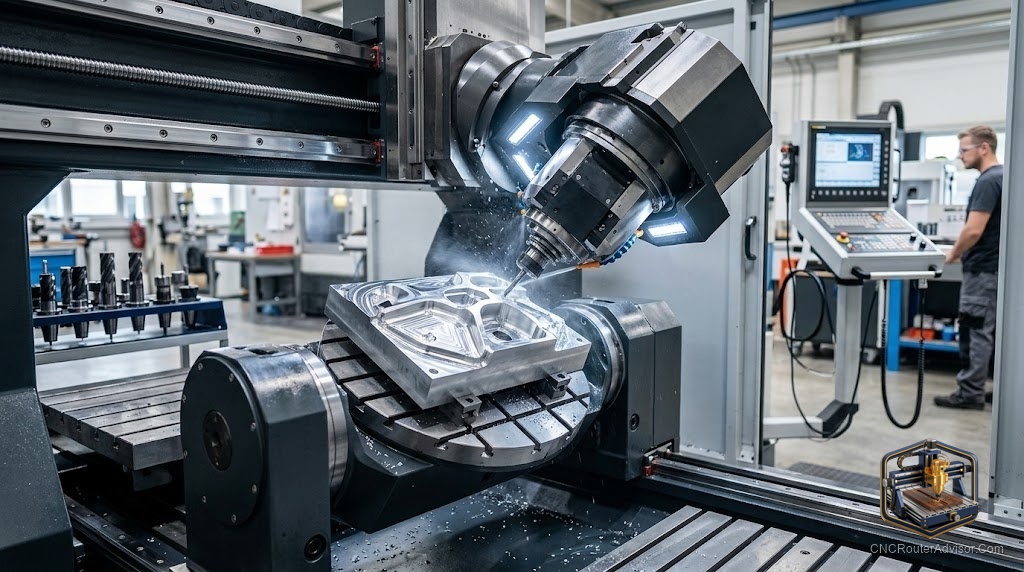
Searching for a “5-axis CNC router kit” typically produces either very expensive industrial systems or hobbyist machines marketed with “5-axis” in the name that are actually 3-axis machines with two additional rotary axes limited to positioning rather than simultaneous machining. Understanding the difference saves significant confusion.
A 5-axis CNC router kit is a machine kit that includes five axes of motion: three linear (X, Y, Z) plus two rotary (typically A and B or A and C). True simultaneous 5-axis machining requires all five axes to move together under CAM control. Many machines labeled “5-axis” only support 3+2 operation: the rotary axes position the workpiece, then the machine operates as a 3-axis machine.
The direct answer: for woodworking and sign applications, a 5-axis kit is not needed. The applications that genuinely require simultaneous 5-axis - aerospace parts, automotive molds - are in industrial territory. If you’re looking for cylindrical carving capability (rotating a workpiece for table legs and columns), that is 4-axis (rotary), not 5-axis.
3+2 vs. True Simultaneous 5-Axis
3+2 machining: The rotary axes tilt the part to a fixed angle, lock there, and a 3-axis toolpath runs on the tilted workpiece. Simpler than true 5-axis, useful for accessing multiple faces of a part in fewer setups.
Simultaneous 5-axis: All five axes move at the same time. The tool traces complex compound curves continuously. Requires specialized CAM software (Mastercam, Hypermill, NX CAM) and much more complex setup.
Common Misrepresentation in Hobbyist Listings
Some Chinese-manufactured machines describe themselves as “5-axis” when they have a standard XYZ motion system plus a rotary A axis and a router head that pivots B axis. If the machine’s controller can only move three axes simultaneously, it is not a 5-axis machine regardless of how many motors it has.
Verdict
For woodworking, cabinetry, and sign work: a 5-axis kit is unnecessary. If you need cylindrical carving (table legs, awards): that’s 4-axis (rotary). True 5-axis is an industrial manufacturing requirement.
FAQ
Do I need a 5-axis CNC kit for woodworking? No. All woodworking applications are covered by 3-axis or 4-axis (rotary) capability.
What is the difference between 4-axis and 5-axis? 4-axis adds a rotary axis (cylindrical work). 5-axis adds a second rotary direction (spindle or workpiece tilting), enabling compound angle machining.