Auto Tool Change CNC Router Explained: Uses, Setup, and Key Considerations
The moment that separates a hobby CNC session from a production shop is the tool change. On a home machine, you stop the job, swap the bit by hand, re-zero, and resume. On an auto tool change router, the machine does it all itself - mid-program, in seconds, untouched. Here’s how that capability works, when it’s worth it, and what it takes to run one.
What auto tool change does
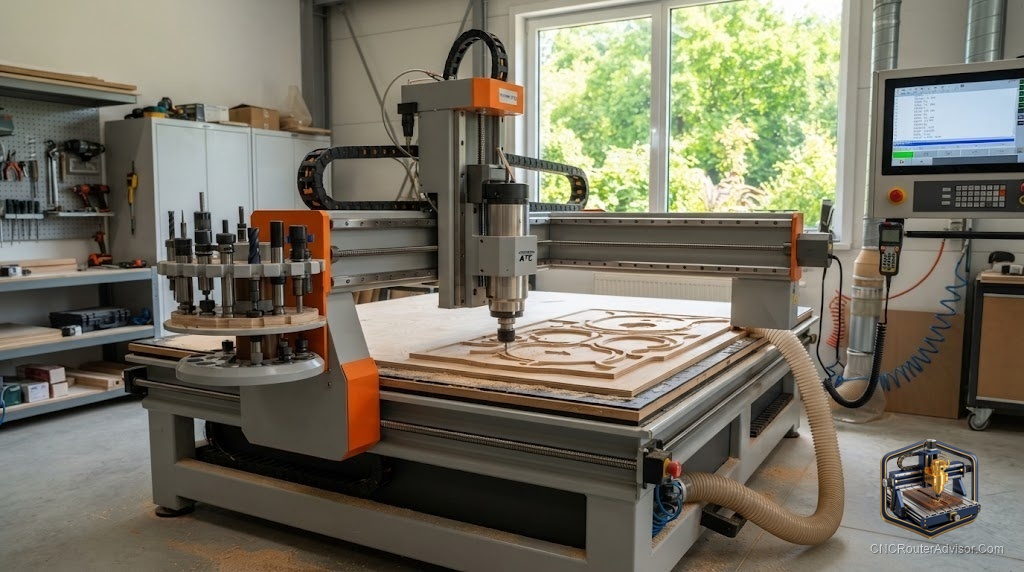
An auto tool change (ATC) CNC router swaps cutting tools automatically during a job. When the program calls for a different bit, the machine parks the current tool in a rack or carousel, picks up the next one, and keeps cutting - no operator, no pause. It relies on an ATC spindle with a pneumatic drawbar, standardized tool holders (such as ISO20 or BT30), a compressed-air supply, and a controller that tracks tool numbers and length offsets.
Think of it as the difference between a printer you have to reload every page and one that runs the whole document unattended.
The workflow advantage
Auto tool change transforms production workflow in concrete ways:
- Unattended multi-tool jobs. A part needing a roughing bit, a finishing bit, and a V-bit runs start to finish without a person standing by.
- Consistency. The machine measures and applies tool offsets automatically, reducing the human errors that creep into manual changes.
- Throughput. Operator time is freed up, and jobs finish faster with no stop-and-swap gaps.
- Complex parts. Designs that require many tools become practical to run in one program.
Why it’s an industrial capability
Auto tool change is, honestly, an industrial feature. Everything it needs - the pneumatic-drawbar spindle, the air system, the tool carousel with standardized holders, and controller support - adds real cost and complexity. That’s why ATC lives on professional machining centers priced in the tens of thousands, not on desktop machines or affordable spindle kits, where tool changes are done by hand. There’s no shame in manual changes; they’re the norm for the vast majority of CNC users.
The fundamentals underneath
An ATC router is still a router, so the core engineering matters as much as the tool changer:
- Frame rigidity. A heavy steel frame to suppress chatter under production loads.
- Motion system. Robust linear rails and drives keeping the X axis, Y axis, and Z axis precise at production speeds.
- Spindle power. A capable ATC spindle with a proper VFD for all-day cutting.
- Control. A controller that manages the tool table, offsets, and complex G-code.
Setup and ownership considerations
- Compressed air. Plan a compressor and clean, dry air - the drawbar depends on it.
- Tool holders and presetting. Invest in standardized holders and a reliable way to measure and preset tool lengths.
- Programming. Your CAM must output tool-change commands and correct tool numbers; set up your tool table carefully.
- Space, power, and support. Industrial footprint, appropriate (often 3-phase) power, freight delivery, and a good support relationship.
Is it right for you?
Auto tool change earns its cost in an established shop where multi-tool jobs and operator time genuinely justify it. If you’re a hobbyist or small shop, manual tool changes on a rigid machine are completely normal and teach you every fundamental - you can move to ATC when your volume and job complexity truly demand it.
The bottom line
An auto tool change CNC router swaps bits automatically mid-program via a pneumatic-drawbar spindle, air system, tool carousel, and smart control - a genuine productivity leap for multi-tool production work. It’s an industrial capability with industrial requirements, so adopt it when throughput justifies the cost, and judge the machine underneath it on rigidity, motion, spindle, and control.
Frequently asked questions
How does auto tool change work? The machine parks the current tool in a rack, picks up the next using a pneumatic-drawbar ATC spindle, and applies the correct tool offsets automatically - all coordinated by the controller mid-program.
Is auto tool change available on hobby machines? No - it requires an ATC spindle, air system, tool carousel, and controller support, making it an industrial feature. Hobby users change tools manually.
When is ATC worth it? When multi-tool jobs and saved operator time justify the added cost and complexity - typically in established production shops.