ATC CNC Router Machine Explained: Uses, Setup, and Key Considerations
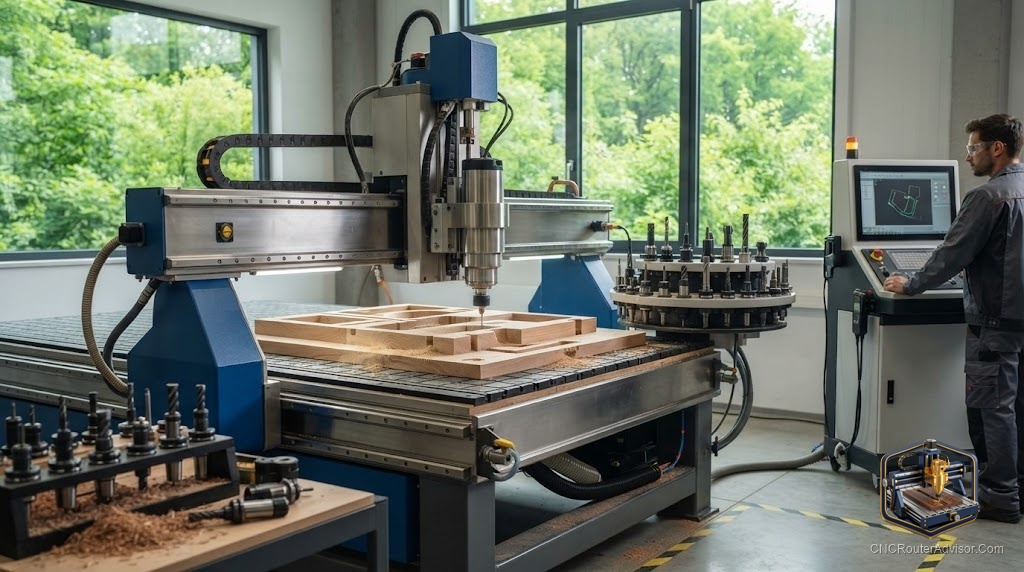
Watch a professional shop’s CNC router swap bits mid-job - no operator, no pause, just the spindle dropping one tool into a rack and grabbing another - and you’re watching an ATC machine at work. It’s one of the most impressive capabilities in CNC, and also one of the most misunderstood by newcomers. Here’s what an ATC CNC router machine is, what it’s for, and why it lives where it does.
What ATC means
ATC stands for Automatic Tool Change. An ATC CNC router can grip and release tool holders automatically - the machine sets one tool into a carousel or linear rack and picks up the next one mid-program, with no human intervention. This is done with a pneumatic drawbar in the spindle and standardized tool holders (like ISO20 or BT30), coordinated by the controller.
The payoff is huge in production: a job that needs a roughing bit, a finishing bit, and a V-bit runs start to finish untouched, instead of stopping for manual tool changes.
Why ATC is an industrial feature
Here’s the honest context every buyer should understand: ATC is effectively an industrial-only feature. It requires several things that hobby machines don’t have:
- An ATC spindle with a pneumatic drawbar
- A compressed-air system
- A tool-change carousel or rack with standardized holders
- Controller support to manage tool numbers and offsets
All of that adds substantial cost and complexity. That’s why you’ll find ATC on professional machining centers priced in the tens of thousands - not on desktop machines or the sub-$500 spindle kits sold to hobbyists, where every tool change is done by hand.
What ATC machines are used for
- Cabinet and furniture production where jobs need multiple tools per part
- Sign and display shops running mixed roughing, profiling, and detail passes
- Any high-volume operation where operator time and consistency matter
The common thread is throughput: ATC pays off when it saves enough operator time and tool-change errors to justify its cost.
The fundamentals still apply
An ATC machine is still a router, so the usual fundamentals matter just as much:
- Frame rigidity. A heavy steel frame to suppress chatter under production loads.
- Motion system. Robust linear rails and drives keeping the X axis, Y axis, and Z axis precise at production rapids.
- Spindle power. A capable ATC spindle with a proper VFD sized for all-day cutting.
- Control. A controller that manages tool tables, offsets, and streams complex G-code.
Setup and ownership considerations
- Air supply. ATC needs clean, adequate compressed air - plan the compressor and air treatment.
- Tool holders and presetting. You’ll invest in standardized holders and a way to measure and preset tool lengths.
- Space and power. Industrial footprint and electrical service, often 3-phase.
- Freight, installation, and support. These are factory-direct machines; delivery, setup, and a good support relationship are part of the purchase.
Is it right for you?
An ATC machine makes sense for an established production shop where multi-tool jobs and operator time genuinely justify the cost. If you’re a hobbyist or small shop, manual tool changes on a rigid machine are completely normal - and you can learn every other CNC fundamental without ATC, upgrading only when volume demands it.
The bottom line
An ATC CNC router machine changes tools automatically via a pneumatic-drawbar spindle, air system, tool carousel, and controller support - a genuinely industrial capability that saves serious time in production. It’s not a hobby feature, and that’s fine: judge it on frame rigidity, motion, spindle, and control, and adopt it when your throughput truly justifies the cost and complexity.
Frequently asked questions
What does ATC stand for? Automatic Tool Change - the machine swaps bits automatically mid-program without an operator.
Why don’t hobby machines have ATC? It requires an ATC spindle with a pneumatic drawbar, an air system, a tool carousel, and controller support - all of which add cost and complexity, making it an industrial feature.
Do I need ATC? Only if multi-tool jobs and operator time justify the cost. Hobby and small-shop users change tools manually as a matter of course.