
Artisan CNC Router Explained: Uses, Setup, and Key Considerations
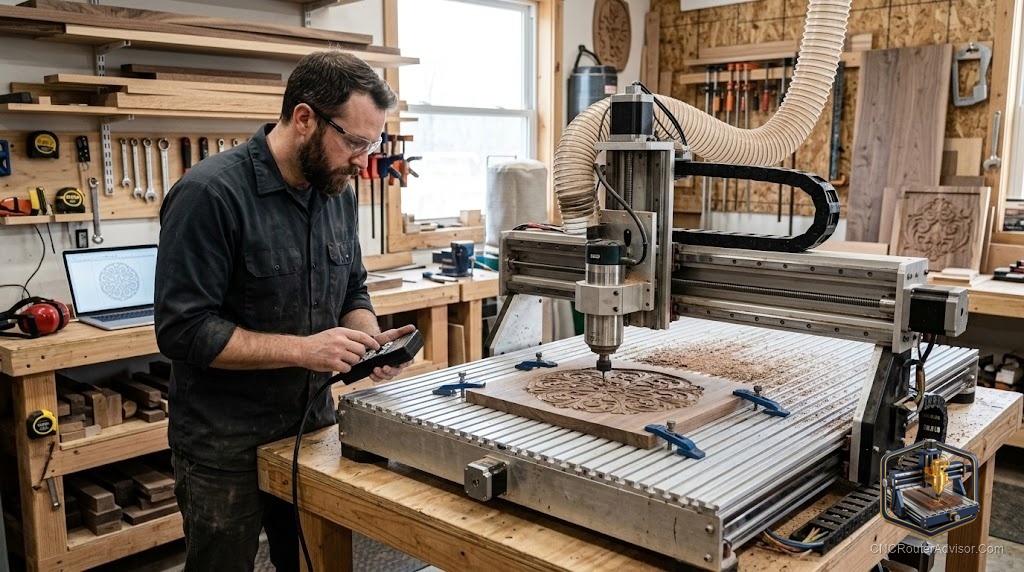
The word “Artisan” gets attached to a few different tools, so the first job of this guide is to clear up which one you’re actually looking at - because guessing wrong sends you down the wrong rabbit hole. Once we’ve sorted that, here’s what an Artisan CNC router does and what to consider.
Clearing up the name
Here’s the key clarification: the main CNC router carrying the “Artisan” name is the Artisan 408 from Industrial CNC, a full-sheet 4×8 production machine. “Artisan” is not a Next Wave Automation product (their line is branded SHARK) and not a Laguna product (Laguna uses names like Swift, IQ, and SmartShop). So if someone mentions an “Artisan CNC router,” they almost certainly mean the Industrial CNC Artisan - a serious, floor-standing machine, not a desktop hobby unit.
Knowing this saves real confusion, because a full-sheet production router and a benchtop hobby machine are completely different purchases.
What the Artisan is
The Industrial CNC Artisan is built to a production standard: a welded steel frame, heavy-duty linear rails, a liquid-cooled spindle, and full-sheet capacity. It’s aimed at woodworkers and shops that need to process entire sheets - cabinets, furniture, signs - in one setup, and it’s sold factory-direct and shipped by freight rather than through consumer retail.
What it’s used for
- Cabinet and furniture production with full-sheet nesting
- Sign and display work at volume
- Serious woodworking where a smaller machine has become a bottleneck
The fundamentals to evaluate
Judge an Artisan (or any full-sheet router) on the core engineering:
- Frame rigidity. The welded steel frame suppresses chatter and holds accuracy across the full envelope.
- Motion system. Heavy linear rails and a drive built for the span keep the X axis, Y axis, and Z axis precise, with enough Z travel for thick stock.
- Spindle power. A liquid-cooled spindle with a proper VFD for all-day cutting.
- Control. A package that cleanly runs your G-code and integrates with CAM.
Setup and ownership considerations
- Space and power. Full-sheet footprint and appropriate electrical service.
- Freight and installation. Delivery, rigging, and setup are part of the deal.
- Workholding and dust. Plan a vacuum or T-slot workholding system and strong dust collection from day one.
- Support and parts. A genuine part of the value - confirm availability and response.
Is it right for you?
An Artisan suits a growing shop or serious maker who truly needs full-sheet capacity and can support an industrial machine. If you’re a hobbyist or your volume is modest, a rigid benchtop or mid-size router will build the same G-code and workholding skills for far less - and you can move up to an Artisan-class machine when the work justifies it.
The bottom line
An “Artisan CNC router” almost always means the Industrial CNC Artisan - a full-sheet, steel-framed, liquid-cooled production machine, not a Next Wave or Laguna product and not a desktop unit. Confirm you’re looking at the right tool, evaluate it on rigidity, motion, spindle, and control, and match it to real production need before committing.
Frequently asked questions
Is Artisan a Next Wave or Laguna machine? No - Next Wave’s line is SHARK and Laguna uses other names. The “Artisan” CNC router is made by Industrial CNC.
Is it a desktop machine? No - it’s a full-sheet (4×8) production router bought factory-direct and shipped by freight.
Should a beginner buy one? Only if you genuinely need full-sheet capacity. Most beginners are better served starting on a benchtop or mid-size machine.