
Arduino CNC Router Explained: Uses, Setup, and Key Considerations
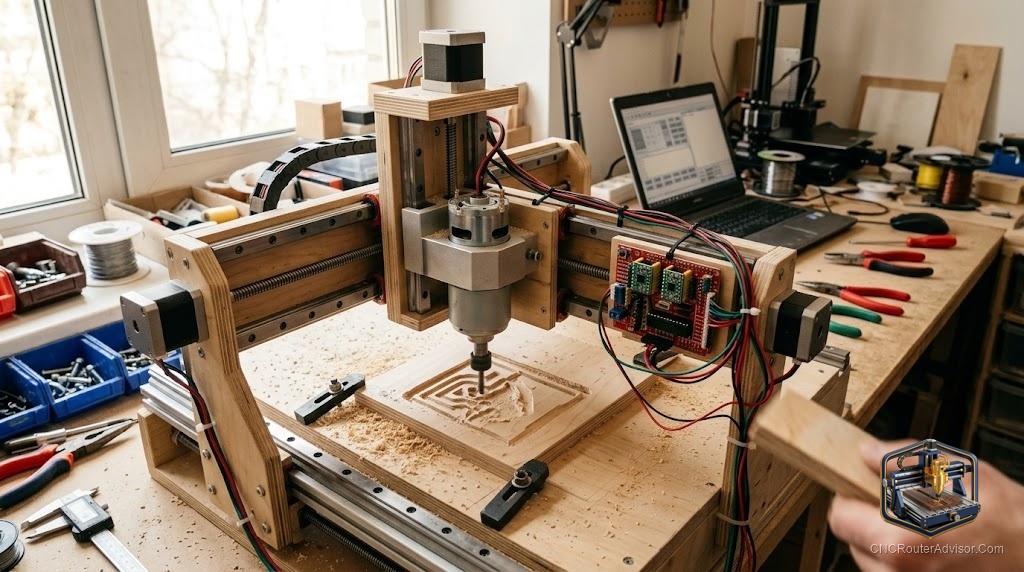
There’s a good chance the little machine humming on a hobbyist’s bench right now is being run by a five-dollar microcontroller you’d normally associate with blinking LEDs. That’s the quiet magic of the Arduino CNC router: an Arduino board, some free firmware, and a handful of drivers turn stepper motors into a precise cutting machine. Here’s how it works, what it’s good for, and how to set one up.
What “Arduino CNC router” actually means
An Arduino CNC router is any CNC router whose motion is controlled by an Arduino running GRBL - the popular open-source firmware that interprets G-code and pulses the stepper drivers. It’s the beating heart of an enormous share of hobby machines, including nearly every 3018-class desktop router. When people say “GRBL controller,” they usually mean an Arduino (or Arduino-compatible board) flashed with GRBL.
The appeal is simple: it’s cheap, it’s open, it’s endlessly documented, and it just works for the loads a hobby router puts on it.
The control chain, start to finish
Understanding the pieces helps you build or troubleshoot one:
- G-code goes to the Arduino from a PC (or an offline controller).
- The Arduino running GRBL interprets each move and sends step/direction pulses.
- Stepper drivers amplify those pulses to drive the motors.
- Stepper motors turn the ball screw, lead screw, or timing belt that moves each axis.
- The X axis, Y axis, and Z axis move in coordination to cut your part.
What it’s good for
Arduino/GRBL control shines exactly where hobby routers live:
- Signs, engraving, and 2.5D carving in wood, plastic, and soft materials
- PCB milling and precision small parts
- Light aluminum on rigid machines with the right tooling
- Learning CNC - there’s no better-documented platform for understanding how these machines actually work
Where it stops is heavy industrial production - GRBL is a three-axis (with extensions, a few more) hobby-and-prosumer solution, not an industrial controller with tool changers and closed-loop servos.
Getting started: the easy path
You don’t have to build from parts to run an Arduino CNC router. The simplest route is a complete GRBL machine:
- The Genmitsu 3018-PRO router kit is the definitive budget GRBL/Arduino-class starter - it arrives ready to learn on.
- The upgraded Genmitsu 3018-PROVer V2 adds a Z-probe, limit switches, and an emergency stop while staying GRBL-based.
- For a bigger, stiffer step up that’s still GRBL, the Genmitsu 3020-PRO MAX V2 offers more room and rigidity.
Want to cut the PC cord? A GRBL offline controller pendant runs jobs straight from an SD card.
Setup considerations
- Flash and configure GRBL. Set your steps-per-mm, max feed, and acceleration to match your hardware - this calibration is what makes cuts dimensionally accurate.
- Wire carefully. Correct electrical grounding and tidy wiring prevent the noise that causes missed steps.
- Add limit switches. Homing switches make zeroing repeatable and protect the machine.
- Match the sender. Use a G-code sender (many free options) that talks cleanly to GRBL.
- Mind rigidity. The controller is only half the story - frame rigidity and good workholding determine cut quality just as much.
The bottom line
An Arduino CNC router pairs a tiny, cheap board running GRBL with stepper drivers and motors to deliver genuinely precise motion - the foundation of the entire hobby CNC world. Start with a complete GRBL machine to learn on, calibrate your firmware, wire it cleanly, and you’ll understand your machine better than most people ever do their tools.
Frequently asked questions
What is GRBL? Open-source firmware that runs on an Arduino, interprets G-code, and drives the stepper motors - the brain of most hobby CNC routers.
Do I need to build one from parts? No - complete GRBL/Arduino-class machines like the 3018 series arrive ready to run. Building from parts is optional and educational.
Can an Arduino router cut aluminum? Yes, on a rigid machine with the right single-flute tooling, feeds, and cooling. GRBL control is not the limiting factor - rigidity is.