
Andi CNC Router Explained: Uses, Setup, and Key Considerations
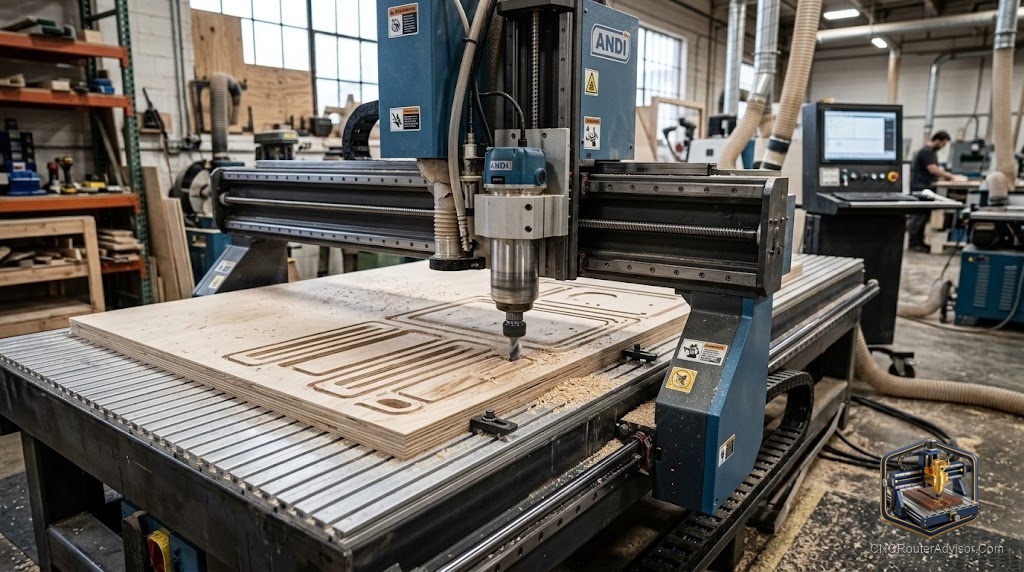
Search “Andi CNC router” and you might come away confused - is it a brand, a model, a typo? It’s a legitimate name with a real history, and clearing up what it refers to saves you a lot of wasted research. Here’s the straight story on Andi, what these machines do, and what to consider if one’s on your shortlist.
What “Andi” actually is
“ANDI” is the original CNC router brand name of Anderson Group, the Taiwanese industrial machine manufacturer founded in 1972. The Andi name debuted in 1985 and even won a Taiwan National Excellent Product Award in 1989. Over the years “Andi” and “Anderson” have been used more or less interchangeably on the company’s machining centers and routers - so an “Andi CNC router” is an Anderson industrial machine. If you’ve been comparing “Andi” and “Anderson” as if they were rivals, they’re the same family.
That also tells you the class of machine: professional and industrial CNC router systems for production shops, not hobby benches.
What these machines do
Andi/Anderson routers are built for serious material processing:
- Cabinet and furniture production with full-sheet nesting
- Sign, display, and panel work at volume
- Plastics and composite fabrication where rigidity and repeatability matter
They’re engineered for shops whose output is measured in sheets per shift, with the durability to run hard for years.
The engineering fundamentals
Whatever badge is on it, an industrial Anderson machine wins on the same fundamentals:
- Frame rigidity. Heavy welded or cast structure that suppresses chatter and holds tolerance across a large envelope.
- Motion system. Robust linear rails with servo-driven axes, keeping the X axis, Y axis, and Z axis precise at production speeds. Drives are built for the loads, whether ball screw or rack-and-pinion at scale.
- Spindle power. A high-power spindle with a proper VFD, sized for all-day cutting.
- Control. An industrial controller that ingests complex G-code and integrates with nesting software and tool changers.
Setup and ownership considerations
An Andi/Anderson machine is a facilities investment, not a delivery:
- Not on Amazon. These are sold factory-direct or through dealers (Anderson America in North America) and shipped by freight. Expect a quote-and-consultation process.
- Space and power. Industrial footprint, and typically 3-phase power.
- Installation. Rigging, leveling, and professional setup are part of the purchase.
- Workholding and dust. Plan a vacuum-table workholding system and serious dust extraction from the start.
- Support and parts. Anderson’s service network is a genuine strength - factor it into the value.
Is it right for you?
An Andi/Anderson router suits an established production shop that needs industrial throughput and can support the machine - space, power, maintenance, trained operators. For hobbyists and small shops, it’s more capacity than you need; a rigid benchtop or mid-size router teaches the same fundamentals and serves well until volume justifies going industrial. And because these machines last, there’s a used market worth exploring if you want the capability at a lower entry price - just inspect the frame, rails, ball screws, and spindle carefully, and confirm parts support for the specific model.
The bottom line
“Andi” isn’t a mystery - it’s Anderson’s original router brand, meaning an industrial-class machine built for production. Judge it on frame rigidity, motion quality, spindle and control, and the freight-and-support reality behind it. Match that to genuine production need and it’s a durable workhorse; for lighter work, start smaller and scale up when the volume calls for it.
Frequently asked questions
Is Andi a different brand from Anderson? No - “Andi” is Anderson Group’s original CNC router brand name; the two are used interchangeably.
Are Andi routers sold on Amazon? No - they’re industrial machines sold factory-direct or through dealers and shipped by freight.
Is it suitable for hobby use? Not really. These are production machines; hobbyists are better served by a benchtop or mid-size router.