Akm 1325 CNC Router Guide: Work Area, Machine Size, and Buying Factors
If you’ve been researching full-sheet machines, the “1325” designation keeps showing up - and the AKM 1325 is one of the names in that crowd. Before you get pulled into a quote, it helps to understand exactly what you’re looking at: what the numbers mean, who actually makes it, and what to weigh before committing.
Decoding “1325”
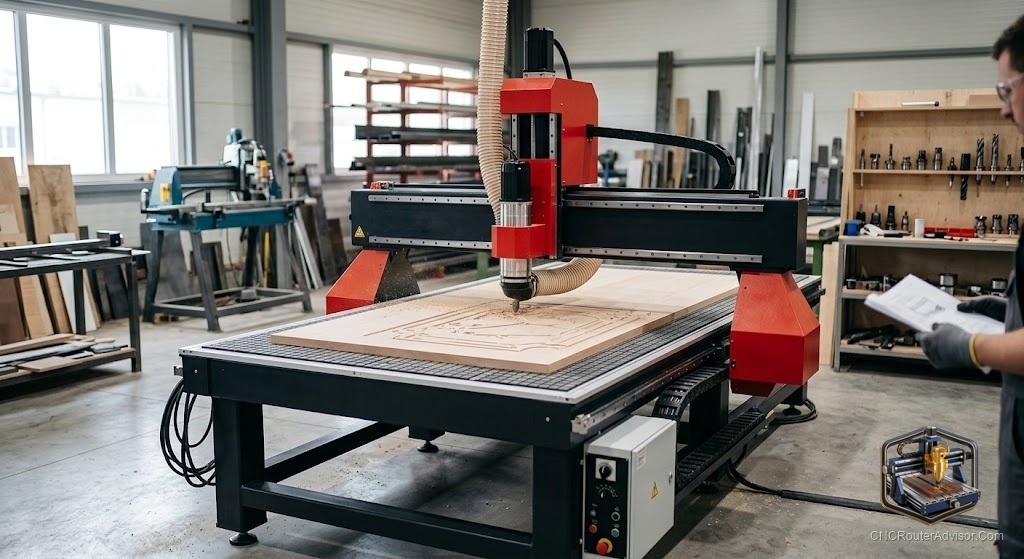
The number isn’t a model in the branding sense - it’s the work area. “1325” means roughly 1300 × 2500 mm of cutting area, which is the metric way of saying a full 4×8-foot sheet. So an AKM 1325 is a full-sheet class CNC router: a big, floor-standing machine built to process entire panels of plywood, MDF, and sign stock in one setup. That single fact tells you most of what you need to know about its footprint, weight, and price tier.
Who makes it
The AKM 1325 is produced by Jinan AccTek Machinery, a Chinese manufacturer that has been building woodworking and sign routers since the mid-2000s. It’s positioned as an entry-to-professional full-sheet machine, and like most machines in this category it’s sold factory-direct - through the manufacturer, export marketplaces, and regional distributors - rather than through consumer retail. You won’t find it on Amazon. These machines ship by freight and typically involve crating, delivery scheduling, and some setup on arrival.
What to look at on the spec sheet
Full-sheet machines live or die on a few fundamentals. When you compare an AKM 1325 quote against alternatives, focus here:
- Frame rigidity. A 1325 spans a lot of unsupported distance. Look for heavy welded steel frame construction - this is what keeps cuts accurate and suppresses chatter across the full bed.
- Motion system. Check whether the axes ride on quality linear rails and whether the drive is rack-and-pinion (common and fine for wood) or ball screw. The X axis, Y axis, and Z axis should all feel solid, with no slop.
- Spindle power. Expect an air- or water-cooled spindle in the multi-kilowatt range with a matched VFD. More spindle power means faster feeds and cleaner cuts in dense material.
- Controller. Ask which control system runs the machine and how it ingests G-code. Some ship with DSP handhelds, others with PC-based control.
- Workholding. A vacuum table is common on this class; confirm the pump is included and sized correctly, and understand your workholding options for smaller parts.
The real buying factors
Beyond specs, a full-sheet machine is a logistics and support decision as much as a hardware one:
- Freight and installation. Budget for shipping, rigging the machine into place, and power (many need 220V/3-phase). This is not a plug-and-play purchase.
- Parts and support. A machine is only as good as your ability to get a spindle, a driver, or a controller board when something fails. Ask where parts ship from and how support is handled in your region.
- Total cost. The sticker rarely includes the spindle upgrade, the vacuum pump, freight, and software you’ll want. Build the real number before comparing.
Is it right for you?
An AKM 1325 makes sense if you’re running a cabinet shop, sign business, or production woodworking operation that genuinely needs full-sheet throughput and you’re prepared for the freight-and-support reality of an imported industrial machine. If you’re a hobbyist or just proving out a business, a rigid benchtop machine will teach you the same G-code and workholding fundamentals at a fraction of the commitment - and you can scale to a 1325-class machine once the volume justifies it.
The bottom line
The AKM 1325 is a legitimate full-sheet CNC router aimed at working shops, not hobby benches. Judge it on frame rigidity, drive quality, spindle and control package, and - just as importantly - on the freight and support story behind it. Get the total delivered-and-running cost in writing before you decide.
Frequently asked questions
Can I buy an AKM 1325 on Amazon? No. Full-sheet machines like this are sold factory-direct and shipped by freight, not through consumer retail.
What does “1325” mean? It’s the work area in millimeters - about 1300 × 2500 mm, or a full 4×8-foot sheet.
Is it a good first CNC? For a working shop that needs full-sheet capacity, possibly. For a hobbyist, a benchtop machine is a far more sensible starting point.