
Affordable CNC Router 4 × 8: Budget Options and Trade-Offs
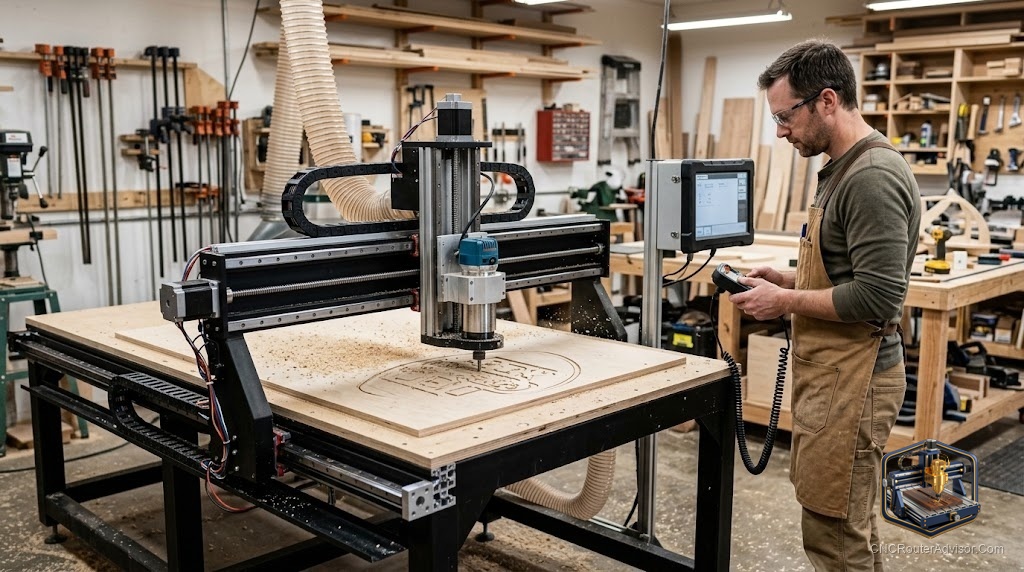
The first time you lay a full 4×8 sheet of plywood on a shop floor and imagine a machine carving it end to end without a single re-clamp, something shifts in how you think about your work. That’s the pull of the full-sheet CNC router. It’s also where budgets go to get a serious reality check. So let’s talk honestly about what “affordable” really means at 4×8 scale, and what you’re actually trading away when you chase the lowest number.
Why 4×8 is a different animal
A desktop CNC router and a 4×8 machine share a name and almost nothing else. When you stretch a gantry across 48 inches of unsupported span, frame rigidity stops being a spec sheet bragging point and becomes the whole ballgame. Flex in the gantry shows up as chatter, uneven depth, and lines that should be straight but aren’t. That’s why real 4×8 machines lean on heavy steel frame construction, robust linear rails, and a motion system driven by ball screw or rack-and-pinion rather than a timing belt that would stretch over that distance.
Everything downstream scales up too: spindle power in the 3 - 6 kW range instead of a trim router, a proper VFD to run it, and a control package built to stream G-code across a big work envelope. The X axis, Y axis, and Z axis all have to stay square across a much larger box. None of that is cheap to do well.
The uncomfortable truth about “affordable” at this size
Here’s the part most listicles skip: genuine 4×8 CNC routers are not sold on Amazon. They ship on freight pallets, often weigh over half a ton, and are sold factory-direct or through dealers who handle crating, delivery, and setup. When you see a rock-bottom “4×8 CNC” price online, it’s almost always one of three things - a machine with a smaller actual cutting area than the bed suggests, a kit that needs significant assembly and tuning, or an overseas unit where the sticker excludes freight, a spindle upgrade, and the software you’ll actually need.
That doesn’t mean affordable is impossible. It means affordable is a set of deliberate trade-offs.
Where the money goes (and where you can save)
- Drive system. Rack-and-pinion is common on budget full-sheet machines and is perfectly good for wood and sign work. A ball screw setup is smoother for fine detail but costs more. A lead screw rarely makes sense at this span.
- Spindle. An air-cooled VFD spindle around 2.2 - 3 kW is the sweet spot for hobby and small-shop budgets. Water-cooled runs quieter and cooler but adds plumbing.
- Frame. This is the one place not to cut. A light frame will haunt every cut you make.
- Controller. GRBL-class controllers keep costs down; DSP handheld or Mach-style controls add convenience and price.
A realistic path if you’re not ready for freight
If a true 4×8 is beyond this year’s budget, the smart move that a lot of makers take is to prove out the workflow on a rigid benchtop machine first, then graduate. A well-built desktop unit like the Genmitsu 4040-PRO teaches you toolpaths, feeds and speeds, and workholding on smaller stock, and it’s genuinely useful for parts even after you scale up. For makers who want a larger footprint that still ships without a freight quote, the OCASAMI 6090 spindle machine covers a 600×900 mm area - not 4×8, but a meaningful step up that lets you build revenue toward the real thing.
The bottom line
Affordable at 4×8 is real, but it lives in the world of freight, dealers, and deliberate spec choices - not one-click checkout. Protect the frame budget, right-size the spindle, and be honest about the cutting area behind the headline dimensions. And if the full sheet has to wait, there’s no shame in earning your way there on a smaller, rigid machine that pays for itself while you learn.
Frequently asked questions
Can I really get a 4×8 CNC router cheaply? You can get one affordably relative to industrial pricing, but not cheaply in the Amazon sense. Budget the freight and a spindle upgrade into your real number.
Is rack-and-pinion good enough? For wood, sheet goods, and signs, yes. If your work is fine detail or metal, prioritize a stiffer frame and screw drive.
Should I build my own 4×8? DIY kits can lower the sticker price, but the tuning and squaring across a full sheet is a real project. Build only if the learning is part of the goal.