
How to Set Up a Safe CNC Router Work Area
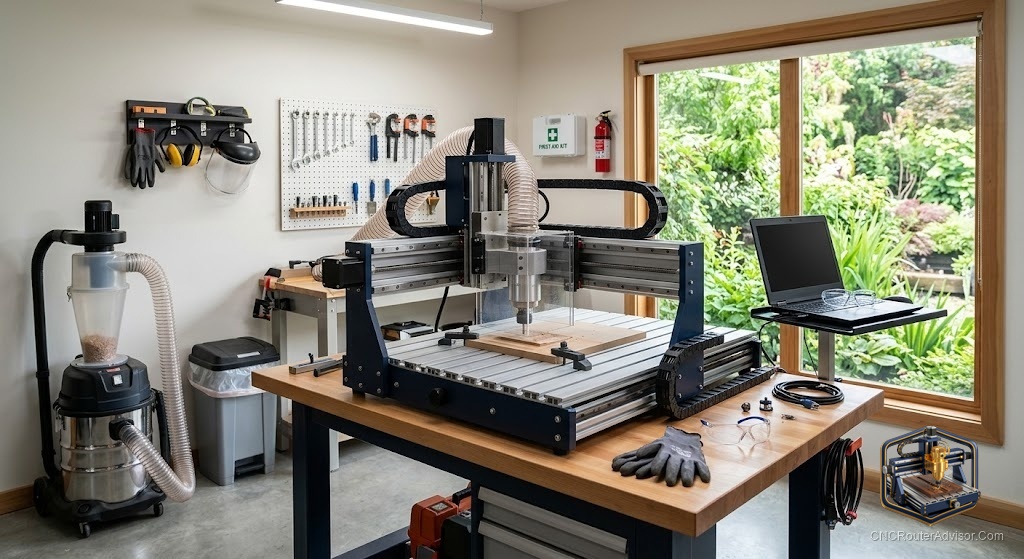
The scary CNC stories almost never involve the cutter. Nobody reaches into a running spindle. The injuries and the ruined shops come from the quiet hazards: the fine wood dust that builds up for months, the loose sleeve near a rapid move, the extension cord daisy-chained to a heater, the workpiece that was not clamped quite tight enough and became a projectile. Setting up a safe CNC router work area is mostly about respecting the boring risks, because those are the ones that actually get people.
A safe CNC router work area is a dedicated space designed to control four things: dust, fire, flying debris, and electrical load, while keeping the operator clear of moving parts and able to stop the machine instantly. You get there with good dust collection, sensible clearances, proper personal protection, an accessible emergency stop, and honest electrical planning. This guide walks through each in the order you should build them.
The short version: control the dust first (it is the biggest long-term hazard), guarantee you can hit an emergency stop without reaching over the machine, and never run the machine unattended until you have earned the confidence to. Everything else builds on those three.
Start with dust, because it is the hazard you cannot see working
Wood dust is not just messy. The U.S. Occupational Safety and Health Administration classifies wood dust as a recognized hazard linked to respiratory problems and, for certain hardwoods, nasal cancer. Fine dust also hangs in the air long after a cut and settles into every surface and lung in the room.
Build collection in from the start. A dust shoe around the bit connected to a shop vacuum or dust collector captures most chips at the source. Add ambient air filtration for the fine particles that escape, and wear a fitted respirator (not a loose paper mask) during long cutting sessions. There is a second reason this matters: accumulated fine dust is combustible, and the National Fire Protection Association treats dust buildup as a real fire and deflagration risk. A clean shop is a safer shop in more ways than one.
Give the machine clearance and the operator an escape
Plan the layout so the gantry, the material, and your body never have to compete for the same space. Leave room on every side the gantry travels, plus space to load and unload full-size stock without leaning across the cutting area.
The emergency stop is the rule that has no exceptions: you must be able to reach it instantly without reaching over or around the moving machine. Mount the e-stop where your hand goes by reflex, test it, and make sure anyone else in the shop knows where it is. A stop you have to lunge for is a stop that fails when it matters.
Protect yourself, and dress for the machine
Eye protection is non-negotiable; chips and snapped bits move fast and unpredictably. Hearing protection matters more than people expect, especially with a trim router, whose piercing noise causes real damage over long sessions. Skip the gloves near the spinning tool: loose fabric and gloves can catch and pull your hand in, which is exactly the accident you are trying to avoid. Tie back long hair, lose the dangling sleeves and drawstrings, and remove jewelry.
Secure the work, every single time
A workpiece that shifts mid-cut can climb the bit, ruin the part, snap the tool, and throw debris. Clamp to the spoilboard with mechanical clamps, or use a combination of hold-downs and, where appropriate, double-sided tape or a vacuum table for thin stock. Do a mental walk-through before you hit start: will any clamp be in the tool’s path? Will the part stay put through the deepest pass? Thirty seconds of checking saves a broken bit and a possible injury.
Plan the electrical load honestly
A spindle, a VFD, a dust collector, a shop vac, and a computer add up fast. Do not run all of it through one tired outlet or a chain of power strips. Give the machine and its dust collection adequate dedicated circuits, keep water-cooled spindle lines and coolant away from electronics, and route cables so they cannot be caught by the gantry or walked on. If any of this is beyond your confidence, a licensed electrician is cheaper than a fire.
The habit that keeps you safe: attend the machine
The single most important safety practice is not a tool, it is a habit: stay with the machine while it runs, at least until you deeply know its behavior on a given job. Fire, a shifted workpiece, or a broken bit all announce themselves early to someone watching, and not at all to an empty room. Unattended operation is how a small problem becomes a call to the fire department.
The bottom line
A safe CNC router work area is built around the hazards people ignore: dust first, then instant access to an emergency stop, then protection, workholding, and electrical load. Set up collection and filtration before you chase clean carves, mount an e-stop you can hit by reflex, dress for a spinning tool, clamp like it matters (because it does), and stay in the room. Do those, and the machine stays the reliable workhorse it should be instead of the source of a story you did not want to tell.
Frequently asked questions
Is CNC router dust really dangerous? Yes. OSHA recognizes wood dust as a respiratory hazard, and certain hardwood dusts are linked to nasal cancer. Fine dust also lingers in the air and is combustible in accumulation, so collection and filtration are essential.
Do I need to be present while the CNC router runs? Until you know a job’s behavior well, yes. Fire, shifted workpieces, and broken bits give early warning to someone watching. Unattended running is a common cause of serious shop incidents.
What personal protection should I wear? Eye protection always, hearing protection during long or router-powered cuts, and a fitted respirator for extended cutting. Avoid gloves near the spinning tool and remove loose clothing and jewelry.
Where should the emergency stop be? Within instant reach without reaching over or around the moving machine, mounted where your hand goes by reflex. Test it and make sure everyone in the shop knows its location.
How do I keep a workpiece from moving during a cut? Clamp firmly to the spoilboard, use hold-downs or a vacuum table for thin stock, and check that no clamp is in the tool’s path and the part will hold through the deepest pass before starting.
What are the electrical requirements for a CNC router setup? Provide adequate dedicated circuits for the machine and dust collection rather than overloading one outlet or power strips. Keep coolant and water lines clear of electronics and route cables safely. Use a licensed electrician if unsure.
References
- U.S. Occupational Safety and Health Administration, wood dust hazard information (osha.gov)
- National Fire Protection Association, combustible dust guidance (nfpa.org)
- Wood Magazine, “A Buyer’s Guide to Benchtop CNC Machines” (woodmagazine.com)