
Accu-Cut CNC Router Guide: What It Is and What to Know Before You Buy
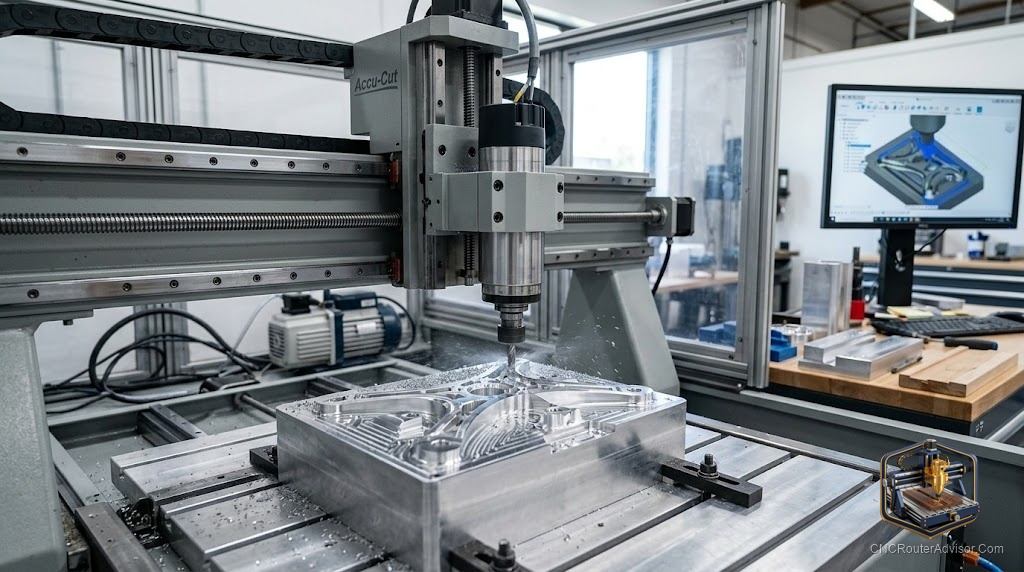
You searched “Accu Cut CNC router” and landed here after wading through results that mix die-cut machines, vinyl plotters, and generic search noise. Let me tell you what “Accu Cut” in the CNC router context usually points to, and what the actually useful machine comparison looks like.
“Accu-Cut” or “AccuCut” appears in the CNC world in a couple of contexts. The most well-known Accu-Cut brand is a die-cut system used in classrooms and craft applications, which is not a CNC router at all. That machine cuts paper, foam, and thin fabric using physical steel-rule dies, not computer-controlled cutter paths. In the CNC router space, “Accu Cut” sometimes refers to aftermarket table extensions and router sled systems used alongside hand routers, and sometimes it appears as a descriptor (accurate cut) in generic product listing language rather than a formal brand name.
Here is the honest orientation: if you are searching for a precision CNC router capable of cutting wood, acrylic, and soft metals, the term “Accu Cut” is unlikely to lead you to a machine in that class. The field you are looking for is the CNC router category broadly, and what you want to evaluate is frame, motion system, spindle, and controller, not a brand name.
What matters when you want a precise CNC router cut
Accuracy in CNC routing is not mainly about brand name. It is about these four things:
Motion system. Ball screws deliver near-zero backlash and hold position accurately after thousands of cycles. Lead screws develop backlash over time and flex slightly under cutting load. Timing belts are elastic and change length with temperature and load. For precise, repeatable cuts, ball screws on all axes are the specification that matters.
Linear guides. Square profile rails with recirculating blocks guide each axis and carry cutting load stiffly. Round rod rails and V-wheels on extrusion flex more under side load. For tight tolerances in hardwood and aluminum, square profile rails are the right choice.
Spindle runout. Runout is how much the bit tip wobbles off center as the spindle turns. A quality water-cooled spindle with low runout holds the bit centered better than a cheap motor with loose bearings. Runout adds to tool wear and surface roughness.
Frame rigidity. Any flex in the gantry or bed under cutting force pushes the bit off its programmed path. A stiff frame holds dimension across a long cut. A flexy frame drifts.
These four factors are what “accurate cutting” actually reduces to, regardless of what brand name is on the side of the machine.
CNC routers built for precision cuts you can actually buy
Three verified machines across different size classes where the accuracy specs are confirmed:
Desktop class: Genmitsu 3018-PROVer V2
A 300x180mm desktop machine with limit switches on all axes, a Z-probe, and lead screw drive. Lead screws (not ball screws) in this class are appropriate for the loads involved: the cutting forces on a 300mm machine are much smaller than on a 600mm production machine, so the lead screws hold accuracy well over time.
Honest flaw: the 40mm Z travel is restrictive. For work on thick stock, you hit the gantry clearance limit quickly.
Mid-size class: Genmitsu 4040-PRO
A 400x400mm aluminum-extrusion machine with dual Y-axis motors and GRBL control. The symmetric dual-motor Y drive keeps the gantry from racking, which is a practical accuracy concern on wider machines running a single motor.
Honest flaw: the 300W spindle limits depth of cut in dense hardwood. Upgrade path to a higher-power spindle is available but adds cost.
Large desktop class: OCASAMI 2.2KW 4-Axis 6090
A 900x600x140mm machine with ball screws on all three axes, a 2.2kW water-cooled spindle with ER20 collet, and a proper Mach3 controller. Ball screws and the water-cooled spindle together put the accuracy of this machine in a different tier from belt-driven hobby machines.
Honest flaw: Mach3 control requires a 32-bit Windows computer. Modern 64-bit Windows is not compatible without a VM or a dedicated older PC.
Understanding repeatability vs. accuracy
Two terms that are related but not the same:
Accuracy is how close the actual position matches the commanded position on the first attempt. A machine with 0.05mm accuracy moves to within 0.05mm of where you told it to go.
Repeatability is how consistently the machine returns to the same position across multiple moves. A machine with 0.02mm repeatability will hit the same spot within 0.02mm every time it revisits a position, even if that spot has a slight offset from the absolute programmed position.
For most CNC woodworking, repeatability matters more than absolute accuracy. Your parts need to match each other, not match an absolute coordinate. Ball screws with low backlash give you excellent repeatability, which is why they matter even for wood work.
Practical accuracy tips for any CNC router
-
Surface your spoilboard. Cuts are only as deep as the machine thinks they are. A non-flat spoilboard introduces Z depth variation across the bed that no amount of motion accuracy can compensate.
-
Use a Z-probe. Manual bit height setting with the paper method introduces variation. A touch plate is consistent to fractions of a millimeter every time.
-
Keep the collet clean. Resin and dust in the collet bore let the bit rock slightly, adding effective runout. Clean the collet bore before every significant run.
-
Check backlash. On lead screw machines, re-tighten or replace the anti-backlash nut when you notice dimensional drift on parts that used to come out correctly.
-
Tram the spindle. A spindle that is not perpendicular to the bed leaves a rippled surface on facing passes and introduces Z error in deep pockets.
FAQ
What is Accu-Cut? The most common Accu-Cut brand is a die-cut system for classrooms and craft use, which cuts paper and foam with physical dies, not a CNC router. In CNC router contexts, “Accu Cut” is sometimes used as a descriptor in listings rather than a formal brand.
What makes a CNC router cut accurately? Ball screws for low backlash, square profile linear rails for rigid guidance, a low-runout spindle, and a stiff frame. These four factors determine accuracy more than brand name.
Is a ball screw significantly more accurate than a lead screw? For repeatability in production use, yes. Ball screws have near-zero backlash and stay accurate over many cycles. Lead screws develop backlash as they wear and require periodic re-tightening of the anti-backlash nut.
What is spindle runout and why does it matter? Runout is how much the bit tip wobbles off its true centerline as the spindle turns. High runout widens cuts, roughens surfaces, and accelerates edge wear on the bit. Quality water-cooled spindles typically have lower runout than cheap DC motors.
Can I improve accuracy on an existing machine? Yes. Surfacing the spoilboard, using a Z-probe, cleaning the collet regularly, checking and tightening anti-backlash nuts, and tramming the spindle all improve practical accuracy without hardware upgrades.
References
- AccTek CNC, “Understanding the Perils of Spindle Runout in CNC Routers”: https://acctekcnc.com/understanding-the-perils-of-spindle-runout-in-cnc-routers/
- cncrouterinfo.com, “How to Choose a CNC Router”: https://cncrouterinfo.com/guides/how-to-choose-a-cnc-router/
- Tormach, “Measure and Fix Spindle Runout”: https://tormach.com/articles/measure-fix-spindle-runout-tool-life-killer