CNC Router Accessories Guide: The Add-Ons That Make Your Machine Work Better
You unbox the machine, get it running, and cut your first test piece. Then you realize the chip dust is going everywhere, your workpiece shifted at minute twelve of a twenty-minute job, and the bit you want is the one size not in the starter kit. The machine is the starting point. The accessories are what turn it into a setup you can actually rely on.
CNC router accessories are the tools, attachments, and consumables that complement the base machine. Some are functional necessities that you need before the first real cut (workholding, dust collection, bits). Others are upgrades that raise the machine’s capability (better collets, a spindle upgrade, a probe). Knowing which category you are buying from, and when, keeps you from spending money on things that do not help yet.
Here is the short answer on priorities: workholding and dust collection before anything else. A part that moves ruins a cut. Dust in the spindle bearings costs you the spindle. Both are immediate-day-one requirements. Everything else is a performance upgrade you add as your workflow clarifies.
Workholding accessories: keeping the part still
Workholding is how you hold the workpiece flat and still while the cutter runs. A movement of even 0.5mm mid-cut ruins the part and risks breaking the bit.
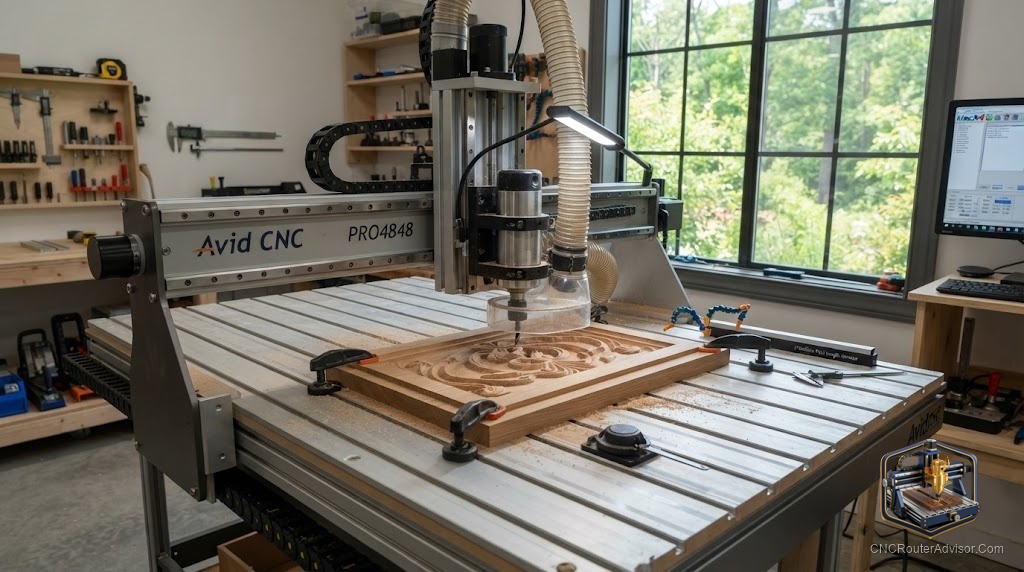
T-slot clamps and hold-downs. The mechanical standard. Low-profile designs keep the clamp body below the bit path. Step clamps let you adjust height to match different stock thicknesses. For T-slot tables or spoilboards with threaded inserts, these are the everyday solution.
Cam clamps. A quick-release low-profile clamp that locks flat against the spoilboard. Faster to set up than step clamps for repeat setups.
Tape and CA glue (the tape-and-glue method). Painter’s tape on the spoilboard and workpiece bottom, CA glue between the tape layers, pressed together. Strong grip, no shadows from clamp bodies in the cutting path, releases clean with isopropyl alcohol. One of the most practical methods for flat stock and sign blanks.
Vacuum pods and vacuum table. A vacuum system holds the workpiece down by suction rather than mechanical clamping. The advantage is that the entire workpiece surface is clear of clamps. Vacuum tables are standard in production shops. Vacuum pods work on smaller hobby machines.
Spoilboard with threaded inserts. A secondary sacrificial surface bolted to the machine bed, with M6 or M8 threaded holes at a regular grid spacing. Lets you bolt directly into the spoilboard at any position.
Verified picks:
- Genmitsu CNC T-slot clamp set: a complete workholding kit with T-slot nuts, step clamps, and clamping bolts sized for standard hobby machine table slots
- POWERTEC quick-action cam clamp set: low-profile cam clamps that work on T-slot tables and threaded spoilboards
Dust collection accessories
CNC routing generates fine dust and chips that should not go into your lungs, your spindle bearings, or your lead screws. Dust collection is a day-one requirement, not an optional upgrade.
Dust shoe. A brush-skirted housing that surrounds the spindle and connects to a vacuum hose. The shoe rides just above the workpiece surface, capturing chips at the source before they spread. Available for most standard 65mm-mount spindles.
Cyclone separator. Sits between the dust shoe hose and the shop vacuum. Spins the air so chips and heavy dust drop into a collection bin before reaching the vacuum filter. Extends vacuum filter life dramatically and improves suction over time.
Shop vacuum vs. dedicated dust collector. A shop vacuum handles light hobby use. A dedicated dust collector (minimum 1HP, preferably 1.5HP or more) is the right tool for production use.
Verified picks:
- Genmitsu dust shoe for 65mm mounts: fits the standard 65mm router body, height-adjustable brush skirt
- Oneida Air Systems Super Dust Deputy cyclone: the most widely recommended cyclone separator for hobby CNC and woodworking
Collets and tool holders
The collet is the small metal sleeve in the spindle that grips the bit shank. Collet quality directly affects runout (how much the bit wobbles off center), which directly affects surface finish.
Collet sets for different shank sizes. Most hobby spindles ship with ER11 collets in one or two sizes. An ER11 collet set from 1mm to 7mm gives you flexibility for different bit shanks. For larger spindles with ER20 collets, a set covering 6mm, 8mm, 10mm, and 12mm expands your bit options significantly.
Elaire Corp metric collets for trim routers. The Makita RT0701C and DeWalt DWP611 come with 1/4-inch collets. Elaire Corp makes metric replacement collets (3mm, 4mm, 5mm, 6mm) for these routers, letting you run European metric tooling without an adapter.
Verified picks:
- Genmitsu ER11 collet set 1-7mm: a complete ER11 collet set for hobby spindles
- Elaire Corp Makita-compatible 1/4-inch and 6mm collet set: replacement precision collets for the Makita RT0701C
Probe and Z-setting accessories
A tool-setting probe automatically sets the Z-axis zero when you change bits. It is a flat plate with a known thickness; you touch the bit to the plate, and the controller records the exact Z position. This eliminates the manual paper-thickness Z-zero method and makes bit changes repeatable.
Z-probe / tool length sensor. A conductive plate and a connector. The machine lowers the bit slowly until contact is made, then records the position. Takes about 10 seconds versus 2 minutes of manual zeroing.
3D touch probe. A probe tip that contacts the workpiece from any direction to map surface position, find the center of a hole, or set X-Y-Z origin from a physical feature. Used for work on partially machined parts, part registration, and surface scanning.
Verified picks:
- Genmitsu Z-probe for GRBL machines: a straightforward Z-touch plate with the cable and clip to connect to a GRBL controller
Bits and tooling
Bits are consumables, but the type you buy determines what you can make. The practical starter set covers four geometries:
- Upcut spiral end mill (6mm or 1/4-inch shank) for pockets and profiles in wood
- V-groove bit (60 and 90 degree) for lettering and engraving
- Ball-nose end mill for 3D relief carving
- Surfacing bit (spoilboard cutter) for facing the spoilboard flat
Verified picks:
- Genmitsu VG05A V-groove set, 5 angles, 1/4-inch shank
- SpeTool 1/4-inch upcut carbide spiral router bit set
Spindle upgrades
For machines that ship with a small DC motor or an 80W brushed spindle, upgrading to a more powerful unit is often the most impactful single change.
65mm spindle upgrade (500W to 800W). Fits into the same 65mm mount as the original motor or a trim router. Typically ER11 collet, fixed speed range, suitable for harder wood and denser plastics.
Water-cooled VFD spindle kit. A full upgrade for machines that can support it: spindle motor, VFD, water pump, and hose. The step up to a water-cooled spindle is the right move when a trim router is too loud or when you need the wider speed range.
When to buy what
| Priority | Accessory | Why |
|---|---|---|
| Day one | Workholding (clamps or tape/glue) | Parts that move ruin cuts |
| Day one | Dust shoe and shop vacuum | Dust collection is health and machine maintenance |
| Week one | Z-probe | Makes bit changes fast and repeatable |
| Month one | Better collet (Elaire Corp or ER11 set) | Reduces runout, improves surface finish |
| Month one | Spoilboard surfacing bit | Ensures consistent Z depth across the bed |
| Month three | Spindle upgrade | After you have outgrown the stock motor |
| When needed | Additional bit types | Buy as projects demand them |
FAQ
What accessories do I need on day one of CNC routing? Workholding (clamps, cam clamps, or the tape-and-glue method) and dust collection (dust shoe plus a shop vacuum at minimum). Everything else can wait until you know what your workflow actually needs.
Does a better collet really matter? Yes. Runout from a poor collet shows up as rough surface finish, particularly on V-carve detail work and small-diameter bits. A quality ER11 collet set and a clean collet bore make a measurable difference.
What is a Z-probe and do I need one? A Z-probe is a touch plate that automatically sets the cutter height when you change bits. You do not strictly need one, but it turns a 2-minute manual step into a 10-second repeatable process and eliminates one of the most common sources of depth error.
Can I upgrade the spindle on my hobby CNC? Usually yes, if the Z carriage accepts a 65mm mount. Many hobby machines can be upgraded to a 500W or 700W spindle using the same mount. Water-cooled spindle upgrades require additional clearance for the hose routing.
What dust collection do I need for a hobby CNC? At minimum, a dust shoe attached to the spindle and a shop vacuum. Add a cyclone separator to extend vacuum filter life and maintain suction over long jobs. For production use, a dedicated 1HP or larger dust collector is the better tool.
References
- cncrouterinfo.com, “How to Choose a CNC Router”: https://cncrouterinfo.com/guides/how-to-choose-a-cnc-router/
- Tormach, “Measure and Fix Spindle Runout”: https://tormach.com/articles/measure-fix-spindle-runout-tool-life-killer
- SainSmart, “CNC Router Accessories” resource: https://www.sainsmart.com