8020 CNC Router Explained: Uses, Setup, and Key Considerations
You are searching for an 8020 CNC router, and the results split in two directions: aluminum extrusion frame builds and a cleaning product with a similar name. You want the machine. Here is the orientation you need before you go any further.
“8020” in the CNC world is an alternate spelling of “80/20,” which itself is shorthand for 80/20 Inc., the company that made T-slot aluminum extrusion a standard material for modular machine frames. The slash gets dropped in casual search queries: “80 20 cnc router” and “8020 cnc router” and “80/20 cnc router” all mean the same thing. Any machine built with T-slot aluminum extrusion as the structural frame falls under this name.
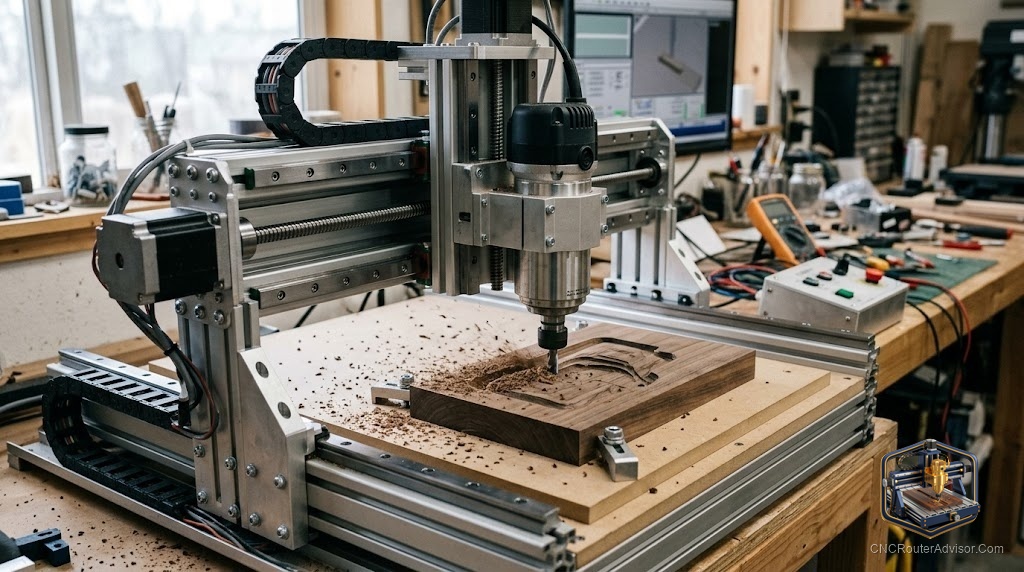
Here is what that means in practice: an 8020 CNC router is a machine where the frame is made of aluminum extrusion profiles with T-shaped slots running along the faces. Components bolt into those slots using T-nuts, letting you assemble, adjust, and expand the machine without drilling or welding. The drive system, spindle, and controller determine what it can cut. The extrusion is just the skeleton.
Why T-slot extrusion became the default for DIY CNC builds
Before T-slot extrusion became widely available from Chinese suppliers at low cost, DIY CNC builders used welded steel tube, threaded rod, or plywood as frame material. Each had real drawbacks: steel required welding skill and post-weld surfacing, threaded rod was imprecise, and plywood flexed with humidity.
T-slot extrusion solved multiple problems at once. You cut it with a cold saw or a chop saw with a metal blade. You join pieces with standard bolts and T-nuts. You square the frame with a precision square and re-tighten. If a joint needs to move, you loosen one bolt instead of grinding a weld. The result is a frame that a non-machinist can build in a weekend and re-tune whenever needed.
The tradeoff: T-slot extrusion is less rigid than welded steel of comparable mass, and it transmits vibration differently. For wood, plastic, and light metal work on a properly built frame, it is entirely adequate. For high-force metal cutting or aggressive feed rates, welded steel or cast iron is the better base.
Profile sizes and what they mean
The number code on extrusion profiles tells you the cross-section in millimeters. The first two digits are one dimension, the second two are the other.
- 2020 (20mm x 20mm): the light standard. Used in mini and desktop builds, gantry arms on small machines, and accessory mounts.
- 2040 (20mm x 40mm): stiffer than 2020 in one plane. Common for gantry cross-members and Y-axis rails on desktop machines.
- 4040 (40mm x 40mm): significantly stiffer. The practical minimum for a mid-size machine that will cut hardwood.
- 4080 and 8080: reserved for large-format and production-scale base structures.
For an 8020 CNC router aimed at hardwood or aluminum, 4040 profiles on the base and at least 2040 on the gantry is the sensible starting specification.
What decides the cut quality
The extrusion is not what makes an 8020 CNC router good. These four parts are:
Linear rails. Rails guide each axis under load. Round supported rod rails are the entry option; square profile linear rails with recirculating blocks are the upgrade. Square profile rails deflect less under side load, which directly improves edge quality in hard material.
Drive system. Ball screws are the right call for any machine that will cut hardwood or metal. They run with low friction and minimal backlash, which means the machine returns to the correct position repeatedly. Lead screws work for light engraving but wear and develop play over time. Timing belts are fast but elastic.
Spindle. A trim router in a 65mm mount is the simplest entry point and adequate for soft wood and plastic. A water-cooled spindle with a VFD adds precise speed control, lower runout, and quieter operation for longer jobs.
Controller. GRBL is the standard for DIY 8020 builds. It runs on affordable hardware, supports all standard G-code, and has a large community. Mach3 or LinuxCNC are alternatives for users who need more advanced features.
Two verified picks for builders who want quality drive parts on Amazon:
- CNCTOPBAOS ball screw set (SFU1605, 400mm) covers the drive components for a mid-size DIY axis
- Genmitsu 3020-PRO MAX is a finished T-slot extrusion machine that demonstrates what a well-assembled 8020-style build delivers
Setup process in plain language
Assembly starts with cutting extrusion to length, loading T-nuts into the slots, and bolting the frame together. For a desktop-class machine, the mechanical assembly is a half-day job. For mid-size machines, plan a full day.
Squaring takes longer than assembly. The gantry must be perpendicular to the bed on both axes, and the Z must be plumb. Measure diagonals with a tape before you tighten anything permanently. An out-of-square frame produces parallelogram parts even when the G-code is correct.
Wiring is the second challenge. Each stepper motor needs a driver channel. The spindle needs a relay or VFD connection. Limit switches go on each axis for homing. Drag chains keep cables from catching on moving parts. Use shielded cable for stepper motor leads to reduce electrical noise.
Software configuration follows. For GRBL, you set the steps per millimeter for each axis, the acceleration limits, and the maximum feed rate. You then surface the spoilboard, tram the spindle, and run a test cut before the first real job.
Typical uses for an 8020 CNC router
A well-built 8020 machine in the desktop to mid-size range handles:
- Signs, name plates, and decorative lettering in wood and MDF
- Relief carving in hardwood and softwood
- Inlay work where tight tolerances matter
- Prototype parts in acrylic, HDPE, and engineering plastics
- Small aluminum parts with light passes on a rigid frame
- PCB milling and isolation routing
Should you build or buy?
This is the real question under most “8020 cnc router” searches.
Build if: the building process is part of what you want, you want to understand every component, and you are comfortable with multi-weekend projects that involve mechanical assembly, wiring, and software configuration.
Buy if: you want to cut parts as soon as possible, and the machine is a tool rather than a project. A finished machine from a maker like SainSmart, Genmitsu, or OMIO ships assembled, calibrated, and with support documentation.
The total outlay is often similar. Where they differ is in time, flexibility, and depth of knowledge.
Verdict
An 8020 CNC router built well on 4040 extrusion, with square linear rails, ball screws, and a proper spindle, matches or exceeds the rigidity of many commercial mid-size machines. The extrusion frame is adjustable, expandable, and requires no specialized tooling to assemble.
Four things to confirm before you commit:
- Profile size matches your work: 4040 minimum for mid-size hardwood cutting.
- Square profile linear rails, not round rod, for anything harder than soft wood.
- Ball screws, not lead screws, for a machine you plan to use for more than casual engraving.
- A complete wiring diagram for your specific controller before you buy any electronics.
FAQ
Is 8020 the same as 80/20? Yes. “8020,” “80/20,” and “80 20” all refer to the same T-slot aluminum extrusion system popularized by 80/20 Inc. The slash is dropped in casual usage.
What is the difference between 2020, 2040, and 4040 extrusion? The numbers are the cross-section dimensions in millimeters. Larger profiles are stiffer and heavier. 2020 is for lightweight desktop builds. 4040 is the minimum for a mid-size machine that will cut hardwood.
Can an 8020 CNC router cut aluminum? Yes, with a rigid enough frame, ball screws, and a proper spindle. Thin desktop frames on 2020 profiles flex too much for aluminum. A 4040-based mid-size build with square linear rails handles light aluminum cutting.
Do I need welding skills to build an 8020 router? No. T-slot extrusion assembles entirely with bolts and T-nuts. That is the system’s main advantage over steel welded frames.
What controller should I use on an 8020 build? GRBL is the standard for DIY builds. It is free, runs on inexpensive hardware, and pairs with free senders like Candle or UGS. For advanced users, LinuxCNC or Mach3 offer more features.
Where do I find 8020 CNC router plans? Instructables and OpenBuilds both have free plans. Etsy sellers offer more complete paid plans with wiring diagrams included. OpenBuilds machines use compatible extrusion and their documentation is thorough.
References
- cncrouterinfo.com, “How to Choose a CNC Router”: https://cncrouterinfo.com/guides/how-to-choose-a-cnc-router/
- cnc-dad.com, “Best CNC Router for Beginners”: https://www.cnc-dad.com/blog/best-cnc-router-for-beginners/
- 80/20 Inc. T-Slot Extrusion reference: https://8020.net