4-Axis CNC Router Machine: What the Fourth Axis Adds
Most CNC routers sold as 4-axis machines spend 90% of their time running as 3-axis machines. The fourth axis is there for the jobs that make it essential: a table leg that needs fluting all the way around, an award cylinder with engraved text wrapping the circumference, a decorative column that requires relief carving on every face. Those jobs justify the cost and setup complexity. If your work doesn’t include any of them, the fourth axis is an impressive number on a spec sheet that you’ll rarely use.
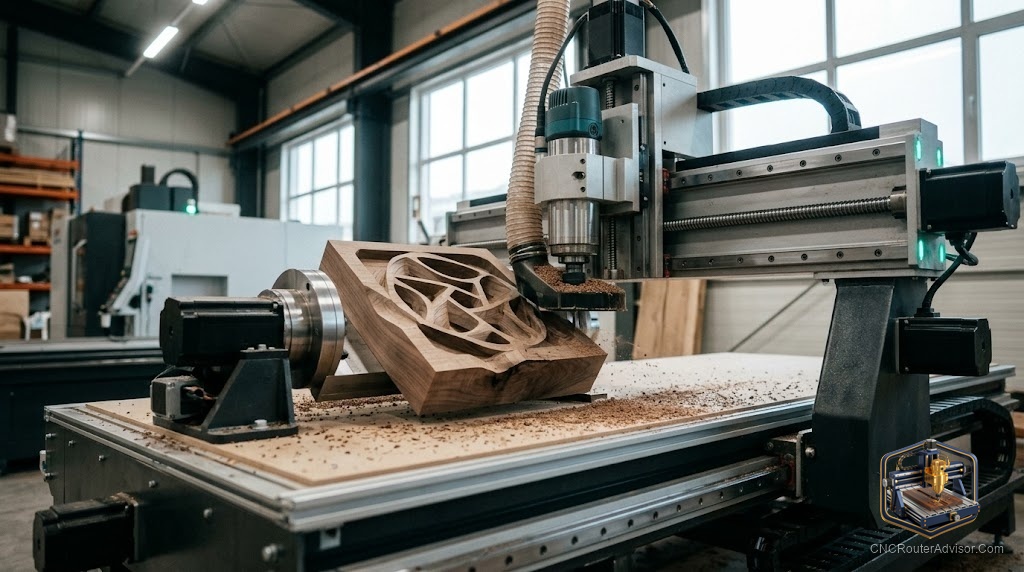
A 4-axis CNC router machine adds a rotary A axis to the standard X, Y, and Z of a 3-axis router. The A axis rotates the workpiece (or the tool head, on some configurations) during the cut, enabling circumferential carving, wrapped engraving, and production of round or cylindrical forms.
The direct answer: for hobbyist and small-shop use, the most practical 4-axis machine is either the Sienci LongMill MK2 with the Vortex rotary accessory or a dedicated 4-axis machine in the 6040 to 6090 format with a verified-quality rotary axis. The fourth axis adds real capability; the question is whether your work needs it enough to justify the additional setup time per job.
Two Types of 4th-Axis Operation
Indexing: The A axis rotates the workpiece to a fixed angle, locks, and the machine cuts the exposed face as a standard 3-axis operation. Rotates to another angle, cuts again. This is the simplest 4-axis operation and works with any 3-axis CAM toolpath.
Simultaneous 4-axis: All four axes move at the same time. The tool wraps continuously around the workpiece surface. This produces seamless cylindrical carvings and wrapped designs that indexing cannot achieve. Requires 4-axis CAM toolpaths (Aspire, Fusion 360).
Applications That Justify the 4th Axis
Furniture legs: Fluted or spiral-carved legs that require continuous carving around the circumference. Indexing can produce flat facets; simultaneous 4-axis produces smooth flutes.
Award and trophy work: Corporate award cylinders with engraved text and logos wrapping around the surface. High-volume production benefits from the 4th axis’s ability to produce seamless results without repositioning.
Architectural columns: Decorative columns with relief carving, reeding, or fluting that must appear consistent from every viewing angle.
Wooden vessels and sculptures: Bowls, vases, and small sculpture forms carved in the round.
Comparison: 3-Axis vs. 4-Axis for Table Leg Production
| Approach | Method | Seam | Setup Time per Part |
|---|---|---|---|
| 3-axis two-sided | Two setups, manual flip | Visible if not aligned | Long |
| 4-axis indexing | Multiple fixed angles | Slight facets at transitions | Medium |
| 4-axis simultaneous | Continuous wrapping | None | Short after setup |
Verdict
The fourth axis adds genuine capability for cylindrical work, wrapped designs, and furniture leg production. For shops where these applications appear regularly, it’s worth the additional cost and setup investment. For shops that rarely cut cylinders, the fourth axis adds complexity without frequent payoff.
- 4th axis useful for: table legs, award cylinders, columns, wrapped designs
- Indexing mode works with 3-axis toolpaths; simultaneous 4-axis requires specialized CAM
- Sienci Vortex + LongMill: best hobbyist 4-axis machine combination
- If cylindrical work appears fewer than once a month, evaluate whether the complexity is worthwhile
FAQ
What is the 4th axis on a CNC router? A rotary A axis that rotates the workpiece during cutting, enabling circumferential carving without manual repositioning.
What is the difference between indexing and simultaneous 4-axis? Indexing rotates to fixed angles and cuts at each angle sequentially. Simultaneous 4-axis moves all four axes together continuously, producing seamless results.
What CAM software generates 4-axis rotary toolpaths? Vectric Aspire and Fusion 360 both support 4-axis rotary toolpath generation.
References
- Sienci Vortex: sienci.com/vortex
- Vectric Aspire rotary: vectric.com