
3D Scanner for CNC Router: Which Scanners Work and How to Choose
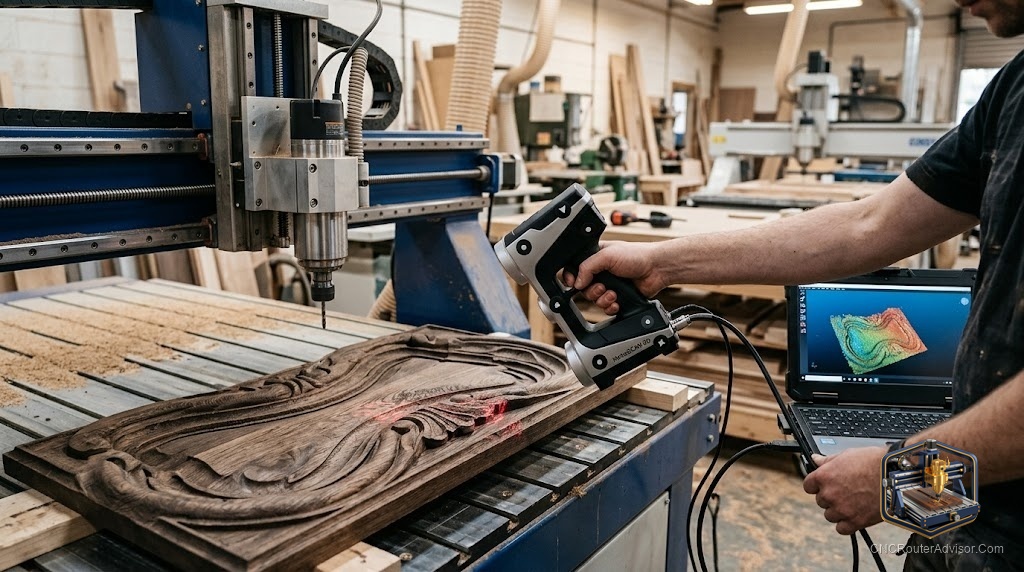
The Revopoint was popular with CNC woodworkers before most of the CNC community realized structured light scanning had come down to an accessible price. The reason is simple: a 3D scanner that can capture a carved decorative element in 15 minutes and output an STL that imports cleanly into Aspire is worth significant time savings in a restoration or reproduction workflow. The question is which scanner to buy for this specific use case.
A 3D scanner for CNC router use is a device that captures the three-dimensional surface geometry of a physical object and converts it to a mesh file (STL or OBJ) for import into CNC CAM software. The key metrics for CNC woodworking use are scan accuracy, surface coverage on organic shapes, mesh output quality, and software compatibility with Aspire, Carveco, and Fusion 360.
The direct answer: for most CNC woodworking applications, the Revopoint RANGE 2 (ASIN: B0CNYSYWCD) provides the best combination of scan quality, usability, and price for this specific workflow. The Artec Eva is more accurate but significantly more expensive. Photogrammetry (Meshroom, free) is a viable low-cost alternative for users already equipped with a decent camera.
Scanner Types for CNC Use
Structured Light Scanners (Active)
Project a pattern onto the object and measure the distortion using dual cameras. Fast, accurate, work indoors without natural light. The Revopoint RANGE 2 and Artec Eva are this type.
Best for: Medium to large carved objects, architectural elements, furniture hardware, decorative carvings in matte surfaces.
Handheld Laser Scanners
Project laser lines and capture them with cameras. Typically very accurate, often used in industrial reverse engineering. More expensive than structured light scanners at equivalent accuracy.
Photogrammetry
Captures the object in many photographs and reconstructs geometry computationally. Meshroom (free) and RealityCapture are the main tools. Cost is zero for the software; requires careful photography technique for good results.
Best for: Budget-conscious users, large objects, users willing to invest in the photography and processing workflow.
Revopoint RANGE 2
The RANGE 2 handles objects from hand-size to room-size with structured light scanning. RevoScan software exports to STL directly.
What works well: Carved wood panels, furniture details, architectural trim, medium-size carved figures. The scan quality is sufficient for CNC relief carving reproduction.
Concrete flaw: Dark surfaces (dark-stained walnut, ebony) scan poorly without white scanning spray. Highly reflective surfaces (lacquered pieces, metal hardware) cause scan failures without preparation.
Artec Eva
Professional-grade handheld structured light scanner. Higher accuracy than Revopoint, better surface handling, industry-standard in reverse engineering and product design.
Concrete flaw: Significantly more expensive than the Revopoint RANGE 2. For CNC woodworking applications where 0.5mm accuracy is sufficient, the additional precision of the Artec Eva is often unnecessary.
Photogrammetry (Meshroom)
Free, requiring only a camera and a computer with a capable GPU. Capture 50 to 100 overlapping photos of the object and let Meshroom reconstruct the geometry.
Concrete flaw: Results are highly dependent on photography quality, lighting, and surface texture. Smooth, uniform, or reflective surfaces produce poor photogrammetry results. Post-processing time is longer than structured light scanning.
Comparison
| Scanner | Type | Accuracy | Surface Handling | Cost |
|---|---|---|---|---|
| Revopoint RANGE 2 | Structured light | ~0.05mm | Good on matte | Mid |
| Artec Eva | Structured light | ~0.1mm | Excellent | High |
| Photogrammetry | Passive | Variable | Poor on uniform | Free |
Verdict
For CNC woodworking reproduction and reverse-engineering work, the Revopoint RANGE 2 is the most practical choice at an accessible price. Use white scanning spray on difficult surfaces. For users on a budget who can invest time in photography, Meshroom photogrammetry produces usable results on textured organic objects.
- Revopoint RANGE 2: best practical scanner for CNC woodworking applications
- Artec Eva: more accurate but costs significantly more; necessary for high-precision work
- Photogrammetry: free but requires photography skill and longer processing
- White scanning spray is necessary for dark or reflective surfaces with any scanner
FAQ
What is the best 3D scanner for CNC woodworking? For most users, the Revopoint RANGE 2. For industrial accuracy requirements, the Artec Eva.
Does the Revopoint RANGE 2 work with Vectric Aspire? Yes. Export the scan as STL from RevoScan and import into Aspire for toolpath generation.
Can I use photogrammetry for CNC reproduction work? Yes, with caveats. Works well on textured organic surfaces. Fails on smooth, shiny, or uniformly colored objects.
How accurate does a scanner need to be for CNC carving? For decorative carving, 0.5mm accuracy is sufficient. The Revopoint RANGE 2 achieves better than this in good conditions.
References
- Revopoint RANGE 2: revopoint3d.com
- Meshroom (photogrammetry): alicevision.org/software/meshroom
- Artec Eva: artec3d.com