
Converting a 3D Printer to a CNC Router: Whats Involved and Whether Its Worth It
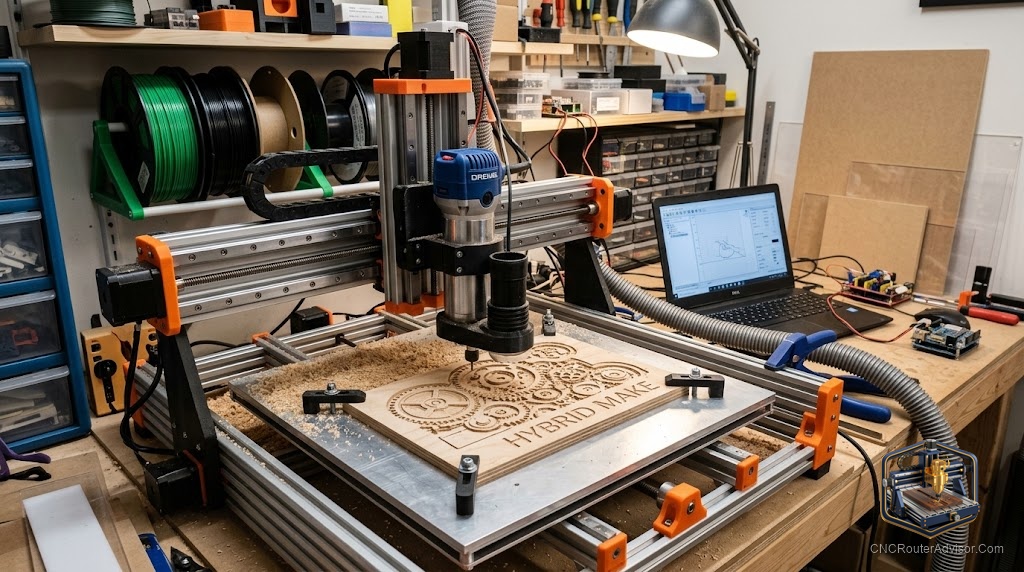
The Ender 3 is the right answer to “what’s the cheapest 3D printer worth buying.” It’s also the basis for more hacked and modified machines than any other frame in hobby manufacturing. Adding a spindle to an Ender 3 and turning it into a CNC router sounds like the kind of project that produces a functional machine for almost no money. Sometimes it does. The constraints are specific enough that you need to know them before you start.
Converting a 3D printer to a CNC router means replacing the print head assembly with a small spindle motor and making the firmware and wiring changes needed to drive it as a CNC machine. The most common base platform is the Creality Ender 3 or similar cartesian FDM printer.
The direct answer: the conversion is possible and produces a functional machine for light engraving, PCB milling, and very soft material cutting. It is not a substitute for a purpose-built CNC router for wood cutting. The Ender 3’s belt-driven axes, plastic frame joints, and modest stepper holding torque are not designed for the lateral forces of routing wood. Think of it as a very capable engraver that can make shallow cuts in soft materials - not a woodworking router.
What the Conversion Requires
Spindle mount: A bracket that attaches to the X-axis carriage and holds a small DC spindle motor (typically a 775-series or compact brushless). These are available on Thingiverse and Amazon.
Spindle motor: A 775-series 24V DC motor with an ER11 collet is the standard choice. Some conversions use a Dremel or compact trim router.
Firmware change: The Ender 3 runs Marlin. For CNC routing, you need to reflash with Marlin configured for CNC mode or switch to a GRBL-based controller. The E-axis stepper driver can be repurposed to control the spindle relay.
Workholding surface: The Ender 3’s glass bed is not a CNC work surface. You need to mount a sacrificial spoilboard over the heated bed or remove the bed entirely.
What It Can Cut
Works well: PCB copper isolation (0.1 to 0.2mm depth), soft foam, balsa wood, thin acrylic at slow feed rates, leather engraving.
Works with care: 3mm MDF at 0.5mm DOC, softwood at 0.3mm DOC.
Does not work well: Pine at any meaningful depth, hardwood, anything that produces significant lateral cutting forces.
The Ender 3’s belted axes flex when resisting lateral cutting loads. The plastic frame joints act as springs. Any material that pushes back against the bit produces chatter and dimensional error.
Honest Comparison with a Purpose-Built Machine
A Genmitsu 3018-PRO desktop CNC costs less than most 3D printer-to-CNC conversion parts combined when you account for a quality spindle mount, motor, and controller board. It’s a purpose-built machine with proper frame rigidity. For users who already own an Ender 3 and have the specific electronics knowledge to reflash firmware, the conversion is a worthwhile project. For users starting from scratch, buying a 3018-PRO is the more practical path.
Verdict
The conversion is a legitimate maker project that produces a functional engraver and light-duty CNC machine. It is not a substitute for a purpose-built CNC router for wood. If you already own an Ender 3 and want to experiment with CNC, the conversion is worth doing. If you’re choosing between the conversion and buying a 3018, buy the 3018.
- Ender 3 conversion produces a functional engraver and soft-material cutter
- Belt-driven axes and plastic joints are not designed for routing force resistance
- PCB milling, foam, and very thin soft materials are the practical sweet spot
- A purpose-built 3018 outperforms the conversion for wood work
FAQ
Can you convert a 3D printer to a CNC router? Yes. The most common base is the Creality Ender 3. The result is capable for engraving and soft materials; it is not suitable for serious wood routing.
What spindle works for an Ender 3 CNC conversion? A 775-series 24V DC motor with ER11 collet is the standard choice. Compact brushless spindles also work with appropriate mounts.
Does a converted 3D printer work for wood cutting? Only for very soft materials at shallow depths. The belt-driven frame is not rigid enough for routing hardwood or MDF at useful depths.
Is converting an Ender 3 to CNC worth it? If you already own one and want to experiment, yes. If starting from scratch, buying a dedicated 3018 CNC machine is more practical and produces better results.
References
- GRBL firmware: github.com/gnea/grbl
- Ender 3 CNC conversion community: reddit.com/r/hobbycnc