
2550 CNC Router Guide: Large-Format Machines at the 2500×5000mm Scale
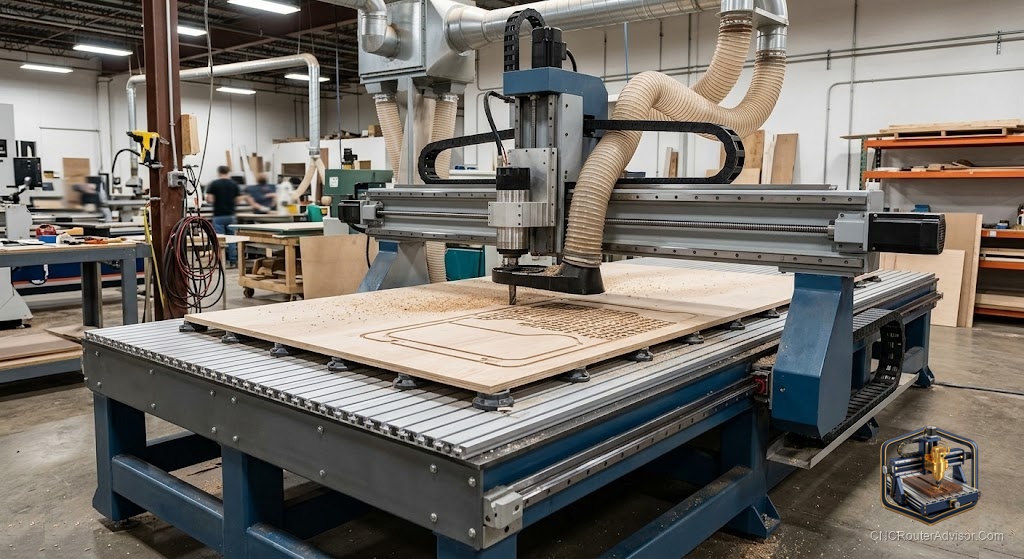
At 2500mm by 5000mm, the 2550 CNC router occupies the large end of what is typically found in industrial woodworking, marine manufacturing, and large-format architectural panel production. This is not a machine that sits in a garage or a small workshop. At this scale, the machine itself weighs several tons, requires a dedicated concrete pad or reinforced floor, demands three-phase electrical supply of significant capacity, and is staffed as a dedicated production station with material handling equipment to match. If you are searching for a 2550 CNC router, you are either in industrial production, actively scaling into it, or researching a machine format that will be a substantial infrastructure investment.
A 2550 CNC router is a machine with approximately 2500mm × 5000mm work area (in Chinese notation: 25 = 2500mm, 50 = 5000mm), one of the largest common formats in the commercial CNC router market. This size processes two full 4×8 foot sheets side-by-side in the X dimension (2500mm accommodates two 1220mm-wide sheets with zone clearance) and accommodates workpieces up to 5 meters in length in the Y direction. It is used in large-format cabinet and panel production, architectural millwork, marine interior manufacturing, and large sign and display production.
The short guide: the 2550 is infrastructure, not equipment. Before evaluating machines, evaluate whether your facility has the floor space, floor load capacity, three-phase power capacity, material handling equipment, and production volume to justify the investment. The machine itself is only the center of a larger investment in the production system around it.
What the 2500×5000mm work area enables
Dual full-sheet processing. Two standard 4×8 sheets (1220×2440mm each) fit side-by-side across the 2500mm X dimension. A nested program processes both sheets in a single run, effectively doubling the sheet area output per cycle compared to a 1325 format machine.
Five-meter length workpieces. Architectural trim, marine hull components, long floor and wall panel runs, and custom furniture pieces up to five meters in length are within the work area in a single setup.
High-volume cabinet and panel production. At this scale, the throughput potential is significant: a production program that takes an hour on a 1325 machine may take half that time on a 2550 with optimized speeds and dual-sheet nesting.
Large custom displays and signage. Trade show displays, large architectural signage, and custom interior panel work at five-meter scale are uniquely accessible on a 2550 machine.
Facility requirements
A 2550 machine is large: the machine footprint with operating clearance on all sides typically requires a minimum of 4×7 meters of dedicated floor space, and 5×9 meters is more comfortable for material handling. Floor load capacity of 8,000 to 15,000 kg per square meter (depending on specific machine weight and base dimensions) is typically required; verify with a structural engineer if the machine will be installed on anything other than a ground-level concrete slab.
Electrical supply: a 2550 machine with a 6kW or higher spindle, vacuum pump, and accessories typically requires 30 to 50 ampere three-phase supply. Verify with the machine’s specification sheet and your facility’s electrical capacity before purchasing.
Material handling: loading and unloading 2500mm×5000mm sheet goods at production volume requires a panel lifter, vacuum lifter, or roller conveyor system alongside the machine. Manual sheet handling at this scale is not sustainable for production volume.
Specifications to verify on a 2550 machine
- Drive: Rack-and-pinion with servo motors is standard at this size. Ball screw at 5000mm Y travel introduces whip issues at production speeds without support bearings.
- Spindle: 6kW to 9kW or higher for production throughput at this format.
- Vacuum pump: 5.5kW to 7.5kW or larger; the table area requires a proportionally powerful pump.
- ATC: Automatic tool changer is essentially mandatory at this production scale; manual tool changes are impractical at the duty cycle this machine format implies.
- Controller: PC-based control (Fanuc-compatible, SYNTEC, or similar) with a CAM post-processor that handles the machine’s specific interface.
Our guide on how to choose a CNC router covers the production machine evaluation framework.
The takeaway: a 2550 CNC router is a large-format industrial production machine. The machine evaluation is the last step, not the first; facility readiness, material handling, and production volume justification come first.
Frequently asked questions
What does 2550 mean in CNC router notation? 2500mm × 5000mm work area. Chinese notation: 25 = 2500mm (X), 50 = 5000mm (Y).
Who uses 2550 CNC routers? Large cabinet and panel production shops, architectural millwork manufacturers, marine interior builders, and large-format sign and display producers.
What floor space does a 2550 machine need? At minimum 4×7 meters; 5×9 meters or more with comfortable material handling clearance.
What electrical supply does a 2550 machine require? Three-phase supply, typically 30 to 50 amperes at 380V or 480V depending on the machine configuration. Verify with the specific machine’s specification sheet.
Is an ATC necessary on a 2550 machine? For production use at this scale, yes. Manual tool changes at the duty cycle a 2550 machine implies are impractical.
Can a 2550 machine process two full sheets simultaneously? Yes. Two standard 4×8 sheets (1220mm wide each) fit side-by-side across the 2500mm X dimension.
References
- Made-in-China, 2550 CNC router listings — https://www.made-in-china.com/
- CNC Router Info, large-format production machine guide — https://cncrouterinfo.com/guides/how-to-choose-a-cnc-router/
- Practical Machinist, industrial CNC machine forum — https://www.practicalmachinist.com/forum/