
1325 ATC CNC Router Guide: What an Auto Tool Changer Adds and Whether You Need It
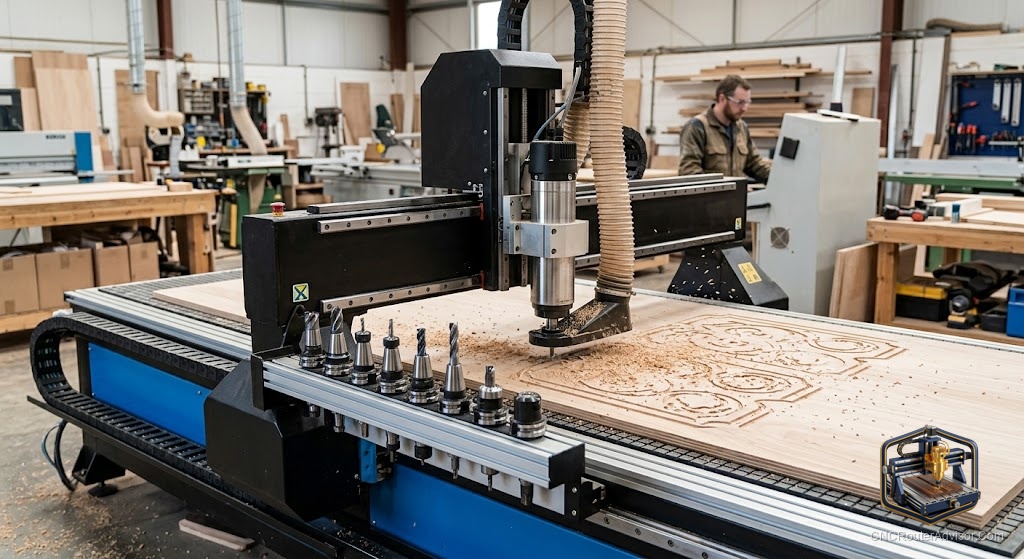
The automatic tool changer is the feature that turns a CNC router from a machine you tend into a machine that tends itself. Without an ATC, a multi-tool program means waiting for the machine to pause, walking to it, loosening the collet, swapping the bit, zeroing the new bit, and restarting. With an ATC, the machine does all of that in fifteen to thirty seconds per tool change without operator intervention. On a 1325mm format machine running cabinet parts, signs, or furniture components with multiple tool operations per part, the ATC pays for itself in operator time and output consistency quickly enough that most shops running production volume regard it as essential rather than optional.
A 1325 ATC CNC router is a machine with a 1300mm × 2500mm (standard sheet goods format) work area, equipped with an automatic tool changer carousel that holds multiple toolholders and swaps bits on command from the G-code program without operator intervention. The ATC integrates with the machine’s controller, the CAD/CAM software’s tool number assignments, and a carousel or row of toolholders mounted on the machine frame.
The short guide: the ATC is worth having on any 1325 machine that regularly runs programs with two or more tool operations per part, and virtually all cabinet, door, and furniture production fits that description. It eliminates manual tool change time, eliminates tool-length zeroing errors on each change, and allows longer unattended operation. What it adds to the machine cost is real; what it adds to production output is usually larger.
How an ATC works on a 1325 CNC router
The ATC system consists of three components: a tool carousel or row of toolholders mounted near the machine frame, a spindle with an ISO or HSK tool interface that can automatically grip and release toolholders, and controller integration that triggers tool changes from G-code tool number commands (T1, T2, T3, etc.).
When the G-code calls for tool T2, the spindle moves to the tool magazine, deposits the current toolholder in its numbered slot, picks up the T2 toolholder from its slot, and returns to cutting position with the new tool already zeroed (because the tool length is stored in the controller’s tool table). The entire sequence takes fifteen to thirty seconds and requires no operator presence.
This workflow has two significant effects on production. First, tool changes during a complex part (a cabinet door with profile, pocket, and through-cut operations using three different bits) happen automatically while the program runs, with no wait time. Second, the operator can load the next blank and walk away, because the machine completes the full program unattended.
ATC toolholder systems
The most common ATC interface on 1325-format machines from Chinese manufacturers is the ISO 30 or BT30 (also written ISO BT30) toolholder, which uses a standard taper and retention knob system. European machines often use HSK-A63 or HSK-F63 interfaces. When buying a 1325 ATC machine, verify the toolholder interface and confirm that compatible toolholders with appropriate collet sizes are available from local or online suppliers. ISO BT30 toolholders with ER20 or ER25 collets are widely available globally.
The tool magazine capacity (number of tool positions) varies: 8, 12, and 16 position carousels are common on entry to mid-range 1325 ATC machines. A cabinet shop typically needs 4 to 6 positions for its standard tool set (surfacing bit, profile bit, pocket bit, drill bit, V-bit); an 8-position carousel covers most standard shop needs with room for spares.
What the ATC does not eliminate
The ATC manages tool changes within a running program, but it does not eliminate all operator time. Material loading and unloading, spoilboard maintenance, dust collection management, and periodic quality checks still require operator attention. The ATC makes the machine more productive between those tasks, not zero-operator.
The ATC also requires correct tool-length data for each tool in the table. If a tool is replaced (sharpened, worn and replaced), the tool length must be re-zeroed. Most ATC machines include a tool-length probe that measures and stores tool length automatically when a new tool is seated. Verify this feature is included in the specific machine you are evaluating.
Who needs a 1325 ATC machine
The clearest case for ATC is a cabinet shop running standard cabinet box parts with a consistent tool set: facing, profile, pocket, and drill are four operations per part, four tool changes per part, and even at 20 seconds per change that adds up to meaningful operator time over a production day. The ATC eliminates that time and allows unattended operation through the tool changes.
The case for a manual-change 1325 machine is smaller shops running simpler programs (one or two tools per program) or shops where the ATC cost premium is not yet justified by the volume. A 1325 manual machine is a capable, lower-cost entry to the format.
For machine selection guidance for the production class, our guide on how to choose a CNC router covers the full evaluation framework.
The takeaway: on a 1325 format machine running production cabinet or furniture work with multiple tools per part, the ATC is a production multiplier that pays for its cost premium in output. Verify the toolholder interface, carousel capacity, and tool-length probe before specifying.
Frequently asked questions
What does ATC stand for on a CNC router? Automatic Tool Changer - a system that swaps bits between tool stations automatically without operator intervention during a program.
How fast is a typical ATC tool change on a 1325 machine? Usually 15 to 30 seconds per tool change on most entry to mid-range ATC systems.
What toolholder interface do most 1325 ATC machines use? ISO 30 / BT30 is the most common on Chinese-manufactured machines. Verify the specific interface and confirm compatible toolholder availability before purchasing.
How many tool positions do I need? For standard cabinet production, 4 to 6 positions typically cover the standard tool set. An 8-position carousel is a safe minimum for most shops.
Does the ATC eliminate the need for a tool-length probe? No, you still need tool-length data. Most ATC machines include an integrated tool-length probe that measures and stores tool length when a new tool is seated.
Is a 1325 ATC machine worth the extra cost over a manual-change 1325? For production shops running multiple tools per part, typically yes. For simpler programs or lower volume, the manual-change machine may be the right cost choice.
References
- Made-in-China, 1325 ATC CNC router listings — https://www.made-in-china.com/
- CNC Router Info, production machine guide — https://cncrouterinfo.com/guides/how-to-choose-a-cnc-router/
- Practical Machinist, CNC ATC system discussions — https://www.practicalmachinist.com/forum/