
1200×1200 CNC Router Guide: Square Large-Format Machines and Who They Fit
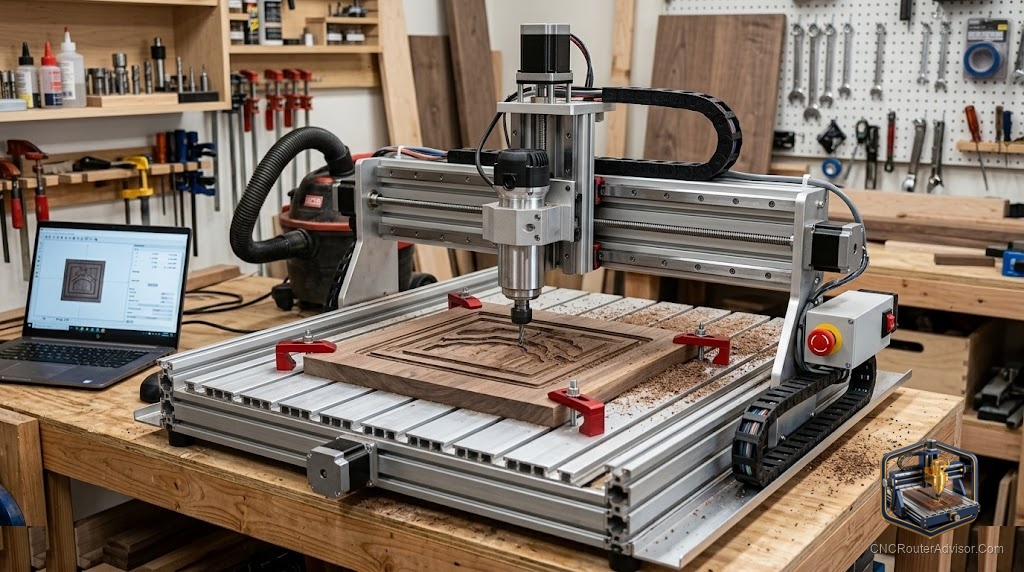
A square large-format CNC router is a rarer specification than the asymmetric rectangles (like 1300×2500mm) that dominate production cabinet and sign shop layouts, and that rarity has a reason: most production work processes rectangular sheet goods, and a rectangular machine matches that material format more efficiently. But the 1200×1200mm square format is genuinely useful for a specific class of work - large decorative panels, square art pieces, instrument tops, architectural pattern tiles, and any project that runs near-square dimensions at scale. If your work fills that profile, the 1200×1200mm class is the right machine footprint. If it does not, it is the right time to understand why most shops choose otherwise.
A 1200×1200mm CNC router is a machine with approximately 1200mm of usable travel in both the X and Y axes, producing a square working area suitable for processing near-square workpieces up to that dimension. It is positioned at the lower end of the large-format class, above the 1000mm mid-size machines, and below the production 1325mm and 1530mm format machines that dominate cabinet and sign production. It is most commonly encountered in arts, crafts, and mixed-production shops where the square format suits the variety of work.
The short buying guide: if you consistently produce work in the 1000mm to 1200mm range in both dimensions (square art panels, large tiles, instrument tops, architectural millwork), the 1200×1200mm machine matches your work better than an asymmetric rectangle. If your primary work is sheet goods (4×8 plywood panels), a 1325mm or 1530mm machine in the standard production format is a better match.
What the 1200×1200mm work area enables
At this size, the accessible project class expands significantly over mid-size machines.
Large decorative and art panels. A 1200×1200mm work area accommodates large square carving panels for wall art, interior design elements, and custom decorative commissions. The square format means the full panel can be processed in one setup without rotation or tiling.
Architectural pattern tiles at scale. Repeating geometric patterns, Islamic geometric art, and ornamental panel production in large format all benefit from the square work area, because tiles and patterns are often close to square in their base module.
Larger instrument tops and backs. A double bass or cello top can approach 800mm in length and 400mm wide. More exotic instrument work and non-standard forms benefit from the larger square work area.
Sign panels up to 1200mm. Square and near-square sign panels up to the full work area are processable in one setup.
Machine characteristics at 1200×1200mm
At this size class, specific hardware expectations apply.
Frame. Welded steel is the standard for rigorous production work at this size. Heavy aluminum extrusion is acceptable for occasional use or lighter materials but shows flex under sustained production loads on harder materials.
Drive system. Ball screw or rack and pinion. Belt drive at 1200mm is not adequate for production-quality work. Ball screw is preferred for precision woodworking and joinery; rack and pinion for high-speed sign and panel production.
Spindle. At 1200×1200mm, a 2.2kW purpose-built CNC spindle is the minimum for efficient production in hardwood and plywood. Trim routers are inadequate at this scale and load.
Vacuum table. At large format, mechanical workholding becomes impractical for sheet goods. A vacuum table is the expected workholding for production use at 1200×1200mm and above.
Where to find 1200×1200mm machines
This machine format is more common in the Chinese export market than in domestic US or European production, where the standard format tends toward the 1325mm (fits standard 1300×2500mm Chinese-manufactured cabinets) or 4×8 foot (fits US standard sheet goods) configurations. Search Chinese machinery platforms (Alibaba, Made-in-China), and European machinery dealers for this specific format.
In the US market, custom-configured machines from Avid CNC or similar kit manufacturers can be built to 1200×1200mm specifications, though this requires customization rather than an off-the-shelf purchase.
Our guide on how to choose a CNC router covers the full machine class selection framework.
The takeaway: the 1200×1200mm CNC router is a specialized large-format machine for work that genuinely benefits from a square work area. If your production is sheet goods (4×8 panels), the standard rectangular production format is a better match. If your work is consistently near-square in the 1000-1200mm range, this is the format that serves it most efficiently.
Frequently asked questions
Why is 1200×1200mm less common than 1325mm machines? Most production work processes rectangular sheet goods (1220×2440mm or 1300×2500mm), and asymmetric rectangular machines match that material format more efficiently than a square machine.
Is a 1200×1200mm machine appropriate for cabinet production? For some cabinet parts, yes. For full sheet goods production, the 1325mm format (which spans a 1220mm standard panel width) is a better fit.
What drive system should a 1200×1200mm machine have? Ball screw for precision woodworking and joinery; rack and pinion for high-speed sign and panel production. Belt drive is not adequate at this size for serious use.
What spindle power is appropriate for 1200×1200mm machines? 2.2kW as a minimum for efficient hardwood and plywood production; 3.5kW to 4.5kW for sustained heavy production.
Where are 1200×1200mm CNC routers sold? Primarily through Chinese export machinery platforms (Alibaba, Made-in-China) and European dealers. US-made equivalents typically require custom configuration.
Does a 1200×1200mm machine need a vacuum table? For production sheet work at this size, yes. Mechanical clamping on individual panels is impractical at large-format production scale.
References
- Avid CNC, custom machine configurations — https://www.avidcnc.com/
- Made-in-China, 1200×1200 CNC router listings — https://www.made-in-china.com/
- CNC Router Info, large-format machine guide — https://cncrouterinfo.com/guides/how-to-choose-a-cnc-router/