
Two Trees TTC6050 CNC Router Machine: Specs, Setup, and Honest Assessment
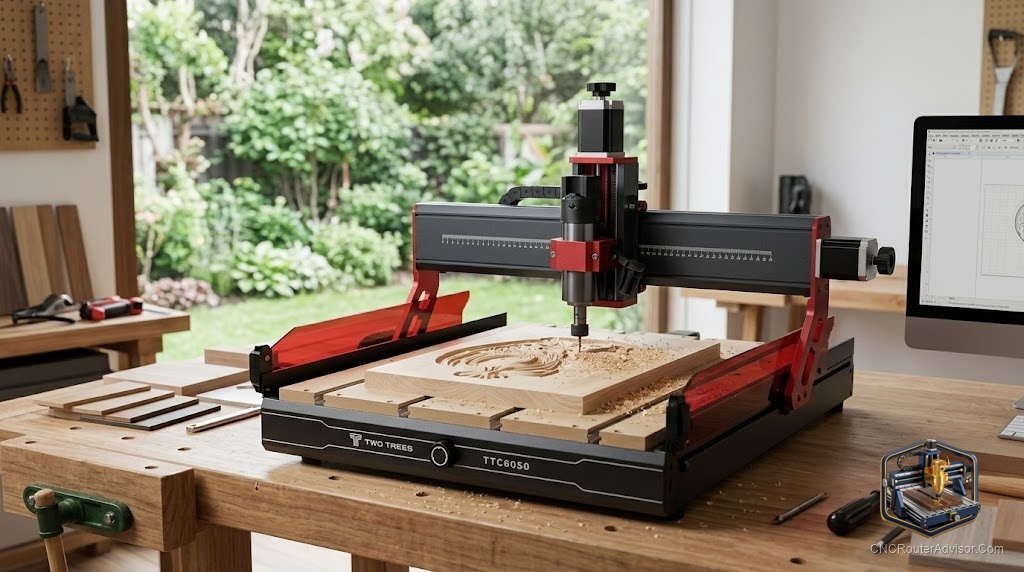
Two Trees built its reputation in the laser engraver market, where their machines have delivered strong value for hobbyists willing to accept a direct-import buying experience. The TTC6050 is their move into desktop CNC routing, and it is worth examining on its own terms rather than letting the brand’s laser reputation substitute for an honest look at the machine itself. For buyers in the 600 by 500 mm desktop class, the TTC6050 competes on price against established alternatives, and the relevant question is whether the hardware justifies the savings over machines with more established CNC support ecosystems.
The Two Trees TTC6050 is a desktop CNC router with a nominal 600 by 500 mm work area, built on an aluminum extrusion frame with lead-screw motion on the axes and a fixed-mount spindle, aimed at hobbyists and light small-shop work in wood, plastic, MDF, and soft materials. It is sold through Two Trees’ Amazon storefront and the brand’s own channels, at a price point below similarly sized machines from more established CNC brands.
The short assessment: the TTC6050’s work area and price are its best arguments. For buyers who want 600 by 500 mm of desktop cutting area without spending Genmitsu ProverXL or Onefinity prices, it is worth examining. Its weaknesses are the lighter frame compared to heavier alternatives, the direct-import support model (Two Trees is primarily a laser brand rather than a CNC specialist), and documentation that is more complete for its laser products than for its router. Buy it if you are comfortable with a value machine and willing to lean on the community for setup guidance.
What 600 by 500 mm gets you
The TTC6050’s nominal 600 by 500 mm work area is the machine’s central appeal. At this size you can cut sizable signs, guitar blanks, cabinet door faces, layered art panels, and batches of smaller parts in one setup. It is a meaningful jump over the tiny 3018-class machines that dominate entry pricing, and it lands in a size class where projects feel like real shop work rather than practice pieces.
Note that effective cutting area is typically slightly smaller than nominal dimensions once you account for the home position and mechanical limits. Verify the exact travel in the product documentation before designing projects to the full 600 by 500 spec.
The motion system and what it means for cut quality
The TTC6050 uses lead screws for axis motion, which is an improvement over the pure belt drive of many entry machines in terms of accuracy and resistance to backlash. Lead screws do not match ball screws for precision and longevity but are a reasonable choice for a hobbyist machine at this price. The aluminum extrusion frame is standard for the class and performs acceptably for wood, plastic, and MDF at moderate feed rates.
Feed it gentle chip loads, reasonable depth per pass, and properly held material, and the TTC6050 cuts clean results in its intended materials. Push it with aggressive settings, heavy materials, or poor workholding, and the lighter frame will remind you why more expensive machines cost more. The machine is honest about what it is when you use it honestly.
Support and documentation: the real trade-off
Two Trees is primarily a laser company, and their CNC router documentation reflects that lineage. The laser community around Two Trees is large and helpful; the CNC router community is smaller and newer. For a buyer who needs hand-holding through CNC setup, this gap matters. For a buyer who has some CNC experience or is willing to use general GRBL resources alongside Two Trees-specific documentation, it is manageable.
The controller is typically GRBL-based, which is the right choice: it means your sender software, CAM workflows, and general troubleshooting resources are all drawn from the enormous GRBL community rather than a proprietary system with limited documentation.
The honest named flaw: finding detailed troubleshooting and tuning information for the TTC6050 specifically requires more effort than for machines with larger dedicated communities. Budget time for this.
How it compares in the 600x500mm class
The TTC6050’s main competitors are the Genmitsu ProverXL 6050 Plus (more established CNC brand, more CNC-specific documentation, higher price) and the SainSmart/Genmitsu ecosystem machines. For buyers who prioritize lowest price, the TTC6050 wins. For buyers who prioritize documentation, support, and an established CNC brand, the Genmitsu family generally wins.
The Genmitsu 3018-PROVer V2 in a smaller bed class or the ProverXL step-up are the natural comparison points. They cover slightly different work areas but share the well-documented Genmitsu ecosystem.
Our guide on how to choose a CNC router helps weigh these trade-offs systematically.
The takeaway: the TTC6050 is a value desktop machine in a useful size. It cuts well within its limits if you use it within those limits. Its community and documentation are its weakest point compared to more established CNC brands in the same class. Buy it for the price and work area; go in knowing you will lean on general GRBL resources for the parts where Two Trees’ CNC documentation runs thin.
Frequently asked questions
What is the work area of the Two Trees TTC6050? Nominally 600 by 500 mm, with the effective travel being slightly smaller. Verify exact travel in the product specifications.
Does the TTC6050 use ball screws or lead screws? Lead screws, which are an improvement over belt drive for accuracy but below ball screws in precision and longevity.
What controller does the TTC6050 use? Typically a GRBL-based board, which is compatible with widely available free CNC sender software and the large GRBL community.
Is Two Trees known for CNC routers? Primarily for laser engravers. Their CNC router community is smaller and their CNC documentation less mature than their laser documentation.
What materials can the TTC6050 cut? Wood, plywood, MDF, acrylic, and other soft materials well. Light soft-metal work is possible with conservative settings and appropriate tooling.
What is the TTC6050’s biggest weakness? The limited CNC-specific documentation and community support compared to more established CNC brands like Genmitsu.
References
- Two Trees, TTC6050 CNC Router product page — https://twotrees3d.com/
- CNC Router Info, desktop class comparison — https://cncrouterinfo.com/guides/how-to-choose-a-cnc-router/
- Reddit r/hobbycnc, TwoTrees CNC discussions — https://www.reddit.com/r/hobbycnc/