
Shaper CNC Router: What the Shaper Origin Is and Whether Its Right for You
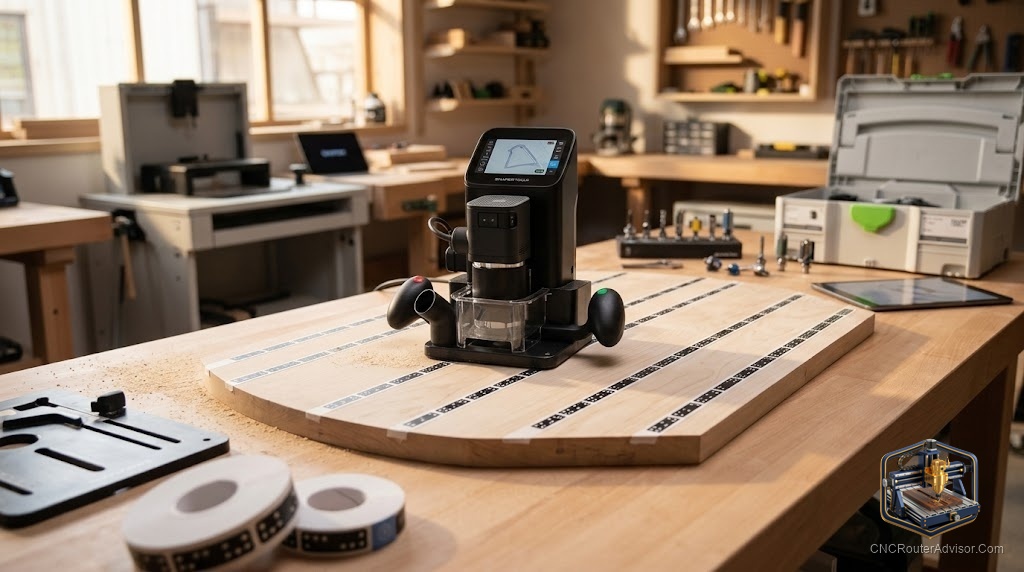
Most CNC routers are fixed machines: you bring the material to them, clamp it down, and let the gantry do the work. The Shaper Origin does the opposite. It is a handheld CNC router, a tool you carry across the workpiece while onboard vision technology reads a special tape pattern and corrects the tool’s position in real time, guiding the cut with CNC-level precision without the machine being fixed in place. It is a genuinely different idea, and whether it solves your problem or misses it depends entirely on the kind of work you do.
The Shaper Origin is a handheld CNC router made by Shaper Tools that uses a camera, onboard computer, and motorized X and Y correction mechanism to follow a design file while the user moves the tool manually across patterned tape applied to the workpiece. It cuts with CNC-level precision but processes one part at a time in a hand-guided workflow, making it suited for on-site work, large or irregularly shaped stock, and joinery that exceeds the size of a traditional CNC router bed.
The short verdict: the Shaper Origin is excellent if you work with large, irregular, or already-installed materials that cannot go on a CNC router, or if you need CNC-quality joinery (inlays, mortises, pockets) in the field or in a piece that cannot be moved. It is the wrong tool if your work is production batch parts, since it processes one cut at a time, or if you mainly work with sheet goods on a bench, where a traditional CNC router is faster and more consistent.
What makes the Shaper Origin genuinely different
The Origin’s key technology is its vision system. You apply Shaper’s proprietary white adhesive tape to the workpiece, the tool reads that pattern with an onboard camera to know exactly where it is on the material, and a motorized offset mechanism corrects the bit’s position as you move the tool. You see a projected overlay on the screen showing where the cut is going relative to your design, and the tool corrects for small hand wobbles within its correction range.
The result is that you can cut a precise pocket, inlay, or mortise in a door, a floor, a piece of furniture, or a sheet of material too large for any CNC router bed, with dimensional accuracy that hand routing cannot match. This capability is genuinely not available from any fixed-gantry CNC router, and it is the Origin’s entire justification for existing.
The cuts the Shaper Origin makes possible
The use cases cluster around three areas.
Large or installed workpieces. A full door slab, an installed cabinet face frame, a flooring section, or a countertop can all be cut with the Origin because the tape goes to the material rather than the material going to the machine. Fixed CNC routers cannot process any of these once installed.
Shop joinery. Dovetails, mortises, tenons, lock mortises, and precision pockets in flat stock are classic Shaper Origin jobs, because the accuracy is high and the setup (apply tape, load design, cut) is faster than fixturing the part on a CNC router for small batches.
Inlay work. Precise pockets for wood inlays, epoxy fills, or hardware recesses are where the Origin’s accuracy justifies its cost. The pocket is exactly the design, and the inlay fits.
The honest limits
Two constraints define where the Shaper Origin stops being the right tool.
First, one part at a time. The Origin processes each part sequentially with a human operator moving it. A traditional CNC router cuts a program once and runs it on a stack of parts. For production quantities, the Origin is dramatically slower than a fixed machine.
Second, the tape workflow. Every job requires applying Shaper tape, loading the design file, and cutting within the tape area. For shop work on pre-dimensioned parts, this is fast. For batch production, the tape application and setup time per part makes it impractical.
So the person who should skip the Shaper Origin is the one doing batch production of identical parts or working primarily with sheet goods on a bench. The person who should strongly consider it is the cabinetmaker, furniture maker, or finish carpenter who works with large installed pieces, does high-quality joinery on irregularly shaped stock, or needs CNC-quality inlays and hardware mortises on pieces that cannot go to a fixed machine.
Where to buy and what it costs
The Shaper Origin is sold through Shaper Tools’ website at shapertools.com. It is not a cheap tool: it is priced as a professional instrument because that is what it is. The investment makes sense for a shop where field joinery, large-piece work, or high-value inlay work is regular rather than occasional. It does not make sense for a weekend hobbyist whose work fits on a standard CNC router bed.
If you are deciding between the Shaper Origin and a traditional CNC router, our guide on how to choose a CNC router helps clarify which tool fits which kind of work.
The takeaway: the Shaper Origin is a remarkable tool that solves a specific problem, CNC-quality cuts on pieces too large or installed to put on a fixed machine, better than anything else available. Outside that problem, a traditional CNC router is faster, cheaper, and more repeatable. Know which problem you have, and the right choice is clear.
Frequently asked questions
Is the Shaper Origin a CNC router? Yes, technically, it is a handheld CNC router that uses vision technology and motorized correction to follow a design file. It is fundamentally different from fixed-gantry CNC routers in how it is used.
What is the Shaper tape? A proprietary adhesive tape with a dot pattern that the Origin’s onboard camera reads to determine its position on the workpiece in real time.
Can the Shaper Origin replace a regular CNC router? For batch production of sheet goods, no. For large or installed workpieces and high-quality joinery, it does work a fixed CNC router cannot.
What materials can the Shaper Origin cut? Wood, plywood, MDF, solid hardwoods, and soft plastics. Similar material range to a compact CNC router.
Where is the Shaper Origin sold? Primarily through shapertools.com and authorized dealers. It is not typically available through general retail.
Is the Shaper Origin good for beginners? The workflow is learnable, but the price and professional focus make it more appropriate for experienced woodworkers who have a specific need for its capabilities.
References
- Shaper Tools, Shaper Origin product page and documentation — https://www.shapertools.com/en-us/origin
- Woodworkers Guild of America, “Shaper Origin Review” — https://www.wwgoa.com/video/shaper-origin-review/
- Popular Woodworking, “Shaper Origin: Hands-On Review” — https://www.popularwoodworking.com/reviews/shaper-origin-review/