
DeWalt Router CNC Explained: Uses, Setup, and Key Considerations
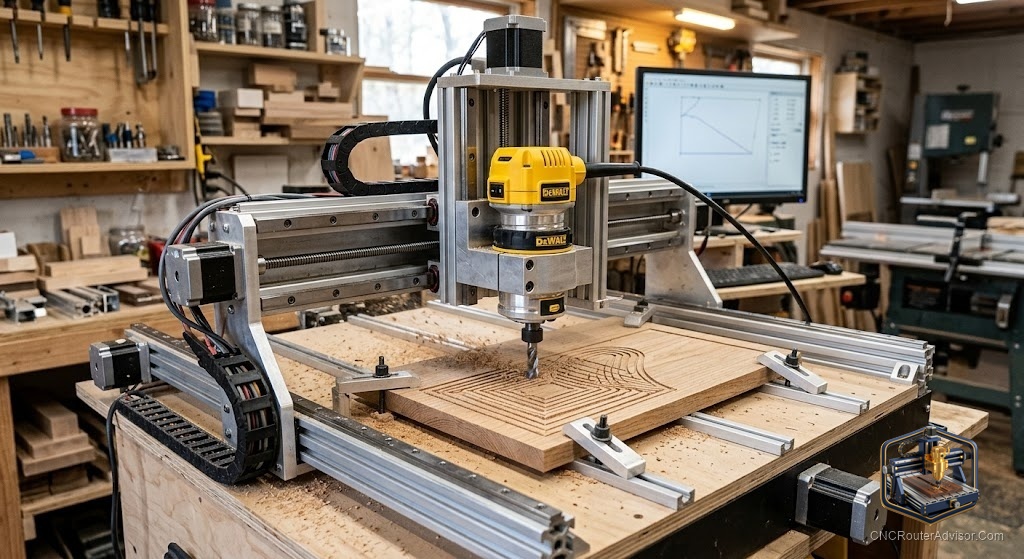
If you have spent any time in CNC router communities, you have seen a familiar yellow trim router bolted to countless machines. The DeWalt compact router has become one of the most popular power heads in hobby CNC, not because it was designed for the job, but because it does it so well. Understanding why, and how to use one as a CNC spindle, helps you get the most from a setup that thousands of makers rely on. This guide explains the DeWalt router in a CNC context.
Why a trim router as a spindle
Many hobby and prosumer CNC routers use a trim router, a compact handheld woodworking router, as their spindle. It is affordable, powerful enough for wood and plastics, easy to find, and simple to replace. The DeWalt compact router earned its popularity here through solid power, dependable performance, wide parts availability, and a familiar mounting diameter that fits common CNC mounts. It is a practical, proven choice rather than an exotic one.
The DeWalt DWP611 in CNC use
The DeWalt DWP611 is the model most often used, prized for its power, variable speed, and the fact that its diameter drops into many 65mm CNC mounts. For those who also want the handheld accessories, the DWP611PK kit adds bases and a plunge attachment, though for pure CNC use the bare router is what mounts to the machine. Its variable speed is genuinely useful, letting you tune spindle RPM to the material rather than being stuck at one speed.
Setting it up on a machine
Mounting a DeWalt router as a spindle is straightforward but rewards care. Confirm your machine’s spindle mount matches the router’s diameter, commonly a 65mm mount. Seat the router securely so it cannot slip under cutting forces. Use a quality collet and check for runout, since a true collet is what turns the router into a precise cutting head. And set the variable speed to suit your material, slower for plastics and aluminum, faster for fine detail in wood.
Strengths and honest limits
A DeWalt trim router is a workhorse for wood, plastics, and light aluminum work, and its reliability is a big part of why it is recommended so often. It does have limits worth knowing. It offers a fixed range of speeds rather than the very low RPMs a dedicated VFD spindle can reach, it is air-cooled and louder than a water-cooled spindle, and it is not built for continuous heavy production the way an industrial spindle is. For hobby and small-shop work, these limits rarely matter. For heavy metal cutting or all-day production, a VFD spindle is the better tool.
Maintenance and longevity
Because it is a brushed universal motor, a trim router has a few wear items. Brushes eventually wear and are usually easy to replace, and bearings can wear over long service, showing up as noise or runout. Keep the router clear of dust, which is the main enemy of its longevity in a CNC setting, and it will serve for a long time. The wide parts availability means that when something does wear, fixing it is simple and cheap.
A proven, practical choice
The DeWalt router became a CNC favorite for good reasons: it is powerful, reliable, widely supported, and fits common mounts. Set it up with a true collet, match its speed to your material, and keep it clean, and it turns a hobby machine into a capable cutter for wood, plastics, and light metal. It is not the machine for heavy production, but for the work most makers actually do, it is hard to beat as a first spindle.