CNC Router with ATC: Tool Capacity, Workflow Benefits, and Buying Factors
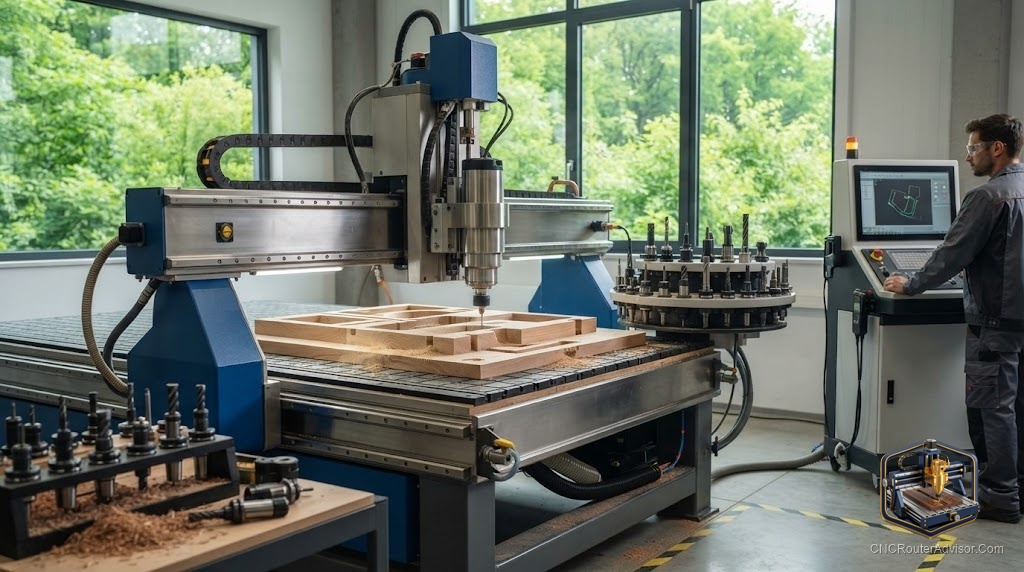
Anyone who has stood at a CNC router swapping bits by hand between operations, re-zeroing each time and hoping they did not introduce an error, understands the appeal of an automatic tool changer. A CNC router with ATC does that swapping itself, pulling the right tool from a rack mid-job and returning to the cut without you lifting a finger. For the right kind of work, it is the difference between babysitting a machine and letting it run. This guide explains what an ATC brings and who actually needs one.
What an ATC does
An automatic tool changer lets the machine store multiple tools and swap between them automatically during a job. Instead of the machine pausing so you can change from a roughing bit to a finishing bit to a V-bit, it parks the current tool, picks up the next, and continues. The controller and G-code manage the sequence, and the machine keeps each tool’s length referenced so cuts stay accurate across changes. The result is a job that runs start to finish with several tools, untouched.
Why that matters
The benefits show up most in jobs that use several tools or run in batches:
- Time saved, because manual tool changes and re-zeroing disappear from the workflow.
- Consistency, since the machine references tools automatically rather than relying on you to zero perfectly each time.
- Complex jobs made practical, because a part that needs roughing, finishing, and detailing can run in one uninterrupted program.
- True hands-off running, which lets you step away or run production while doing other work.
For a shop producing parts, that reclaimed time and reliability adds up quickly.
Who really needs one
An ATC is a genuine advantage for production shops, businesses running multi-tool jobs, and anyone whose work regularly demands several bits per part. It earns its keep when the machine runs often and time is money. For a hobbyist making occasional one-off pieces, the added cost and complexity are harder to justify, since manual tool changes on a low-volume schedule are not much of a burden. Be honest about your volume before paying for the feature.
Buying factors
If an ATC fits your work, weigh these factors:
- Tool capacity, meaning how many tools the changer holds, since more tools allow more complex jobs without interruption.
- The rest of the machine, because an ATC belongs on a capable platform with a rigid frame, solid motion system on the X, Y, and Z axes, and a strong spindle. An ATC on a flimsy machine solves the wrong problem.
- Controller and software support, since the whole system has to manage tool changes reliably through the G-code.
- Spindle type, because ATC systems typically pair with purpose-built spindles rather than a simple trim router.
- Support and reliability, as an ATC adds moving parts that need to work every time.
Setting expectations
An ATC is a productivity feature, not a magic upgrade. It makes a capable machine more efficient, but it does not make a weak machine cut better. Think of it as the last piece you add once the fundamentals are strong and your volume justifies it. Match it to real production needs and it transforms your workflow. Buy it for a hobby that does not demand it, and it mostly adds cost and complexity. Judge it against the work you actually do, and the decision becomes clear.